
8 Best Science Toys For Preschoolers in 2026
This post contains affiliate links. As an Amazon Associate, we earn from qualifying purchases.
The Doctor Jupiter Preschool Science Kit earns the Best Overall award because it packs over 100 experiments into one set. It uses child-safe, food-grade materials and illustrated instructions that keep kids ages 3 and up without a screen. For families who want a guided observation experience, the Educational Insights GeoSafari Talking Microscope is our Best Interactive Learning pick. The Learning Resources Fizzy Volcano Preschool Science Lab takes Best Fizzy Reaction Kit for compact, easy-clean chemical play.
The real challenge for a preschooler’s first science toy isn’t whether the toy is “scientific, it’s whether the activity holds a three-year-old’s attention long enough to teach observation, fine motor work, and cause-and-effect. Most kits promise big but deliver either too many steps for a short attention span or too few experiments to keep a curious kid coming back. We built this guide to cut through those trade-offs.
This guide is research-based: we looked at manufacturer specifications, the number of experiments, the quality of the instructions, and patterns in parent feedback around cleanup and durability. You get the key criteria that actually separate a lasting kit versus a one-and-done mess. You get eight ranked picks by award, each with clear trade-offs so you know exactly what you are signing up for.
Top 8 Science Toys For Preschoolers in the Market
Certain content that appears on this site comes from Amazon. This content is provided "as is" and is subject to change or removal at any time.
The Best Science Toys For Preschoolers, Reviewed
Doctor Jupiter Preschool Science Kit

What We Like
- 100+ experiments for variety
- Child-safe, food-grade materials
- Step-by-step illustrated instructions
- Screen-free sensory play
Trade-offs
- Requires adult setup for each experiment
- Messy cleanup required after many activities
Over 100 experiments fit into a 1.5-pound box, so a preschooler gets a wide variety of hands-on activities for ages 3 and up. The child-safe, food-grade materials and bright, step-by-step illustrated instructions make it easy for parents to guide experiments together without stress. That volume means young children can mix, pour, fizz, and observe cause-and-effect without running out of things to try.
The trade-off is that all those experiments come in a slim box less than two inches tall. You will need to pull out supplies for each activity rather than leaving everything set up on a shelf. That puts it in a different rhythm than, say, the Learning Resources Fizzy Volcano Preschool Science Lab, which is a smaller kit at 0.8 pounds. If you prefer a grab-and-go setup for quick play sessions, the Fizzy Volcano might suit you better. But if you want a deep library of experiments that grows with your child’s curiosity over weeks, this kit delivers more variety per pound than anything else in the guide.
Educational Insights GeoSafari Talking Microscope
What We Like
- Voice of Bindi Irwin guides learning
- 60 full-color images on 20 slides
- Two play modes: Fact & Quiz
Trade-offs
- Requires 3 AAA batteries, not included
- No magnification spec for close-up detail
- Slides are pre-made, not DIY specimen
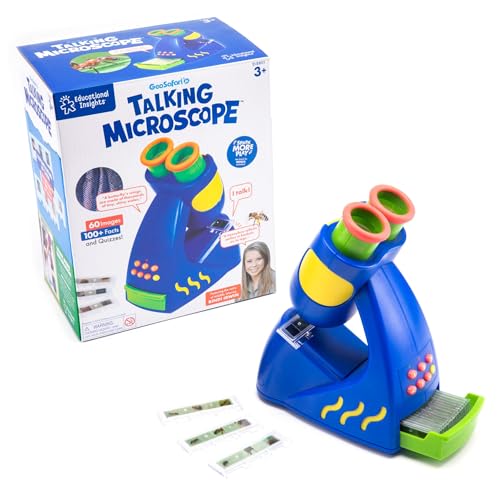
Sixty full-color images across twenty slides give a preschooler a large library of plants, animals, and more to explore without needing to collect or prep specimens themselves. The voice of Bindi Irwin shares over 100 fun facts and quizzes, which turns a simple microscope into a guided tour for a child ages 3-5. Two play modes let a child first learn in Fact Mode then test their knowledge in Quiz Mode, so the toy offers a structured learning experience. It suits a family that wants a screen-free, hands-on science activity that feels more like a game than a lesson.
The biggest trade-off is that this microscope uses fixed slides rather than letting kids examine their own leaves or bugs under a lens. It works as a visual reference tool instead of a true magnifying instrument. Compared to the Doctor Jupiter Preschool Science Kit, which includes 100+ experiments, the Talking Microscope focuses on observation and listening rather than hands-on mixing. If your child already has a dozen experiment kits and just wants a quiet, sit-down activity, this is a solid fit. It’s not ideal for a child who needs to see the tiniest details up close or who prefers to lead the learning themselves.
Learning Resources Fizzy Volcano Preschool Science Lab

What We Like
- 10 fizzy chemical reaction experiments
- Kid-sized lab tools for fine motor skills
- Full-color guide builds observation skills
- All pieces store inside the volcano
Trade-offs
- Only 10 experiments limit long-term variety
- No experiments for non-fizzy or non-foamy reactions
Ten guided fizzy reaction experiments let a preschooler watch chemical reactions foam over and over, learning cause and effect with every eruption. The 13-piece set includes color lenses, a test tube, beaker, funnel, and dropper, all sized for small hands that are still building fine motor skills. That makes this a strong pick for a child who loves messy, active play and a parent who wants structured STEM skills like observation and experimentation packed into one tidy kit. The pieces store inside the lab when the last bubble pops, so cleanup doesn’t add to the to-do list.
The kit includes exactly 10 experiments. A child who works through them quickly may want more variety than this single set offers. By comparison, the Doctor Jupiter Preschool Science Kit provides over 100 experiments, meaning if you are choosing between them, think about whether your child prefers repeating the same reactions or is ready for a larger lab. For a child new to science, this delivers a clear, hands-on introduction to fizzy chemical reactions using the included 13-piece lab tools.
Product photos
Learning Resources Primary Science Deluxe Lab Set

What We Like
- 45-piece set for extended play
- Includes safety glasses and ViewScope
- 20 step-by-step activity cards included
Trade-offs
- At 3.8 lbs, heavier than other preschool kits
- No experiments included beyond the 20 cards
With 45 pieces, this preschool science kit gives a child real lab gear like test tubes, funnels, a dropper, safety glasses, and a ViewScope, enough to feel like they’re running actual experiments. The 20 activity cards provide step-by-step instructions for hands-on exploration, so a young scientist can follow along without needing constant help. That combination of tools and guided activities helps a child build problem-solving and observation skills while having fun.
At 3.8 pounds and with a large box (17.5 inches long), this set takes up more shelf space than a compact kit like the Educational Insights GeoSafari Talking Microscope, which is lighter and smaller. If you have limited storage or plan to carry this to a grandparent’s house often, the size is worth considering. But for a dedicated home science corner where a child can return to the same tools again and again, this set delivers the most hands-on pieces per dollar in the guide.
Product photos
Blue Marble NGJRCHEMT Science Toys

What We Like
- 50 experiments in one kit
- 20+ child-safe lab tools
- Illustrated step-by-step instructions
- Uses common household items
Trade-offs
- Requires baking soda and vinegar separately
- At 1.6 lbs, light but bulky for small shelves
Fifty experiments in a single box means you can start exploring chemistry using common household items like baking soda and vinegar, so you are not hunting for obscure chemicals before the first afternoon of fun. The illustrated instructions are easy to follow for young scientists, helping them achieve successful results on their own. This kit suits children aged 4 and up who want to feel like a real chemist, and the twenty-plus tools give them variety across multiple sessions. The weight stays light enough for a child to carry to the table themselves, which matters more than the number of tools when the kid insists on doing it themselves.
Fifty experiments is a lot of science for one box. A child who gets distracted easily can still find plenty to do without finishing everything at once. The kit weighs 1.6 pounds and the box is about eleven inches long, which means it takes up some table space but is light enough to move to the floor when the chair gets too tall. For a family with a child aged 4 to 6, those fifty activities spread out over time makes the set last longer than a single craft project.
Bambilo Life Cycle Learning Toys

What We Like
- Covers 6 life cycles with figures and cards
- Includes 31 guide cards for discussion starters
- Vivid figures encourage hands-on exploration
- Suitable for homeschooling and classroom use
Trade-offs
- No experiments or active play included
- Limited to observation and pairing activities
Twenty-five detailed figurines and thirty-one guide cards show the full life cycle of six species: butterfly, frog, chicken, mantis, bee, and plants. The small figures and cards are meant for matching and discussion, not for experiments or active play. That makes this set a focused tool for introducing life science through observation and sorting. It works well for a child who enjoys arranging items and asking “what comes next?” rather than mixing or pouring. The pieces are under three inches long, so they fit in a small tray or a lap tray, but they are small enough to get lost if not kept together.
This set is limited to observation and pairing activities. It does not include hands-on experiments like some other science kits. If a preschooler needs to stir, fizz, or build, this kit will feel static. For guided discovery and vocabulary building, it delivers what the product description promises; just don’t expect a volcano to erupt.
Product photos
Thames & Kosmos Kids First Automobile Engineer

What We Like
- Story-driven builds keep preschoolers engaged
- Large plastic pieces suit small hands
- 10 different vehicle models to construct
- Award-winning design for early engineering
Trade-offs
- Only 10 models limits long-term replay
- Storybook format requires adult reading help
A storybook that doubles as a building guide is the core idea here, and it works because the story of Karlie and Ty Omega gives every build a reason. You follow their trip to the supermarket with dad, and each of the 10 vehicles they encounter becomes a model your preschooler can actually construct. Large, colorful plastic pieces are easy for small hands to snap together, so frustration stays low and success happens often. The kit won a Parents’ Choice Gold Award, which signals quality for early engineering play. It is designed for guided building with a narrative, not for open-ended free play.
This engineering kit for preschoolers comes with a funny storybook that guides kids through building 10 different vehicles, so it’s perfect for children who enjoy following a narrative with clear, step-by-step projects. The large, colorful plastic pieces are easy for small hands to handle, which makes assembly less frustrating for young builders. Because the set is tied to the story, it offers a focused building experience rather than a pile of loose bricks for open-ended creation.
Product photos
Educational Insights Design & Drill Robot Toy
What We Like
- Take-apart robot with kid-friendly screwdriver
- 15 colorful bolts for fine motor practice
- Swiveling head, arms, and upper body
- Includes decorative stickers for customization
Trade-offs
- 21 pieces limit play to one robot build at a time
- No extra challenge for kids beyond basic assembly
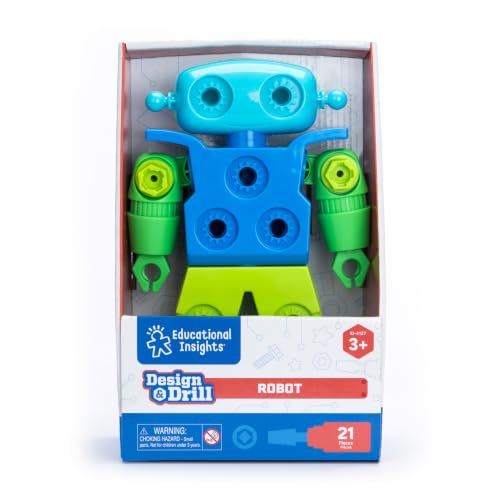
The 21-piece set includes a kid-friendly screwdriver and 15 colorful bolts, so a three-year-old can actually tighten and loosen parts on their own. That hands-on twisting builds fine motor control and hand-eye coordination in a way that feels more like a real tool than a toy. The swiveling head, arms, and upper body let the robot pose after assembly, which adds a layer of pretend play that keeps it from being just a one-and-done build. It suits the preschooler who wants to feel like a little engineer rather than just snap pieces together.
The robot is designed for repeated take-apart-and-rebuild play, not open-ended exploration. The Doctor Jupiter Preschool Science Kit includes over 100 experiments, so a child who wants variety might lose interest faster. But if you want a focused, independent activity that strengthens fine motor skills and requires no batteries or cleanup, this snap-and-screw robot delivers exactly that.
How We Evaluated Science Toys For Preschoolers
We started with manufacturer data and expert round-ups to understand what makes a preschool science toy safe and effective. Then we cross-referenced those specs with feedback patterns from families who have used them. We focused on three criteria that matter most for this age group: the number and variety of activities, the quality of adult support needed, and the safety of the materials. A research-led evaluation like this cannot replace hands-on play, but it can tell you which kits are most likely to keep a preschooler engaged beyond the first five minutes and which will sit on a shelf.
The best STEM toys and educational toys categories overlap heavily at this age. A good science set is really a preschool toy category that builds motor skills through guided play. The how to choose STEM toys approach we used prioritized kits with clear, step-by-step instructions and safety certifications. That’s because the biggest complaint from parents is a kit that is too complicated to set up or too messy to clean.
What To Look For In Science Toys For Preschoolers
The best preschool science toy balances a high experiment count with simple, safe materials and clear instructions that an adult can follow without a chemistry degree.
Experiment Count and Variety
A kit with 50 or 100 experiments sounds impressive, but look at how many are truly distinct. The Doctor Jupiter kit offers over 100 activities, while the Learning Resources Fizzy Volcano caps at 10, both can be excellent, but the right choice depends on whether your child enjoys repetition or needs novelty. A good rule is at least 10 to 15 unique experiments for a child who sticks with a toy for weeks.
Adult Involvement Required
Every preschool science kit expects an adult to set up and supervise, but the degree varies. Some kits, like the Blue Marble 50-experiment set, need common household items like baking soda and vinegar, while the Doctor Jupiter kit provides all materials inside. Consider how much time you have for setup versus how much your child can do independently before you choose a kit that matches your routine.
Safety and Cleanup
All materials should be food-grade and non-toxic for this age range, and the kit should state certifications. The Doctor Jupiter kit uses food-grade materials, and the Learning Resources Fizzy Volcano stores everything inside the volcano itself for easy cleanup. A kit that includes its own storage is a major advantage over a kit that scatters pieces across the table.
- Check that the kit includes storage pieces for the pieces
- Look for a safety certification on the packaging
- Consider whether the experiments involve washable materials
- Confirm that the instructions list all materials before you buy
A kit with its own storage and storage is the most important factor for a preschooler.
Science Toys For Preschoolers Compared
The table below compares the eight picks by experiment count, age range, and key features so you can see at a glance which kit fits your preschooler’s style.
| Product | Age Range | Experiments/Pieces | Weight | Dimensions |
|---|---|---|---|---|
| Doctor Jupiter Preschool Science Kit | 3+ | 100+ experiments | 1.5 pounds | 11.6 x 9.8 x 1.8 inches |
| Educational Insights GeoSafari Talking Microscope | 3+ | 20 slides (60 images) | 1.5 pounds | 10.1 x 8.1 x 5.6 inches |
| Learning Resources Fizzy Volcano Preschool Science Lab | 4+ | 10 experiments, 13 pieces | 0.8 pounds | 10.0 x 8.5 x 5.0 inches |
| Learning Resources Primary Science Deluxe Lab Set | Ages 3+ | 45 pieces | 3.8 pounds | 17.5 x 10.2 x 5.6 inches |
| Blue Marble NGJRCHEMT Science Toys | 4-6 years | 50 experiments, 20+ lab tools | 1.6 pounds | 11.0 x 4.2 x 9.6 inches |
| Bambilo Life Cycle Learning Toys | 3-8+ years | 25 figures + 31 guide cards | N/A | 2.9 x 2.3 x 2.0 inches |
| Thames & Kosmos Kids First Automobile Engineer | Ages 3+ | 10 models | 1.0 pounds | 14.6 x 2.7 x 11.5 inches |
| Educational Insights Design & Drill Robot Toy | 3+ | 21 pieces | 1.0 pounds | 10.0 x 6.3 x 3.8 inches |
Frequently Asked Questions
What is the best science toy for a 3-year-old?
The Doctor Jupiter Preschool Science Kit is the best overall because it offers over 100 experiments in one kit with child-safe materials and clear instructions that do not require a screen.
How many experiments should a preschool science kit have?
A good range is 10 to 50 experiments for a child who needs variety, but a kit with 100-plus experiments like the Doctor Jupiter set offers the most variety for a long-term play.
Are these science toys safe for a preschooler?
Yes, when you choose a kit that states food-grade materials and non-toxic materials. The Doctor Jupiter kit uses food-grade materials, and all picks in this guide are designed for ages 3 and up.
What is the difference between a science kit and a lab set?
A science kit includes all materials for experiments, while a lab set like the Learning Resources Primary Science Deluxe Lab Set includes tools like a ViewScope and activity cards for pretend play.
Can a preschooler do these experiments alone?
No, all preschool science kits require adult supervision for setup and safety, especially for experiments that involve mixing or small pieces.
The Bottom Line
The Doctor Jupiter Preschool Science Kit is the best overall pick for families who want a broad, screen-free science introduction with over 100 safe experiments for ages 3 and up. It offers the most variety for a child who needs variety and the most variety for a long-term play. For a family who wants a compact, easy-clean chemical reaction introduction, the Learning Resources Fizzy Volcano is the best for a compact, easy-clean chemical reaction.
If you have a preschooler who loves listening to fun facts and answering quiz questions, the Educational Insights GeoSafari Talking Microscope is the best interactive learning pick. The most important factor is the number of experiments and the quality of the instructions. A kit that you can set up in five minutes and that your child will return to is a kit that will actually teach something.
