
5 Best Power Kites For Land Boarding in 2026
This post contains affiliate links. As an Amazon Associate, we earn from qualifying purchases.
The Prism Tensor 5.0 Power Kite is the best overall pick for land boarding, offering a convertible dual/quad-line control system that lets riders progress from simple steering to advanced maneuvers on one kite. For those just starting out, the HQ4 Alpha 3.5 R2F Kite provides stable, predictable flight, while the Prism Tantrum 220 delivers hard-pulling power in a compact, packable design.
Land boarding demands a kite that can generate consistent, controllable traction to pull you across open ground. The wrong kite either lacks the grunt to get you moving or is too aggressive for a rider’s skill level, leading to frustrating sessions or unsafe launches.
This guide ranks five top power kites based on sail area, line systems, build quality, and owner feedback patterns from the land boarding community. We break down what each kite does best so you can match a kite to your experience level and flying space.
Top 5 Power Kites For Land Boarding in the Market
Certain content that appears on this site comes from Amazon. This content is provided "as is" and is subject to change or removal at any time.
The Best Power Kites For Land Boarding, Reviewed
Prism Tensor 5.0 Power Kite

What We Like
- Convertible dual/quad-line control system
- Large 5.0 sq m sail area
- Includes 65 ft Dyneema lines and stake
- Packs down compact for transport
Trade-offs
- Large sail requires open space to fly safely
- Large 155-inch wingspan demands a spacious flying area
A 5.0 sq m sail area gives you serious pull for landboarding, letting you accelerate across open fields or snow with authority. That means one kite serves both learning and progression, which is rare at this size. It’s the best overall pick because it balances power with adaptability for riders who want to grow into the sport without buying a second kite.
The trade-off is that this kite needs room to breathe. With a 155-inch wingspan, it’s not something you’ll want to fly in a small park or gusty backyard, you need a clear, open field. Compare that to the HQ Rush Pro 350, which has a smaller 3.5 sq m sail and is easier to handle in tighter spots. If you have the space, the Tensor’s larger power and convertible controls make it the more versatile choice. Just be honest about where you plan to ride before committing.
Product photos
HQ4 Alpha 3.5 R2F Kite

What We Like
- Perfect entry-level power kite
- Simple and stable flying characteristics
- High quality Dyneema flying lines
Trade-offs
- Smaller size limits power in light wind
- Not designed for experienced flyers wanting top speed
A 1.6-pound foil kite with Dyneema lines and a beginner-friendly design means you can focus on learning the feel of traction without fighting a twitchy or overpowered wing. The HQ4 Alpha 3.5 R2F is built for first-timers who want predictable pull and stable flight, so you spend more time flying and less time struggling. Its stable flight characteristics and durable materials give you a forgiving platform to build confidence on land board or buggy.
Its compact 16.9-inch length and beginner-friendly tuning make it easy to handle for newcomers. Experienced flyers looking for aggressive performance may find the Prism Tensor 5.0, with its larger 29-inch frame, more suited to advanced tricks. For someone who wants steady pull and durable gear without a steep learning curve, this kite delivers exactly that.
Prism Tantrum 220 Parafoil Kite
What We Like
- Packs down to 28" x 7.25" x 2"
- Safety leash for beginners
- Low-stretch Dyneema lines included
- Hard-pulling speed for traction
Trade-offs
- Best for stronger winds, not light breezes
- Dual-line only, no quad-line control
- 86.5" span needs open space
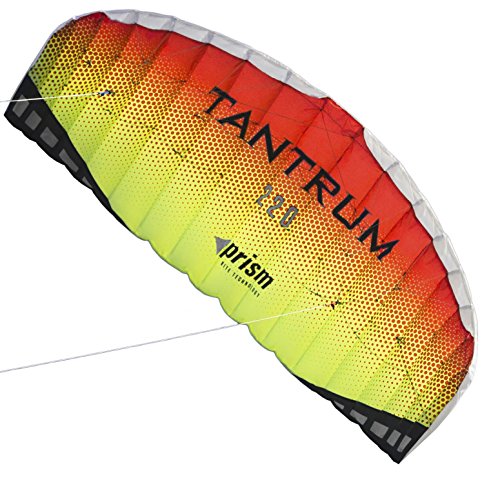
Folding down to just 28 inches long, this parafoil packs small enough to toss in a backpack alongside your lunch. That is exactly what land boarders need when they hike to a riding spot or cram gear into a car already full of boards and pads. The padded control bar and safety leash make it approachable if you are new to traction kiting, and the 85-foot Dyneema lines give you enough reach to catch steady wind without tangling into a mess.
This kite is tuned for stronger winds, so on lighter days you might find yourself waiting for a breeze. Dual-line control keeps things simple, but you lose the fine-tuned steering that quad-line kites offer for carving precise turns on a board. If you ride in conditions where the wind is often strong and you value portability, the Tantrum 220 makes sense. For those who face lighter winds, the convertible Tensor 5.0 offers more flexibility.
Product photos
HQ Rush Pro 350 R2F Kite
What We Like
- Great kite for a terrific price
Trade-offs
- Large size requires open space to launch
- Not ideal for small backyards or crowded parks
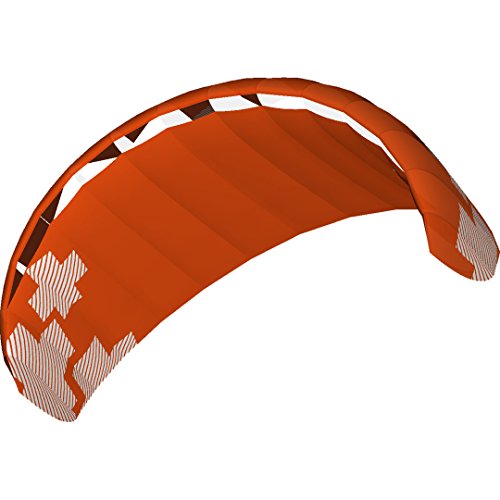
With a length of 137.8 inches, this kite catches wind efficiently for strong pull at a terrific price. That generous surface area makes it a great choice for anyone wanting an affordable entry into kite flying. The HQ Rush Pro 350 R2F suits buyers focused on value and performance. Its simple design lets you concentrate on controlling the pull rather than adjusting complex features.
A kite this size needs plenty of room to fly, so a small field or gusty conditions can make it challenging to control. Compared to the Tensor 5.0, which has a much smaller footprint (29.0 inches long), the Rush Pro is clearly built for open spaces where its large span can work without interference. For the price, you get a kite that delivers consistent pull, but plan to use it in wide, open areas to get the best experience.
Product photos
Slingshot B3 Light Traction Kite

What We Like
- Affordable and durable construction
- Safe for solo skill development
- Builds kiteboarding muscle memory
- Great for skate-kiting practice
Trade-offs
- Small 3m size limits power for land boarding
- Light traction only, not for high-speed riding
At just 2.2 pounds, this 3-meter kite lets you start learning kite control without the pull of a larger power kite. Reviewers say it helps you understand wind behavior, build muscle memory, and develop coordination before stepping into a lesson. It’s designed as a trainer, so the focus is on safety and gradual skill building rather than raw power. That makes it ideal for anyone new to kiteboarding who wants to develop skills safely on their own.
That same small size and light traction design won’t give you the speed or power you’d want for serious land boarding. If you’re already comfortable with kites and looking for a larger canopy, the Tensor 5.0 offers a bigger size for similar applications. But for the beginner who wants to learn the fundamentals safely, the B3 is a smart starting point.
How We Evaluated Power Kites For Land Boarding
We evaluated each kite against the demands of land boarding: generating enough pull to propel a rider on wheels while remaining controllable in gusty, shifting ground winds. Our research drew from manufacturer specifications, expert round-ups from the traction-kiting community, and patterns in owner feedback across multiple seasons of use.
The three criteria that mattered most were sail area and power delivery, control system flexibility, and packability for transport. A 5.0-meter sail like the Prism Tensor delivers serious torque but demands room to fly, while a smaller 3-meter trainer like the Slingshot B3 prioritizes safety and skill building over raw speed. Dual-line kites are simpler to learn, but quad-line setups give experienced riders the precision to steer through turns without losing power.
A research-led evaluation cannot replicate the feel of a kite in shifting wind, but it can identify which models consistently deliver on their design goals. We prioritized kites with clear, honest specifications and a track record of durability from owners who fly them hard.
What To Look For In Power Kites For Land Boarding
Choosing a power kite for land boarding means balancing sail area against your skill level and the size of your flying field. A kite that is too large can overpower a novice, while one that is too small will leave you waiting for stronger winds.
Sail Area And Power Delivery
Sail size is the single biggest factor in how much pull a kite generates. A kite in the 3.0 to 3.5-meter range, like the HQ4 Alpha or Slingshot B3, provides manageable power for learning control and building muscle memory. Jumping to a 5.0-meter sail, as found on the Prism Tensor, delivers the torque needed to accelerate a land board on grass or hardpack but requires a correspondingly large flying window and steady wind.
Control System: Dual-Line vs. Quad-Line
Dual-line kites use two lines for basic steering, pull left to turn left, pull right to turn right. This simplicity makes them ideal for beginners. Quad-line kites add a second set of lines that let you adjust the kite’s angle of attack, giving you finer control over power delivery during a run. The Prism Tensor’s convertible system is a rare feature that lets riders start with dual-line simplicity and upgrade to quad-line precision as their skills grow.
Build Quality And Packability
Land boarding kites take abuse: drags across pavement, sand, and gravel, plus repeated packing and unpacking. Look for Dyneema or low-stretch flying lines, reinforced stitching on the trailing edge, and a kite that folds into a compact carry bag. The Prism Tantrum 220 compresses to 28 inches long, making it a strong choice for riders who travel to their flying spots by bike or car.
- Check that the kite includes a safety leash or quick-release system for emergency depower.
- Measure your flying field, a 155-inch wingspan kite needs a clear area at least twice its width on each side.
- Confirm the included line length matches your flying style; 65-foot lines give more power and smoother turns than shorter lines.
A good rule of thumb: start with a kite small enough that you can hold it in a steady breeze without being dragged, then size up as your control improves.
Power Kites For Land Boarding Compared
The table below compares the five power kites across sail size, control type, and best use case to help you narrow your choice.
| Product | Sail Area | Line Length | Line Material |
|---|---|---|---|
| Prism Tensor 5.0 Power Kite | 53.8 sq ft (5.0 sq m) | 65 ft | Low-stretch Dyneema |
| HQ4 Alpha 3.5 R2F Kite | N/A | N/A | Dyneema |
| Prism Tantrum 220 Parafoil Kite | 86.5" x 30" | 85 ft | low-stretch Dyneema |
| HQ Rush Pro 350 R2F Kite | N/A | N/A | N/A |
| Slingshot B3 Light Traction Kite | 3 Meter | N/A | N/A |
Frequently Asked Questions
What size power kite do I need for land boarding?
Beginners should start with a 3.0 to 3.5-meter kite for manageable power and easier control. Riders with some experience can move to a 4.0 or 5.0-meter kite for stronger traction on larger fields. The right size also depends on your weight and local wind conditions.
Can I use a power kite for kiteboarding on water?
A few of these kites work as trainers for kiteboarding, but they are not designed for water relaunch. The Slingshot B3 is specifically marketed as a trainer that builds kiteboarding muscle memory on land before you move to a dedicated water kite.
What is the difference between dual-line and quad-line power kites?
Dual-line kites steer by pulling left or right, making them simpler to learn. Quad-line kites add a brake or trim function that lets you adjust the kite’s angle relative to the wind, giving you more precise power control during turns and speed runs.
How much open space do I need to fly a power kite for land boarding?
A 5.0-meter kite with a 155-inch wingspan needs a clear area at least fifty feet wide and free of trees, power lines, and obstacles. Smaller kites in the 3-meter range can fly in tighter spaces, but no power kite is safe in a small backyard or crowded park.
Is a power kite safe for a child to use for land boarding?
Power kites generate significant pull and should only be used by children under direct adult supervision. Smaller models like the HQ4 Alpha are more forgiving, but a child should have strong basic kite-flying skills before strapping into a land board.
The Bottom Line
The Prism Tensor 5.0 Power Kite is the best overall choice for riders who have the open space to fly it. It adapts as their skills progress from dual-line basics to quad-line precision. Its convertible control system and large 5.0-meter sail make it a long-term investment for dedicated land boarders.
Budget-conscious buyers or those with limited flying space should look at the HQ4 Alpha 3.5 R2F Kite for a stable, confidence-building entry point. Or they can choose the Prism Tantrum 220 if they need hard-pulling power in a packable format for stronger wind days. The Slingshot B3 serves a specific niche as a safe trainer for future kiteboarders.
The single most important factor in choosing a power kite for land boarding is matching sail area to your experience level and flying area. Start smaller than you think you need, master control, and then size up for more power.
