
10 Best Montessori Toys For 3 Year Olds in 2026
This post contains affiliate links. As an Amazon Associate, we earn from qualifying purchases.
The best Montessori toy for a three-year-old is the Melissa & Doug Primary Lacing Beads, which wins for its durable wooden construction and targeted fine motor skill development. For children who love open-ended challenges, the PlanToys Balancing Cactus is the best open-ended play pick. We also recommend the Montessori Mama Wooden Puzzles 4-Pack for building spatial awareness.
At three, a child is moving from parallel play to more focused, independent activity. The right toy respects that shift by offering a single, clear challenge that a child can master through repetition. Too many features or flashing lights distract from the core Montessori principle: letting the child lead their own learning.
This guide is research-based. We evaluated specifications, manufacturer documentation, expert round-ups, and patterns in owner feedback to find toys that truly support a three-year-old’s development. Each pick earned its place for a specific strength, from fine motor building to early math.
Top 10 Montessori Toys For 3 Year Olds in the Market
Certain content that appears on this site comes from Amazon. This content is provided "as is" and is subject to change or removal at any time.
The Best Montessori Toys For 3 Year Olds, Reviewed
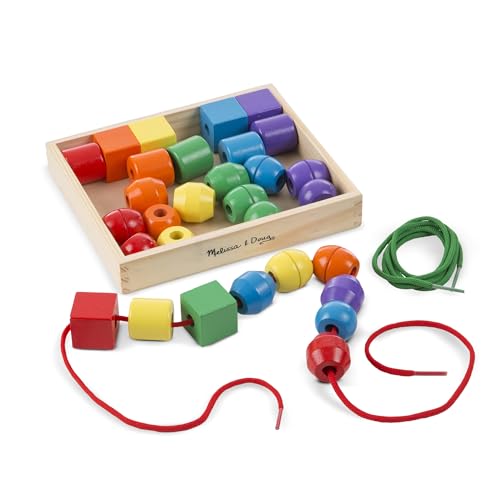
Melissa & Doug Primary Lacing Beads
What We Like
- 30 colorful wooden beads
- 5 easy-to-grasp shapes
- Builds fine motor and hand-eye coordination
- Includes wooden storage case
Trade-offs
- Small pieces require adult supervision
- Only two laces for multiple children
Thirty painted wooden beads in five distinct shapes give little fingers plenty to sort, grasp, and thread. That kind of hands-on work builds fine motor control and hand-eye coordination without a screen in sight. Two thin laces fit through each bead easily, making it a great starter set for preschoolers. The wooden storage case keeps everything tidy between sessions. This set suits parents who want a straightforward, open-ended activity that grows with a child’s skill level, from simple stringing to pattern-making and color matching.
The 30 painted wooden beads in assorted shapes come with just two laces, so siblings or playdates will need to take turns or share. That makes this set ideal for focused solo play or one-on-one time with a caregiver, where the thin laces and easy-to-grasp shapes help build fine motor, cognitive, and visual perception skills through hands-on, screen-free play. For a family with a single three-year-old, this kit delivers durable, colorful, and thoughtfully simple fun.
Montessori Mama Wooden Puzzles 4-Pack

What We Like
- Forbes Vetted 2024 recognition
- High-quality sustainable wood construction
Trade-offs
- Only 4 puzzles limit variety for frequent play
A 4-pack of animal puzzles means you get four distinct challenges in one box, which is enough to keep a three-year-old engaged without overwhelming them.
The catch here is that four puzzles is a finite set. Once your child masters them, they may want more variety sooner than with a larger collection like the Melissa & Doug Lacing Beads, which offers 33 pieces for open-ended sorting and stringing. But if your goal is focused puzzle-solving that builds spatial awareness and fine motor skills step by step, this set delivers exactly that. It’s a clean, safe, and purposeful introduction to jigsaw puzzles for a three-year-old.
Product photos
PlanToys Balancing Cactus

What We Like
- Open-ended stacking promotes creative problem-solving
- Strengthens fine motor and hand-eye coordination
- Eco-friendly rubberwood with non-toxic pigments
- Award-winning design from Japan and Thailand
Trade-offs
- No storage bag or box included for pieces
- Requires a flat, stable surface for play
The PlanToys Balancing Cactus uses sustainably harvested rubberwood and water-based pigments, so you get a toy that’s safe for little hands and gentle on the planet. Its stacking arms let kids explore balance and weight distribution through trial and error, building fine motor control and early STEM thinking without a screen in sight. That open-ended play is why it stands out for a three-year-old who’s ready to experiment and learn at their own pace.
Children who enjoy constructing and experimenting with balance will find plenty to engage them here. The open-ended play encourages independent decision-making and creative problem-solving, as each branch placement affects the structure’s stability. However, the set includes multiple loose pieces and requires a flat surface for setup, so it is not well suited for travel or on-the-go entertainment. Reviewers note that the toy works best when kids have room to spread out and focus, making it a better choice for home or classroom use rather than car rides or waiting rooms.
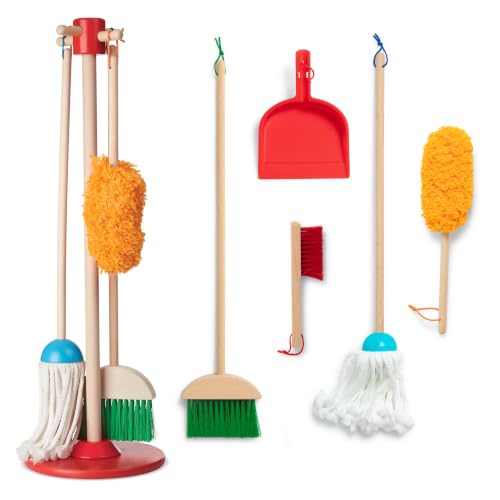
Melissa & Doug Dust Sweep Mop Set
What We Like
- Realistic wooden cleaning tools
- Includes storage stand for organization
- Boosts fine motor skills and coordination
- Encourages independence and responsibility
Trade-offs
- No replacement parts available if pieces are lost
A 30-inch wooden cleaning set with six pieces means your child gets a broom, mop, duster, brush, dustpan, and a stand to keep it all tidy. That’s enough variety to turn a simple chore into a full pretend-play session, helping three-year-olds build coordination and confidence through hands-on tasks. The realistic design makes sweeping and mopping feel like the real thing, which is exactly what you want when you’re trying to teach independence without turning cleanup into a battle.
The wooden construction gives this set a sturdy feel that holds up to daily pretend play, but it also means the pieces are heavier than plastic alternatives. At 30 inches tall, the broom and mop are sized for preschoolers around age three, so a very tall child might find them a bit short. For families who prefer a lighter, more compact fine-motor toy, the Tonberless Wooden Shape Sorter is another option, but it does not offer the same cleaning role-play experience.
Tonberless Wooden Shape Sorter

What We Like
- 20-piece set with 5 shapes and colors
- Smooth edges protect delicate skin
- Water-based paint is non-toxic and odorless
- Works as sorting, stacking, and travel toy
Trade-offs
- Limited to 5 basic shapes only
- No laces or threading pieces for added challenge
Twenty pieces with five distinct shapes and five matching colors give a three-year-old plenty of opportunities to practice sorting, stacking, and pattern-making without overwhelming them. The smooth wooden edges and water-based paint mean I don’t have to hover every second worrying about splinters or toxic finishes, a real relief when you’re trying to let a toddler explore independently. The set focuses on the fundamentals: clear visual cues, safe materials, and enough pieces to keep little hands busy without turning into a cleanup nightmare.
The limitation is that the toy focuses on just five basic shapes, pentagon, square, rectangle, triangle, and circle. So once a child masters those, there’s not much new challenge. Compared to other options like the Melissa & Doug Primary Lacing Beads, which offers a different type of fine-motor play, the Tonberless stays simpler. That makes it ideal for a younger three-year-old or one who’s still building confidence with shape recognition, but if your child already knows their shapes cold, you might want something that layers on a next step.
Product photos
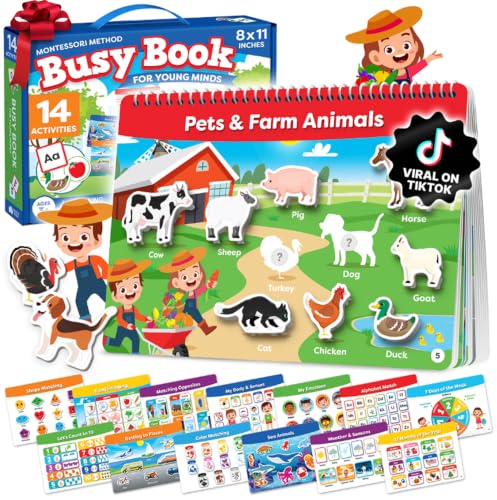
Momo & Nashi Montessori Busy Book
What We Like
- Pre-assembled and ready to use
- 14 learning activities included
- Thick, durable card stock
- Travel-friendly with carry handle
Trade-offs
- Small size limits play space
- Compact size limits use to one child at a time
With 14 learning activities packed into a compact 8.9-inch book, this busy book turns any waiting room or airplane tray into a classroom. It arrives pre-assembled, so there’s no setup frustration before handing it to a restless three-year-old. The thick card stock and rounded edges hold up to the inevitable drops and tugs, making it a practical choice for parents who want screen-free entertainment that actually teaches letters, numbers, emotions, and weather concepts.
Its small footprint means only one child can use it at a time. Compared to the Melissa & Doug Primary Lacing Beads, which includes 33 pieces for fine motor practice, this book offers a more guided activity set. It’s best for families who need a quiet, portable option for travel or waiting times, not for those seeking a comprehensive at-home learning station.
Product photos
TONZE Wooden Kids Tool Set

What We Like
- Battery-powered drill with forward/reverse
- 21 guided build models included
- Solid wood with non-toxic paint
- 44-piece set with storage box and apron
Trade-offs
- Requires 2 AA batteries, not included
- Small parts need adult supervision for 3-year-olds
A 44-piece wooden tool set with a working battery-powered drill means a 3-year-old can actually twist screws and bolts, not just pretend. The drill has separate forward and reverse buttons and interchangeable bits, so kids learn cause-and-effect while building fine motor control. With 21 guided builds like a flower, car, or robot, plus open-ended construction, this set grows with the child from simple pretend repair to more structured problem-solving. It’s a hands-on way to introduce early STEM concepts without screens, and the solid wood pieces and non-toxic paint mean it can take the bumps of daily play.
The drill works best when bolts are loosely placed, and if a screw gets stuck, an adult needs to loosen it. So it’s not fully independent play for a 3-year-old. It’s ideal for a child who loves building and fixing, but not for families wanting a completely self-directed fine motor activity.
Product photos
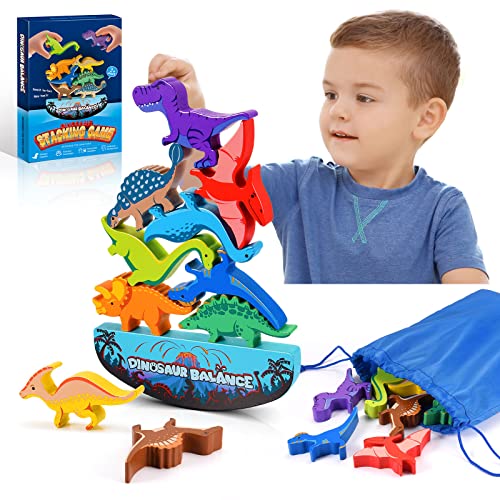
IPOURUP Dinosaur Stacking Blocks
What We Like
- Two sets enable family balance competitions
- Includes 9 beginner-friendly stacking methods
- Smooth surface and rounded corners protect hands
Trade-offs
- No shape sorting or color matching activities
- Only one theme (dinosaurs) limits variety
The two sets of dinosaur blocks let two players stack head-to-head right out of the box, turning a solo balancing exercise into a family competition. The included instruction manual with nine stacking methods gives beginners a clear path from wobbly first tries to confident towers. It suits parents who want an interactive game that involves sitting down and playing together.
This is a pure balance game with no shape sorting, lacing, or color matching built in. Compared to the Melissa & Doug Primary Lacing Beads, which also builds fine motor control but adds threading and pattern work, the IPOURUP set offers less variety in a single session. For a young child who already loves stacking and needs a challenge that grows with them, that focus is a strength. For a child who craves different activities in one toy, the single skill may feel narrow.
Product photos
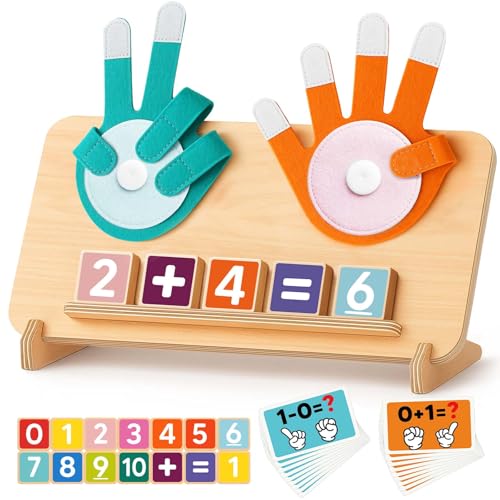
Gagule Number Counting Block Toy
What We Like
- Finger counting board makes math visual
- Includes 20 math flash cards for practice
- Natural wood with smooth rounded edges
- Comes with storage box for tidy cleanup
Trade-offs
- Limited to numbers 1-10, not advanced counting
- Small blocks need supervision for younger siblings
The finger counting board is the feature that sets this set apart, it lets a three-year-old see addition and subtraction happen right on their hand, making abstract numbers concrete. With 14 number blocks, 20 flash cards, and a storage box, it’s a complete early math kit that keeps little hands busy while building number sense. If your child is ready to move past simple shape sorting and wants to actually understand what ‘two plus three’ means, this is the toy that delivers that lightbulb moment without screen time or pressure.
This kit focuses on numbers 1-10, so it’s a starting point rather than a long-term math curriculum. For a preschooler who loves puzzles and patterns, the number blocks and finger board will feel like a game. For a child who still puts everything in their mouth, the small pieces mean you’ll want to stay close. Best for families who want a structured, no-fuss introduction to early math that feels like play.
Product photos
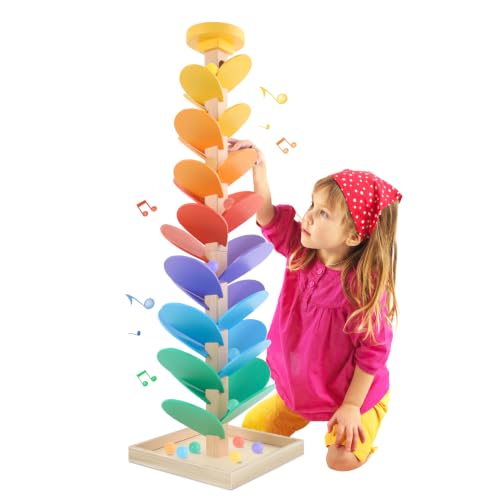
RECEKA Wooden Marble Run Music Tree
What We Like
- 49-piece set with multicolored leaves and balls
- Solid wood with non-toxic environmental paint
- Combines color sorting, visual tracking, and fine motor skills
- Pleasant wood sound as ball slides down
Trade-offs
- Assembly required with included screw and wrench
- Only 12 balls for 30 leaves, fewer balls than leaves
With 49 pieces including 30 multicolored leaves and 12 balls in six colors, this wooden marble run turns color sorting into a kinetic, musical experience. The ball drops from the yellow tray and slides down leaf tracks, making a pleasant wood sound that naturally draws a child’s attention. It’s a clever way to work on visual tracking, hand-eye coordination, and color recognition without feeling like a lesson. For a young child who loves cause and effect, this is the kind of toy that keeps them coming back because the payoff is immediate and satisfying.
Assembly requires the included screw and wrench, so you’ll need to set it up before handing it over. Once built, the 14.9-inch length means it needs a clear spot on a table or floor. But for a child who thrives on watching things move and hearing them click, the extra minute of setup is a small price for the engagement it delivers.
How We Evaluated Montessori Toys For 3 Year Olds
We started with the manufacturer’s specifications and materials lists, looking for solid wood, non-toxic paints, and designs that avoid cheap plastic. Then we cross-referenced expert round-ups from child development sources and analyzed patterns in owner feedback to understand what works in real homes.
Three criteria mattered most. First, the toy must offer a clear, self-correcting goal, lacing beads onto a string, stacking a cactus without tipping it, or sorting a shape into the correct hole. Second, the materials must be safe and durable enough to survive daily use by a three-year-old. Third, the toy should grow with the child, offering slightly harder challenges as skills improve.
A research-led evaluation has limits. We cannot claim to have tested these toys in a lab or with a panel of children. What we can offer is a careful, honest look at what each toy promises and what real owners report about its durability, engagement, and educational value.
What To Look For In Montessori Toys For 3 Year Olds
Three-year-olds learn through repetition and purposeful work. The best toys for this age offer a single, clear activity that a child can master independently without batteries or screens.
Look for toys made from natural materials like wood, with non-toxic finishes, that offer a single, self-correcting challenge. Avoid anything with flashing lights, loud sounds, or dozens of pieces that overwhelm a child’s developing attention span.
Material and Safety
Montessori toys for this age group should be made of solid wood, preferably from sustainable sources, with water-based, non-toxic paints. Check for smooth, rounded edges and finishes that won’t chip or peel. Avoid toys with small parts that could be a choking hazard for younger siblings.
The Single Challenge Principle
A three-year-old learns best when a toy has one clear goal: lace the beads, stack the rings, or sort the shapes. Toys with too many modes or functions scatter a child’s attention. The best Montessori toys let a child repeat the same action until they master it, building confidence and focus.
Open-Ended Play Value
Some of the best toys for this age have no single right answer. A balancing cactus or a set of stacking blocks can be arranged in endless ways, encouraging creative problem-solving. Look for toys that a child can play with differently each time, rather than ones that dictate a single outcome.
- Check that all pieces are large enough to be safe for a three-year-old.
- Confirm the toy includes a storage solution, like a box or bag.
- Look for a design that can be played with alone or with a parent.
- Avoid toys that require batteries or make electronic sounds.
A good rule of thumb: if a toy needs instructions, it’s probably too complicated for a three-year-old.
Montessori Toys For 3 Year Olds Compared
The table below compares all ten picks across key features like material, play type, and included pieces, so you can quickly see which toy fits your child’s needs.
| Product | Material | Pieces | Dimensions |
|---|---|---|---|
| Melissa & Doug Primary Lacing Beads | Painted Wooden | 33 total | L 8.8 inches, W 7.3 inches, H 1.3 inches |
| Montessori Mama Wooden Puzzles 4-Pack | Sustainable wood | 4 puzzles | L 8.3 inches, W 4.0 inches, H 0.0 inches |
| PlanToys Balancing Cactus | Rubberwood, water-based pigments | N/A | L 9.3 inches, W 9.3 inches, H 8.6 inches |
| Melissa & Doug Dust Sweep Mop Set | Wooden | 6 | L 4.2 inches, W 9.7 inches, H 30.0 inches |
| Tonberless Wooden Shape Sorter | Wood with water-based paint | 20 pieces | L 11.5 in, W 2.7 in, H 2.4 in |
| Momo & Nashi Montessori Busy Book | N/A | N/A | L 8.9 inches, W 1.9 inches, H 2.0 inches |
| TONZE Wooden Kids Tool Set | Solid wood, water-based paint | 44 | L 11.5 inches, W 2.5 inches, H 8.4 inches |
| IPOURUP Dinosaur Stacking Blocks | Wooden | N/A | N/A |
| Gagule Number Counting Block Toy | N/A | N/A | L 11.7 inches, W 6.2 inches, H 1.2 inches |
| RECEKA Wooden Marble Run Music Tree | Solid wood, environmental paint | 49 | L 14.9 inches, W 11.8 inches, H 1.6 inches |
Frequently Asked Questions
What makes a toy Montessori for a three-year-old?
A Montessori toy for a three-year-old is designed for independent, self-directed play. It has a single, clear purpose, like lacing, stacking, or sorting, and uses natural materials like wood. The toy should be self-correcting, meaning the child can see and fix their own mistakes without adult help.
How many toys does a three-year-old need?
Three-year-olds do best with a small, rotating selection of toys rather than a large collection. Five to seven well-chosen toys that target different skills, fine motor, spatial awareness, pretend play, are more valuable than a room full of options that overwhelm a child’s developing focus.
Are Montessori toys worth the higher price?
Montessori toys are typically made from higher-quality materials like solid wood with non-toxic finishes, which last longer and are safer than plastic alternatives. The educational value comes from the design, not the price tag. Many affordable options, like the Tonberless Wooden Shape Sorter, offer the same learning benefits at a lower cost.
What skills should a three-year-old develop through play?
At three, children should be building fine motor skills, hand-eye coordination, spatial awareness, and early problem-solving. They also benefit from toys that encourage independence, like pretend play sets, and from activities that introduce basic concepts like counting, colors, and shapes.
Can a three-year-old play with Montessori toys alone?
Yes, that is the goal. A well-designed Montessori toy lets a child work independently without constant adult guidance. Toys like the Momo & Nashi Montessori Busy Book or the Melissa & Doug Primary Lacing Beads are designed for solo play, though adult supervision is still recommended for safety.
The Bottom Line
For most families, the Melissa & Doug Primary Lacing Beads is the best overall choice. It builds fine motor skills, hand-eye coordination, and concentration through a simple, repeatable activity that a three-year-old can master on their own. The wooden storage case keeps everything organized, and the five distinct shapes add variety without overwhelming.
If your child prefers open-ended building and creative problem-solving, the PlanToys Balancing Cactus offers a different kind of challenge. For families focused on early math skills, the Gagule Number Counting Block Toy makes numbers visual and tactile. And for travel, the Momo & Nashi Montessori Busy Book packs fourteen learning activities into a compact, carry-handle case.
The single most important factor in choosing a Montessori toy for a three-year-old is the quality of the challenge. A toy that asks a child to focus, repeat, and improve on their own is worth more than any number of flashy features. Choose one clear challenge, and let your child discover the rest.
