
How to Keep a Sandbox Clean: Step-by-Step
This post contains affiliate links. As an Amazon Associate, we earn from qualifying purchases.
The short answer to how to keep a sandbox clean is four habits: cover it, drain it, sift it, and keep food and animals out. Sand itself is inert and doesn’t absorb liquid, so the mess and the mold live at the base of the box.
That distinction decides where you spend your effort. Sand grains rinse clean in a bucket. A solid plastic or wood base traps rainwater with nowhere to go, and that trapped moisture is where mold and bacteria take hold. So the routine splits in two: what you do to the sand, and what you do to the box holding it.
Below is the four-rule routine I use on every install, the places where the published guidance genuinely conflicts, and the frame material that matters more than any cleaning schedule.
Key Takeaways
- Cover the box whenever it isn’t in play. Cornell’s IPM program says a loose tarp alone won’t stop animals; you need a durable cover and a solid bottom.
- Mold and bacteria need standing water at the base. Sandtastik’s FAQ says the sand itself won’t grow mold, so drainage holes come first.
- Rinsing is optional. Clean the sand when you notice debris or an odor, or as a seasonal refresh.
- Skip railroad ties for the frame. The American Academy of Pediatrics warns they splinter and can be saturated with creosote, a carcinogen.
- Keep food and pets out. A “no food in the sandbox” rule removes an enticement for local animals.
What Actually Makes a Sandbox Dirty
You rake the box on a Saturday afternoon. By Wednesday there are leaves in it, the sand smells faintly sour where the sun hits it, and something has been digging at one corner.
That smell is the tell. Damp sand at the bottom of a closed box smells like a wet basement floor, and it sits low in the box rather than on top.
Play sand is an inert mineral product that does not absorb liquid. Debris, crumbs, animal waste, and standing water collect on the surface or at the base of the box. Because the grains themselves do not support biological growth, sanitation problems trace to what sits on the sand and what drains beneath it.
Sandtastik’s FAQ makes the same point from the manufacturer side. Sand is inert and won’t grow mold, and the company says the real problems start when rain or condensation collects at the bottom of a box with a solid plastic or wood base and has nowhere to drain.
The American Academy of Pediatrics frames the wet-sand risk differently. Its guidance stresses letting sand dry thoroughly and warns that wet sand can harbor bacteria. Different mechanism, same fix.
What actually fouls a box is a short list:
- Standing water at the base. A solid bottom holds rainwater with nowhere to go, and that’s where mold and bacteria take hold.
- Debris. Leaves, twigs, grass clippings, and crumbs.
- Animal waste. Cats and raccoons both treat an uncovered box as a latrine.
- Food and drinks, which is the single biggest draw for wildlife.
Everything else is cosmetic.
How to Keep a Sandbox Clean Without Replacing the Sand
Four habits do almost all the work: cover, drain, sift, and separate.
Before you start: Two things bite here. Bleach and dish soap go into rinse water in drops, never as a pour, because residue stays in sand your kid handles. And sand that goes down an indoor drain can set up like grout in the trap, so rinse outdoors with a hose.
- Cover the box every time it isn’t in use. Cornell’s school and childcare IPM program is blunt about this one: a durable cover that only comes off during playtime is the baseline. Skip it and you’re not just raking leaves, you’re running an open invitation to the neighborhood cats.
- Give the box a way to drain. Drill a few holes in the bottom, or set landscape fabric under the sand if the box sits on grass. Without drainage, rainwater pools at the base, and that standing water is where mold and bacteria grow.
- Sift or rake the sand regularly to pull out leaves, twigs, and whatever the dog dragged in.
- Keep food, drinks, and pets out. Sandtastik and Cornell land on the same rule, and it’s the cheapest one to follow.
Covering works because animals are hunting for soft, dry, uncovered ground. Cornell’s Joellen Lampman points out that cats and raccoons both use sand as a latrine. That’s the reason the exclusion rules matter more than the cleaning schedule.
If a toddler is the primary user, sandbox safety for toddlers covers the parts of the box that cleaning can’t fix.
How Do You Clean Sand That Already Smells or Has Had Spills?
Does the sand actually need washing, or does it just need air? Sandtastik’s own cleaning guide says washing is optional. You clean the sand when you notice debris or an odor, or as part of a seasonal refresh.
The Rinse Method, Step by Step
- Scoop the sand into a pail until it’s about half full. Room at the top lets you stir without spilling. For a large box, work in batches.
- Add water and stir. For sand that smells or has had spills, Sandtastik suggests a few drops of dish soap or bleach. A few drops. Not a capful.
- Rinse with clean water until the water runs clear and no suds are left. Skipping this leaves soap residue sitting in sand your kid will handle.
- Pour off the excess water and return the wet sand to the box.
- Let it dry before you cover it. This is the step people skip, and it’s the one that matters most.
Sandtastik says to return wet sand to the box and cover it when not in use, while the AAP stresses letting sand dry thoroughly and warns that wet sand can harbor bacteria.
What most people get wrong: Covering damp sand. Sandtastik says to return wet sand to the box, but the AAP’s guidance stresses letting sand dry thoroughly first. Rinse on a sunny morning so the sand has the whole day to dry before the lid goes back on.
Where the Sources Disagree on Soap and Bleach
Sandtastik tells you to add a few drops of dish soap or bleach to the rinse water. The American Academy of Pediatrics doesn’t endorse chemical additives at all, and leans on thorough drying and regular raking instead.
Both positions hold up under different conditions. If the sand just has leaves in it, water and a rake are enough. If something spilled in there, or the box has an odor, the drops of soap earn their place. Use the minimum, and rinse until the water runs clear either way.
The Fine-Grain Trick
When fine grains build up, the rinse does something genuinely useful. The fine particles float to the top of the water, so you can pour them off instead of sifting them out by hand.
Trying to rinse the whole box in one pass is how a small job turns into a miserable one. Batches are the sane approach.
Bucket, shovel, and mold need the same treatment. A hose and a stiff brush handle the clean sand toys side of the job in one go.
Tarp, Lid, or Solid Bottom: What Actually Keeps Animals Out
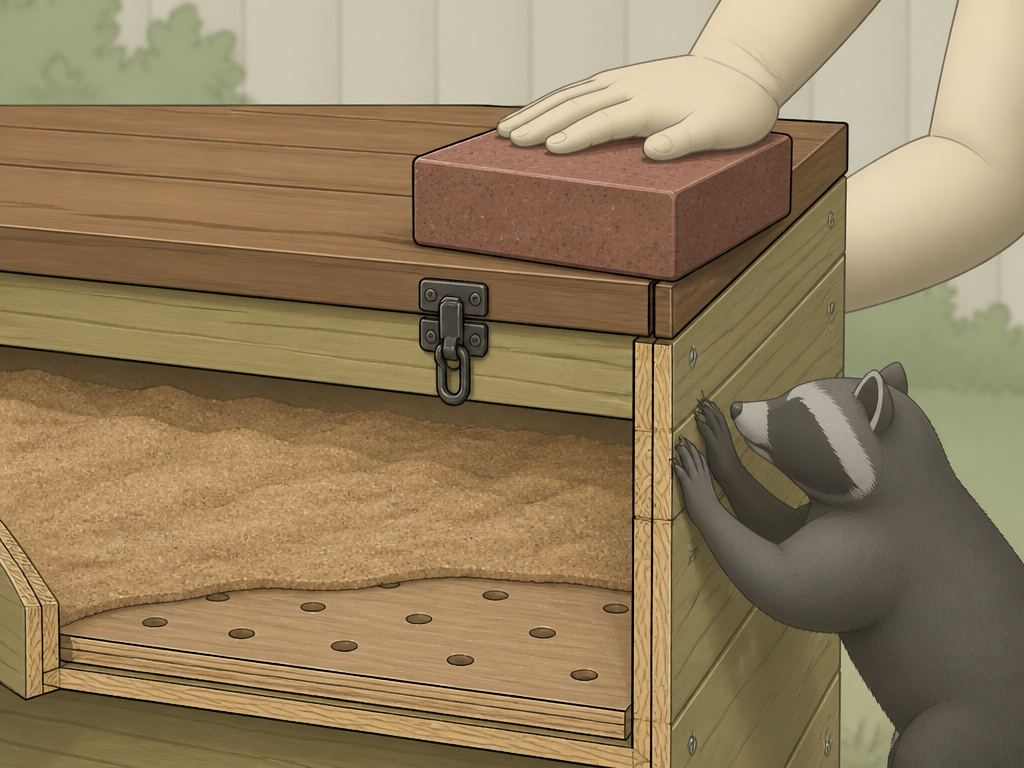
A loose tarp does nothing.
Cornell’s IPM program is specific about why. Without securing it, animals can easily slip under the tarp. The cover has to be durable, and it has to stay on except during playtime.
| Cover type | Keeps out | Where it fails |
|---|---|---|
| Tarp laid over the top | Leaves and rain | Animals push under an unsecured edge |
| Polyethylene film or plywood | Debris and moisture | Same, unless weighted down |
| Solid-bottom box with a fitted lid | Burrowing animals from below | Still needs drainage holes drilled |
QUIKRETE’s own product literature recommends covering play sand with polyethylene film or plywood when it isn’t in use, which handles cleanliness. It doesn’t handle burrowing.
Cornell adds the piece a cover can’t solve: a solid box bottom. That stops sand loss and stops animals from coming in from underneath.
A cover that lifts off in the wind is a leaf screen, not an animal barrier. If you can slide a hand under the edge, a cat can get in.
The sandbox cover matters less than how it’s held down. Weight and overlap beat material every time. And Cornell’s guidance for cats is the same as for raccoons: exclusion, not repellent. That’s the core of how to keep cats out of a sandbox, a solid bottom plus a cover that latches down.
Drainage Is Where Most Sandbox Problems Start
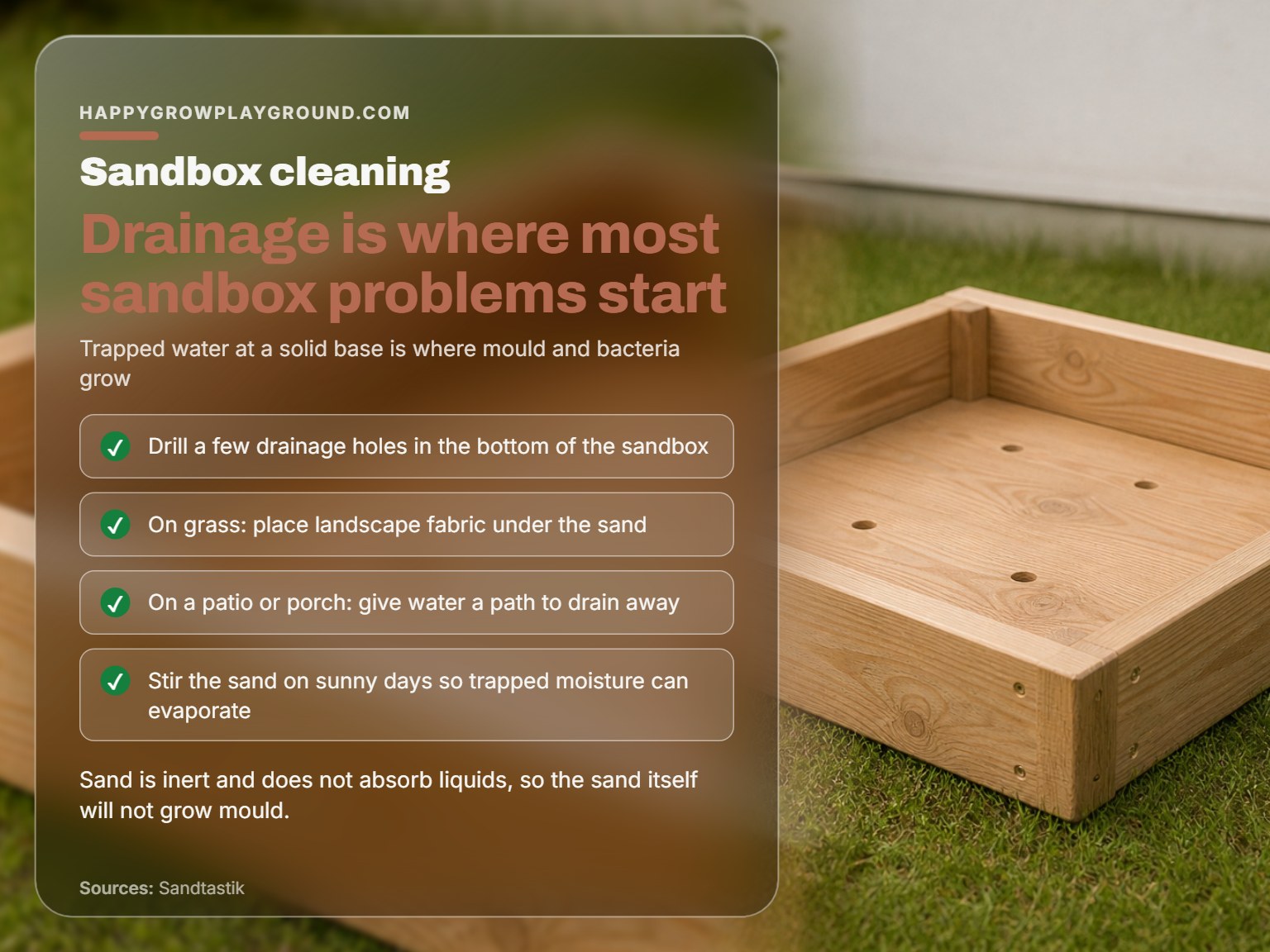
Water has to leave the box.
I’ve had this go wrong on a sloped site more than once. The grade looked gentle enough that nobody worried about it, but it drained straight toward the play area, and every rainstorm put a puddle under the sand. Now I plan a small berm or a shallow channel on every sloped install, before anything gets set in place.
A sandbox is a bowl. If the bowl has no hole, it holds water, and the water sits against the base where mold and bacteria grow.
| What you see | Likely cause | Fix |
|---|---|---|
| Sand smells sour after rain | Water pooling at a solid base | Drill drainage holes in the bottom |
| Sand stays damp for days | No airflow under a closed lid | Stir the sand on sunny days |
| Sand vanishing from the box | No solid bottom | Add landscape fabric under the sand |
| Grit caked in one corner | Runoff entering from uphill | Berm or channel above the box |
I put drainage in before I put sand in. Every time. Drilling a few holes in a new box takes less time than one afternoon of scooping wet sand out of it, and I’ve done both.
Sandtastik’s FAQ puts the fix plainly. If the box sits on grass, put landscape fabric under the sand. On a patio or porch, make sure water has a path away from the box. That’s the whole job when you drain a sandbox on a hard surface.
Do You Need to Replace the Sand, or Just Clean It?
In 1986, concern surfaced that some commercially available play sand contained tremolite, a fibrous mineral found in crushed limestone and crushed marble. The worry was that long-term exposure would behave like asbestos exposure.
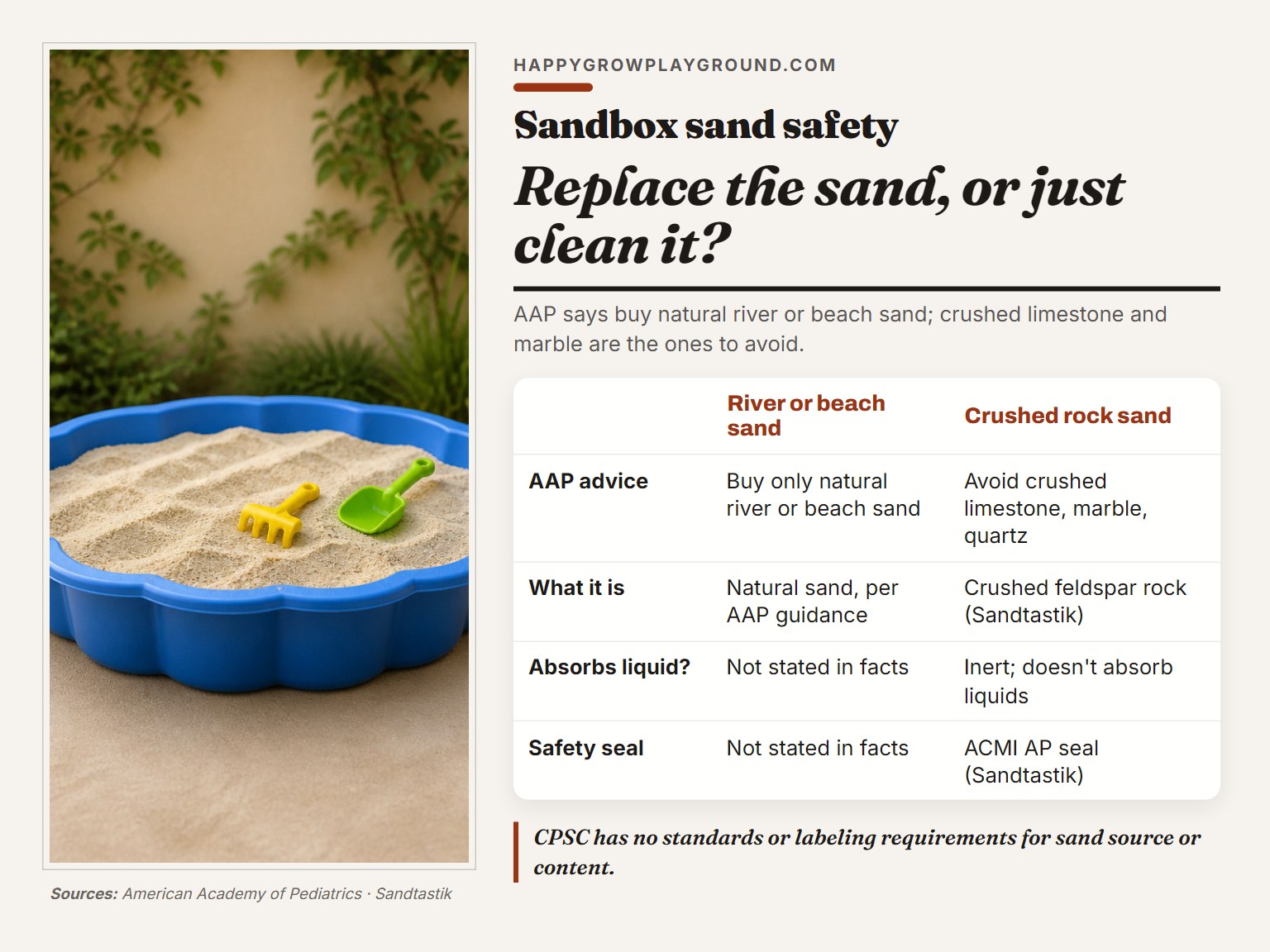
The US Consumer Product Safety Commission denied a petition to ban the marketing of play sand containing significant tremolite levels. It still has no standards or labeling requirements covering the source or content of sand.
That’s the part worth sitting with. No federal label tells you what’s in the bag.
| Product | What it is | Spec worth knowing |
|---|---|---|
| QUIKRETE Play Sand No. 1113 | Screened, washed, dried sand | About 1/2 cubic foot (14 L) per unit |
| Sandtastik Sparkling White Play Sand | Crushed feldspar rock | Inert; doesn’t absorb liquids |
| River or beach sand | Natural sand, per AAP guidance | The type the AAP recommends buying |
What the AAP Says to Buy
The American Academy of Pediatrics advises buying only natural river sand or beach sand. It flags crushed limestone, crushed marble, and crushed crystalline silica (quartz) as the ones to avoid.
Sandtastik’s feldspar sand fits neither category. It’s neither river sand nor beach sand, so the AAP’s buying rule doesn’t cover it directly. What Sandtastik does carry is the ACMI AP seal, which means a board-certified toxicologist evaluated the product, it’s non-toxic when used as intended, and it’s labeled in line with federal law.
What’s Actually on the Shelf
Sandtastik states its sand contains no free silica, crystalline silica, quartz, asbestos, wheat or gluten, nuts or seeds, or other potentially hazardous impurities. It also says the sand has been tested by a CPSC-accredited lab, with results showing no organic materials or insects.
QUIKRETE Play Sand No. 1113 takes a different route. It’s screened, washed, and dried, and the company suggests dampening it to improve packing and shaping while cutting dust.
Replacement is rarely the answer. If the sand is gritty with debris, rinse it. If rinsing isn’t enough, the next step up is to disinfect sandbox sand rather than haul the whole load out.
The Frame Material Matters More Than Your Cleaning Schedule
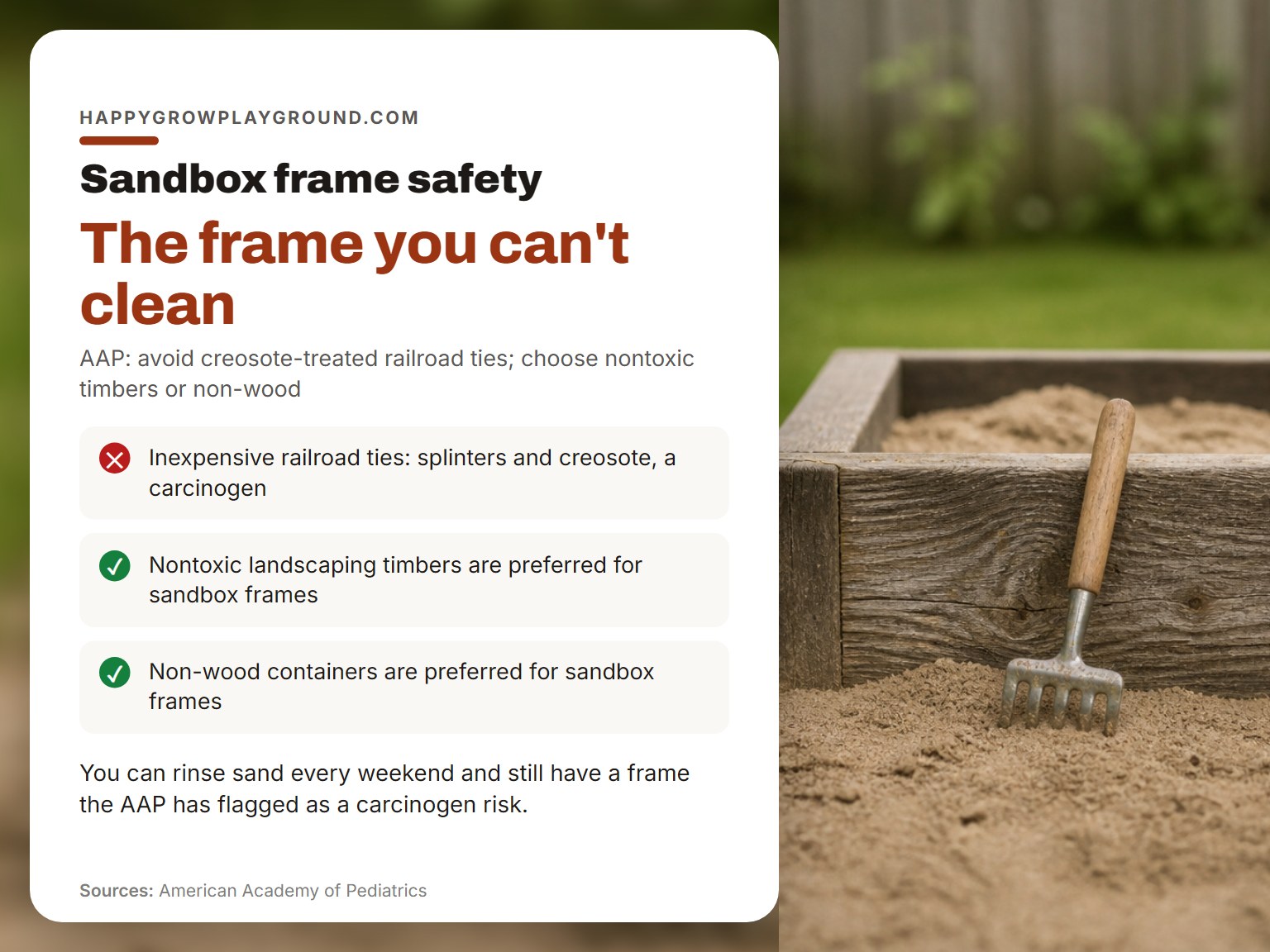
Railroad ties are the cheapest frame material at the lumber yard, and the American Academy of Pediatrics says not to use them.
The AAP’s warning is specific. Inexpensive railroad ties may cause splinters, and they may be saturated with creosote, a carcinogen. The preferred alternatives are nontoxic landscaping timbers or a non-wood container.
This is the one I’d change first on a new build. You can rinse sand every weekend and still have a frame the AAP has flagged as a carcinogen risk. Durable beats fancy every time, but safe beats durable.
Your realistic options:
- Nontoxic landscaping timbers. The AAP’s first choice for a wood frame.
- A non-wood container. A molded plastic box falls into the non-wood container category the AAP prefers.
- Anything except creosote-treated railroad ties.
Easy to miss: The frame is the one part of a sandbox you can’t clean. Sand, covers, and toys all get replaced eventually. Creosote-soaked ties stay in the ground for the life of the box.
At the end of the season, how you store a sandbox for winter decides whether you start clean in spring or start over. The same goes for everything that lives inside it. Running the routine to clean outdoor toys before storage saves you a full scrub in April.
Frequently Asked Questions
How often should you clean a sandbox?
Sandtastik’s guidance is that washing is optional. Clean the sand when you notice debris or an odor, or as part of a seasonal refresh. Raking and sifting should happen far more often than washing does.
Can sandbox sand make kids sick?
The sand itself is inert and doesn’t support biological growth. The risk sits in what’s on top of it and what’s underneath: animal waste, food, and standing water at the base. Keeping the box covered, drained, and food-free handles most of it.
Does bleach kill germs in sandbox sand?
Sandtastik allows a few drops of bleach in the rinse water for sand that smells or has had spills. The American Academy of Pediatrics doesn’t endorse chemical additives and stresses drying sand thoroughly instead. If you use bleach, use drops, and rinse until the water runs clear.
What kind of sand is safest for a sandbox?
The AAP advises natural river sand or beach sand and warns against crushed limestone, crushed marble, and crushed crystalline silica (quartz). There’s no federal standard or labeling requirement for sand content, so the ACMI AP seal is one of the few independent checks you’ll find on a bag.
Will a tarp keep cats out of the sandbox?
Not on its own. Cornell’s IPM program notes that without securing it, animals can easily slip under a tarp. You need a durable cover that stays on except during playtime, plus a solid box bottom to stop burrowing from below.
Why does my sandbox smell after it rains?
Rainwater is collecting at the base of the box with nowhere to drain. Drill a few holes in the bottom, add landscape fabric if the box sits on grass, and stir the sand on sunny days so trapped moisture can evaporate.
The Bottom Line
The first thing I’d do this weekend is drill drainage holes in the bottom of the box. Not rake it, not rinse it. Drainage is the one change that stops the problem from coming back, and it takes less time than reading this article did.
One caveat. If your box sits on a concrete patio and you can’t drill it, everything above shifts. Your job becomes redirecting water away from the box rather than out of it.
And if you’re still choosing a frame, skip the railroad ties. I know they’re the cheapest thing at the yard, and the AAP has flagged them as a carcinogen risk. That’s a trade I wouldn’t make for a box my kid sits in.
Keep the sand dry, keep the box covered, and keep the food out. Do those three and you won’t think about how to keep a sandbox clean again until spring.
