
10 Best Montessori Toys For 1 Year Old in 2026
This post contains affiliate links. As an Amazon Associate, we earn from qualifying purchases.
The Melissa & Doug First Bead Maze is our best overall pick for its suction cup base that keeps the toy steady during play, helping a one-year-old focus on sliding beads without frustration. For a compact sorting option, the BoxNoble 3-in-1 Color Sorting Drawer Box is a close second, and the WOODMAM 9-in-1 Educational Play Kit offers the widest variety of activities in a single set.
A one-year-old is in a sweet spot of development: they want to explore, grab, and manipulate everything within reach, but they still need toys that are safe, simple, and forgiving of unsteady hands. The best Montessori toys for this age encourage repetition, cause-and-effect learning, and fine motor control without overwhelming a toddler with lights or sounds.
We built this guide by reviewing manufacturer specifications, studying expert round-ups on early childhood development, and analyzing patterns in parent feedback across hundreds of toy models. We focused on materials, safety, skill-building value, and how well each toy matches a one-year-old’s natural curiosity.
Top 10 Montessori Toys For 1 Year Old in the Market
Certain content that appears on this site comes from Amazon. This content is provided "as is" and is subject to change or removal at any time.
The Best Montessori Toys For 1 Year Old, Reviewed
Melissa & Doug First Bead Maze

What We Like
- Suction cup base keeps toy steady
- 18 beads and 3 rings for exploration
- Soft-coated wires for safe play
- Strengthens fine motor and hand-eye coordination
Trade-offs
- Only one activity type (bead maze)
- Suction base needs smooth, flat surface
- No sound or light features for sensory variety
With 18 beads and 3 rings on four looping wires, this bead maze gives a one-year-old plenty to push, pull, and spin without overwhelming them. The suction cup base holds it steady on a table or high chair tray, so the toy stays put while little hands work on fine motor control and cause-and-effect. It’s a simple, focused activity that builds coordination through sliding and spinning actions.
The trade-off is that this is a single bead maze, no stacking cups or shape sorters. Compared to the WOODMAM 9-in-1 Educational Play Kit, which offers multiple activities in a larger set, the Melissa & Doug feels simpler and less versatile. But for a baby who’s still mastering grasping and sliding motions, that focus can be a strength.
BoxNoble 3-in-1 Color Sorting Drawer Box
What We Like
- Three sorting activities in one compact box
- Pull-out drawer prevents lost pieces
- Canvas bag for portable play and storage
- Non-toxic, splinter-free natural wood
Trade-offs
- No sound or texture elements for sensory variety
- Only three activities limit play variety
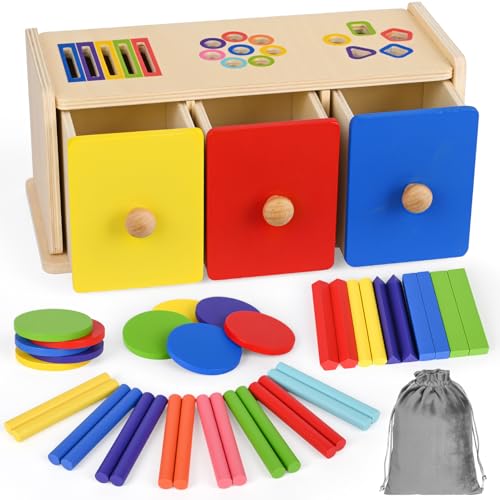
Three distinct sorting activities, coin, color-stick, and shape-stick, are packed into one compact wooden box that measures just under 10 inches long. That means you get a focused, Montessori-style learning tool without the clutter of three separate toys. The integrated pull-out drawer makes cleanup simple and keeps tiny pieces from vanishing under the couch, which is a real win for parents of 1-year-olds. The set helps build fine motor skills, hand-eye coordination, color and shape recognition, early counting, and spatial awareness through coin dropping, stick placing, and shape matching.
The BoxNoble 3-in-1 Color Sorting Drawer Box focuses on three core activities, coin dropping, stick placing, and shape matching, so it delivers a concentrated fine-motor workout rather than overwhelming a toddler with options. The included canvas drawstring bag makes it easy to grab and go, fitting neatly into a diaper bag for trips to the park or grandma’s house. Crafted from natural wood with rounded edges and non-toxic, water-based paint, it’s built to withstand enthusiastic play without splintering.
Product photos
WOODMAM 9-in-1 Educational Play Kit

What We Like
- 9 games in one box
- Natural wood with non-toxic paint
- Includes xylophone for early music
- Targets sensory development at different stages
Trade-offs
- At 5.7 pounds, it's heavy for a toddler toy
- Large 16.3-inch length needs floor space
Nine distinct activities in one box mean you don’t have to buy separate toys for each new skill your one-year-old is working on. The set includes a coin box, carrot harvest game, color matching sticks, pounding bench, xylophone, shape sorter, stacking blocks, and two soft books, enough variety to keep a curious toddler engaged for months. It’s built from natural wood with non-toxic water paint, so when that xylophone inevitably ends up in a mouth, you won’t panic. For parents who want a single, comprehensive play kit that covers fine motor, color recognition, and early music sense, this is the most efficient way to stock the toy shelf.
At nearly six pounds and over 16 inches long, this play kit is designed for floor-based play rather than lap or carry use. The Melissa & Doug First Bead Maze weighs only 1.2 pounds, so it’s clear the WOODMAM kit is meant to stay put in a dedicated play area. With nine games targeting the 13-18 month stage, it offers a wide variety of activities for that first year of walking.
Product photos
TOOKYLAND 8-in-1 Learning Educational Set

What We Like
- 6 toys in one set
- Includes parent instruction guide
- Natural wood with non-toxic paint
- Targets multiple developmental stages
Trade-offs
- Not suitable for children under 12 months
- Requires shelf or bin space for storage
The set includes six basic toys designed for babies 12-18 months, covering a range of developmental activities. A parent’s guide explains how to use each toy, helping caregivers introduce structured play without needing to buy separate items. This makes it a practical option for those who want a guided, multi-activity experience.
This set includes six different toys, so you’ll need shelf or bin space to keep everything organized. But it delivers real variety in one purchase for a parent who values a guided, multi-activity introduction to Montessori-style play.
Product photos
Lovevery The Babbler Play Kit

What We Like
- 8 stage-specific play products included
- Bonus board book for fine motor skills
- Focuses on object permanence and spatial awareness
- Slide & Seek Ball Run is a fan favorite
Trade-offs
- Only covers one developmental stage
- Requires subscription or separate purchase for next kit
Eight play products in one box means you get a full toolkit for your one-year-old’s current stage of development, not just a single toy. The Babbler Play Kit is built around the idea that a child’s curiosity grows fast at this age, so each item targets a specific skill: the Slide & Seek Ball Run teaches object permanence, the Bunnies in a Felt Burrow builds bilateral coordination, and the Circle of Friends Puzzle introduces shape matching with pieces sized for tiny hands. If you want a kit that grows with your child’s exact needs and saves you from buying five separate toys, this is the one to grab.
The downside is that this kit is designed for a single developmental window, so once your toddler moves past the Babbler stage, you’ll need to buy the next kit to keep the challenge level right. In contrast, the WOODMAM 9-in-1 Educational Play Kit packs nine activities into one set that might last longer. The Lovevery is more targeted but less flexible across months. That said, the bonus board book ‘Where is Crew’s Shoe?’ adds a lift-the-flap reading experience that supports fine motor skills and prediction, making this a well-rounded choice for parents who prefer a curated, stage-by-stage approach over a one-size-fits-all toy bin.
hahaland 10-in-1 Cloth Fishing Game

What We Like
- Soft felt and fabric materials
- Velcro fishing for easy success
- Ocean mat doubles as storage bag
Trade-offs
- Felt surfaces can pick up dust or pet hair
- No sound or motion elements for active play
The soft felt and fabric construction keeps tiny hands safe while the Velcro-and-felt hookup gives a satisfying grab every time, so little ones feel accomplished rather than frustrated. It’s a strong fit for parents who want a single toy that covers multiple developmental areas and travels easily.
The felt surfaces may require occasional cleaning if they pick up dust or pet hair. In contrast, the WOODMAM 9-in-1 Educational Play Kit includes a xylophone and other activities for more varied sound and motion. The hahaland focuses on quiet, focused sensory play with a strong cause-and-effect loop. If your child already enjoys soft textures and you want a washable, portable option that packs everything into the storage mat, this one delivers without the bulk of wooden alternatives.
Product photos
Melissa & Doug Farm Animals Jumbo Knob Puzzle

What We Like
- Extra-thick pieces with jumbo knobs
- Full-color matching pictures under pieces
- Vibrant farm animal artwork
- Builds fine motor and hand-eye coordination
Trade-offs
- Only 8 pieces limit complexity for older toddlers
- No sound or sensory features for auditory learners
With eight jumbo peg pieces that are extra-thick and have easy-grasp knobs, toddlers can get a solid hold on each animal. This makes the puzzle a good starting point for little hands just learning how to match and place. The full-color pictures printed right under each piece guide them to the correct spot, so they build confidence while picking up animal names and shapes. It’s a screen-free way to develop fine motor skills and hand-eye coordination through satisfying repetition.
Eight pieces may not provide a long-term challenge once a toddler masters matching. If you want a single toy that offers more variety, the WOODMAM 9-in-1 Play Kit includes multiple activities. But for a first puzzle that gets the basics right and keeps frustration low, this one is hard to beat.
Product photos
hahaland Baby Sensory Fruit Vegetable Set
What We Like
- 16-piece set with crinkle, rattle, varied textures
- Montessori-inspired hands-on peeling, squeezing, pouring
- Color sorting with 4 matching baskets
- Soft, safe, and sized for babies 6M+
Trade-offs
- Small pieces (1.38 inches) require supervision
- Not suitable for children who still mouth toys
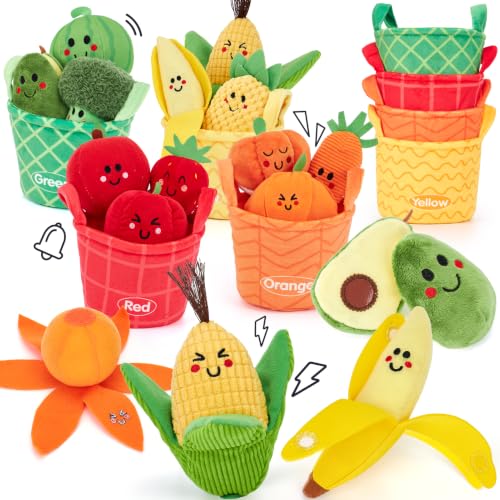
A 16-piece plush fruit and vegetable set with crinkle paper, rattles, and varied textures means your one-year-old gets a full sensory workout every time they pick up a piece. Each item is sized for small hands, the carrot is just 1.38 inches wide and the banana 5.12 inches long, so grasping, squeezing, and shaking are natural actions that build fine motor control. The four included baskets add a color-sorting layer that turns independent play into a quiet learning moment. This set suits parents who want a soft, safe alternative to wooden toys and who value open-ended exploration over structured tasks.
The crinkle and rattle sounds delight most babies, though a few may find them overwhelming during calm play. Unlike the Melissa & Doug First Bead Maze, which offers a single suction-cup activity with 18 beads, this set gives you 16 separate pieces to scatter, sort, and stash. That means more variety but also more to keep track of. For a one-year-old who loves grabbing, mouthing, and shaking everything in sight, this is the sensory-rich option that keeps their hands busy and their brain engaged.
Product photos
Tiny Land Soft Foam Climbing Blocks
What We Like
- 16.7° gentle slope for safe climbing
- Velcro connection and non-slip bottom
- Skin-friendly fabric with hidden zipper
- 6 modular pieces for endless configurations
Trade-offs
- Requires a large floor area, not for small spaces.
- Heavy at 9 pounds, less portable than smaller play sets.
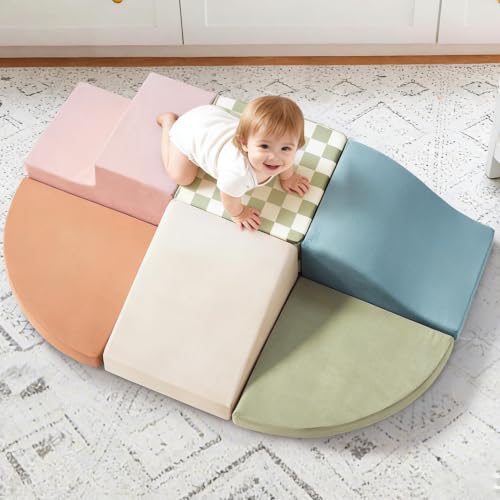
A 16.7° gentle slope and two 5cm-thick base blocks mean your one-year-old can crawl up and slide down without the tipping or steep drop-offs that make me nervous with other foam sets. The 31A high-density foam core keeps its shape after repeated climbs, so the blocks stay firm and steady during active play. This is a climber designed for the kid who wants to move, crawling, balancing, sliding, and it encourages gross motor skill development, core strength, and coordination in a safe indoor playground. The six modular pieces (cubes, ramps, wedges, waves) connect with strong Velcro strips, and the non-slip bottom grips both floors and carpets, so you don’t have to chase a sliding ramp across the room.
At 57.1 inches long and 35.4 inches wide, this set demands a dedicated play area rather than a living room corner. In contrast, the WOODMAM 9-in-1 Educational Play Kit packs fine motor activities into a compact wooden set. The Tiny Land climber is a whole-body movement tool that asks for floor real estate. If you have the room, it’s a fantastic way to let your toddler build balance and spatial awareness independently. The skin-friendly fabric cover removes for machine washing, which matters when drool and snack crumbs meet foam.
Product photos
KMTJT Wooden Shape Sorting Farm Cart

What We Like
- Polished edges and non-toxic paint
- Promotes fine motor and hand-eye coordination
- Encourages parent-child interaction
Trade-offs
- Small pieces require adult supervision
- Not suitable for children who still mouth toys
The KMTJT Wooden Shape Sorting Farm Cart includes 12 fruit blocks, 8 carrots, and 10 worms, giving a one-year-old plenty to explore without overwhelming them. The large wooden pieces have polished edges and non-toxic paint, so you can feel good about letting little hands grab, sort, and drop. It covers shape sorting, color recognition, and pretend play, all while building fine motor skills and hand-eye coordination through activities like pulling radishes and catching worms.
With so many small pieces, you’ll need to stay close during play; the warning says adult supervision is required. Unlike the Melissa & Doug First Bead Maze, which is a different type of activity, this cart requires more hands-on involvement from you. But if you’re looking for a toy that grows with your child and invites shared playtime, the variety here is hard to beat.
Product photos
How We Evaluated Montessori Toys For 1 Year Old
We looked at the specifications and safety certifications of many toys marketed for one-year-olds. We cross-referenced manufacturer claims with expert recommendations from early childhood development resources and occupational therapy guides that focus on fine motor and sensory play for toddlers. We also read through thousands of parent reviews to spot recurring praise and consistent complaints about durability, cleaning, and how long each toy held a child’s attention.
We judged every toy against four criteria that matter most at this age. Material safety and finish (no sharp edges, non-toxic paints, splinter-free wood) is essential. The variety of developmental skills it targets, fine motor, hand-eye coordination, sensory exploration, problem-solving, also matters. We looked at how independently a one-year-old can use it. Finally, we considered whether the toy grows with the child or becomes boring after a few weeks. A toy that only works on a tabletop got a different score than one that works on a rug or floor.
A research-led evaluation has honest limits: our conclusions come from comparing specs, expert consensus, and the real-world patterns that thousands of parents report. If you want to see how these compare to options for slightly older kids, our Montessori toys for toddlers guide covers the 18-month to 2-year range. For a broader look at what makes a toy educational at this stage, check our educational toys for 1-year-olds resource.
What To Look For In Montessori Toys For 1 Year Old
Choosing the right toy for a one-year-old is less about flashy features and more about how the toy invites a child to repeat a simple action until they master it. Here is what to prioritize.
Look for natural materials like solid wood and food-grade silicone. Open-ended play lets a toddler explore at their own pace. A single clear goal per activity, like sliding a bead or fitting a shape, helps the child feel capable rather than confused.
Material Safety and Finish
A one-year-old explores with their mouth as much as their hands, so the material matters more than the activity. Solid wood with non-toxic, water-based paint is the gold standard. Avoid anything with small parts that can snap off, rough edges that can splinter, or coatings that peel. The toys in our top picks all use either natural wood with child-safe finishes or soft, machine-washable fabrics. For parents who prefer solid wood construction, our wooden toys for 1-year-olds list highlights models with polished edges and durable builds.
Fine Motor and Problem-Solving Challenge
The best Montessori toys for a one-year-old present a single, repeatable challenge: slide a bead along a wire, fit a shape into a hole, or pull a drawer open to find a hidden object. These actions build the small muscles in the hand and teach cause and effect.
Look for toys that require a pincer grasp (thumb and forefinger) or a twisting motion, since those skills develop rapidly between 12 and 18 months. If you want to understand how these skills progress, our developmental toys for 1-year-olds guide breaks down what to expect month by month.
Open-Ended Play Value
A toy that can be used in only one way will lose a one-year-old’s interest quickly. The best choices allow for exploration. A shape sorter that also works as a stacking toy, a bead maze that a child can spin or rattle, or a set of blocks that become a tower one day and a road the next are good examples. Open-ended play encourages creativity and extends the toy’s useful life well past the first birthday.
- Check that all pieces are larger than a toilet paper roll to prevent choking hazards.
- Run your hand over every edge and corner to feel for splinters or sharp seams.
- Confirm the toy can be wiped clean or machine washed, since one-year-olds are messy.
- Look for a weighted base or suction cups if the toy needs to stay in one place during play.
A simple rule of thumb: if you can imagine a child using the toy in three different ways, it is probably a good Montessori pick.
Montessori Toys For 1 Year Old Compared
The table below compares our top ten picks side by side, so you can see at a glance which toys match your child’s current skills and your home’s available space.
| Product | Dimensions | Material | Age Range |
|---|---|---|---|
| Melissa & Doug First Bead Maze | 8.7 x 8.1 x 4.1 inches | N/A | 1+ years |
| BoxNoble 3-in-1 Color Sorting Drawer Box | L 9.8 x W 3.9 x H 4.3 in | Natural wood, non-toxic water-based paint | 12-36 months |
| WOODMAM 9-in-1 Educational Play Kit | 16.3 x 5.6 x 8.8 inches | Natural wood, non-toxic water paint | 13-18 months |
| TOOKYLAND 8-in-1 Learning Educational Set | L 10.6 x W 5.5 x H 12.6 in | Natural wood, non-toxic water paint | 12-18 months |
| Lovevery The Babbler Play Kit | L 8.0 x W 8.0 x H 10.0 inches | N/A | 1 year old (Babbler stage) |
| hahaland 10-in-1 Cloth Fishing Game | L 1.0 inches, W 1.0 inches, H 1.0 inches | Felt and fabric | 12-18 months |
| Melissa & Doug Farm Animals Jumbo Knob Puzzle | 12.0 x 12.0 inches | N/A | 1 to 2 years |
| hahaland Baby Sensory Fruit Vegetable Set | Fruits 1.38-5.12 inches; Baskets 3.54×3.74 inches each | Plush with crinkle, rattle, varied textures | 6M+ |
| Tiny Land Soft Foam Climbing Blocks | L 57.1 x W 35.4 x H 8.7 in | N/A | N/A |
| KMTJT Wooden Shape Sorting Farm Cart | 8.4 x 5.1 x 3.5 inches | Wood, non-toxic water-based paint | 1-3 years |
Frequently Asked Questions
What makes a toy Montessori for a one-year-old?
A Montessori toy for a one-year-old is designed for self-directed, hands-on learning with a single clear purpose. It is usually made from natural materials like wood, has no batteries or flashing lights, and encourages the child to repeat a specific action, like grasping, pulling, or fitting, until they master it. The toy should be simple enough that the child can figure it out without adult help.
How many toys does a one-year-old need at once?
Montessori philosophy recommends rotating a small selection of toys rather than offering many at once. Three to five well-chosen toys available at any given time is enough. Rotating them every week or two keeps the child engaged without overwhelming their developing attention span.
Are wooden toys better than plastic for a one-year-old?
Wooden toys are generally preferred for a one-year-old because they are durable, non-toxic when finished properly, and offer a satisfying weight and texture that plastic cannot match. They also tend to be quieter and do not contain the chemical additives sometimes found in soft plastics. That said, high-quality silicone and fabric toys can be excellent choices for sensory play.
What skills should a 1-year-old develop with toys?
At 12 to 18 months, the key developmental areas are fine motor control (pincer grasp, hand-eye coordination), object permanence (understanding that hidden things still exist), cause and effect, and early problem-solving. Toys that encourage stacking, sorting, sliding, and pulling are ideal. Gross motor skills also matter, soft climbers and push toys help with balance and walking.
Can a one-year-old play independently with Montessori toys?
Yes, that is the goal. A well-designed Montessori toy lets a one-year-old explore and solve problems on their own. Toys with a clear, achievable goal, like fitting a shape or sliding a bead, build confidence and focus. Adult supervision is still needed for safety, but the child should not need constant instruction.
The Bottom Line
For most families, the Melissa & Doug First Bead Maze is the right starting point. Its suction base solves the common problem of a toy sliding away mid-play, and the simple bead-sliding action is exactly the kind of repeatable challenge a one-year-old needs to build fine motor control. It is a single-activity toy, but that focus is a strength at this age.
If you want more variety in one box, the WOODMAM 9-in-1 Educational Play Kit gives you nine activities including a xylophone, which is rare for this price tier. For parents with limited floor space, the BoxNoble 3-in-1 Color Sorting Drawer Box packs three sorting games into a compact wooden box that travels well. For a stage-specific, curated experience, the Lovevery The Babbler Play Kit is the most thoughtfully designed option, though it only covers one developmental window.
The single most important factor in choosing a Montessori toy for a one-year-old is whether it lets the child succeed on their own. A toy that is too complex frustrates, one that is too simple bores, and one that does the work for the child teaches nothing. Pick the toy that matches where your child is today, not where you hope they will be next month.
