
10 Best Montessori Toys in 2026
This post contains affiliate links. As an Amazon Associate, we earn from qualifying purchases.
The PlanToys Balancing Cactus Wooden Toy is our best overall pick because it turns a simple stacking challenge into a patient, open-ended lesson in balance and fine motor control. For pretend play, the Melissa & Doug Cleaning Pretend Play Set stands out, and the Joyreal Wooden Montessori Hammering Toy delivers strong value for small spaces.
Choosing the right Montessori toy means matching the activity to your child’s current developmental stage, a 7-month-old needs different sensory input than a 2-year-old building spatial awareness. The best toys grow with the child or target a specific skill window precisely.
This guide ranks 10 Montessori toys based on their materials, safety, developmental alignment, and what patterns emerge from owner feedback. We cover ages from infancy through preschool, so you can find the right fit whether you are starting a Montessori playroom or adding a single purposeful toy.
Top 10 Montessori Toys in the Market
Certain content that appears on this site comes from Amazon. This content is provided "as is" and is subject to change or removal at any time.
The Best Montessori Toys, Reviewed
PlanToys Balancing Cactus Wooden Toy

What We Like
- Montessori-based open-ended learning
- Strengthens fine motor and hand-eye coordination
- Eco-conscious rubberwood with organic pigments
- Award-winning design (Good Design, Japan)
Trade-offs
- No storage bag or box included for loose pieces
- Not suitable for children under 3 due to small pieces
A 1.2-pound wooden cactus base challenges kids to stack arms without toppling it, that’s the whole game, and it works. Rooted in Montessori principles, the Balancing Cactus offers a hands-on, screen-free way for toddlers and preschoolers to explore logic, cause and effect, and creative problem-solving. Children learn by doing: making decisions independently, testing strategies, and learning from mistakes in a pressure-free environment. Each carefully placed piece helps refine grip, control, and precision, building fine motor strength, visual tracking, and balance. The game also introduces early STEM concepts like weight distribution, balance, and structural design through trial and error, developing analytical thinking and spatial awareness. It supports 1 to 4 players of any age, making it great for solo play, family game night, or classroom learning.
At 1.2 pounds, the base is light enough for a toddler to move, but reviewers note it can slide on smooth surfaces during play. Compared to the Melissa & Doug Pattern Blocks and Boards, which uses flat tiles on a board, this cactus requires a steady hand and a level, non-slip spot. That’s not a flaw, it’s the point of the balancing challenge, but it means younger or less patient kids might get frustrated before they get the hang of it. For caregivers who value open-ended STEM play and sustainable materials over a more guided puzzle experience, this toy stands out.
Melissa & Doug Cleaning Pretend Play Set
What We Like
- 6 realistic wooden cleaning tools
- Includes storage stand for organization
- Supports fine motor skills and coordination
- Encourages independence and responsibility
Trade-offs
- Only 6 pieces limits variety for older kids
- 30-inch height requires floor space for play
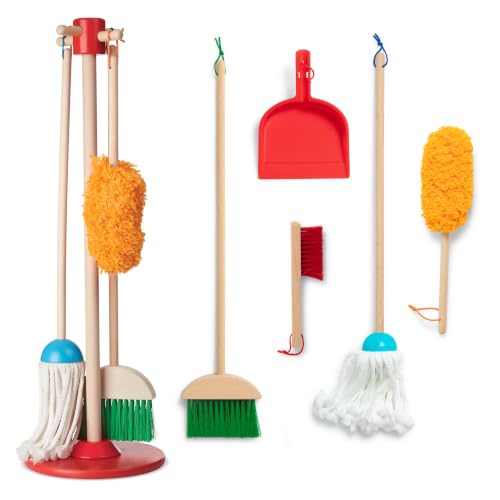
This 6-piece wooden cleaning set includes a broom, mop, duster, brush, and a red dustpan that clips onto the handles, plus a sturdy storage stand to keep everything tidy. It’s designed to boost confidence and fine motor skills through hands-on tasks, making it a natural fit for families who want Montessori-style learning at home. If your child loves to copy your chores, this gives them the tools to do it safely and independently.
The cleaning set stands 30 inches tall with its wooden stand, so it needs floor space and won’t fit in a drawer, something to consider if you’re short on room. For kids who love mimicking grown-up chores, the realistic broom, mop, and duster encourage hours of pretend play while building independence and responsibility. Reviewers note the sturdy storage stand keeps everything organized, making cleanup part of the fun. Designed for ages 3 and up, it’s a purposeful toy for learning life skills through hands-on role play.
Melissa & Doug Pattern Blocks and Boards

What We Like
- 120 wooden tiles for varied play
- 5 double-sided puzzle boards
- Portable storage box included
- Develops spatial awareness and math skills
Trade-offs
- Only 5 pattern boards limit variety
With 120 multi-colored wooden shape tiles and five double-sided puzzle boards, this set gives kids plenty of pieces to sort, stack, and match. It’s a screen-free activity that teaches early math concepts through pattern solving, so it fits well for preschoolers who need structured yet open-ended play.
The trade-off here is weight: at 2.2 pounds, the box is sturdy but not something a young child will carry around easily. The PlanToys Balancing Cactus focuses on stacking and balance, while this Melissa & Doug set offers a larger number of pieces for shape recognition. If your child enjoys puzzles and you want a self-contained activity, this is a practical pick. For very small hands or on-the-go portability, a lighter toy might be better.
Product photos
Joyreal Wooden Montessori Hammering Toy

What We Like
- Four activities in one compact set
- Neutral colors reduce visual overstimulation
- Includes two hammers for shared play
- Smooth, polished edges for safety
Trade-offs
- Compact size limits space for multiple children playing simultaneously
- No built-in storage for loose pieces like fishing game items
Four distinct activities in a single wooden frame means you get a pounding bench, xylophone, magnetic fishing game, and gear spinner without needing four separate toys. That saves shelf space and keeps a toddler from bouncing between scattered pieces. The neutral color palette is a deliberate design choice: softer browns and creams instead of the usual primary-bright rainbow, which helps maintain a calmer play environment and keeps a child focused on one activity longer. For parents who want Montessori-style variety without the clutter, this is a smart, compact solution that covers motor skills, music, and problem-solving in one box.
The trade-off is that at 10.4 inches wide, the play surface is compact. Two children can sit side by side with the included pair of hammers and mallets, but they’ll be working in a tight space. The Joyreal set includes four activities in one frame, which saves shelf space but means you’ll need to keep track of the fishing pieces and xylophone mallet separately. If your priority is a versatile, space-efficient toy that encourages turn-taking and quiet focus, this one delivers. Just plan for a little organization on the side.
Product photos
Tiny Land Montessori Sensory Play Kit
What We Like
- 5-in-1 wooden sensory set
- Includes body board book
- Expert parenting guide included
- Sustainable materials construction
Trade-offs
- Only covers a 3-month age window
- No batteries or electronic features
- Small pieces require adult supervision
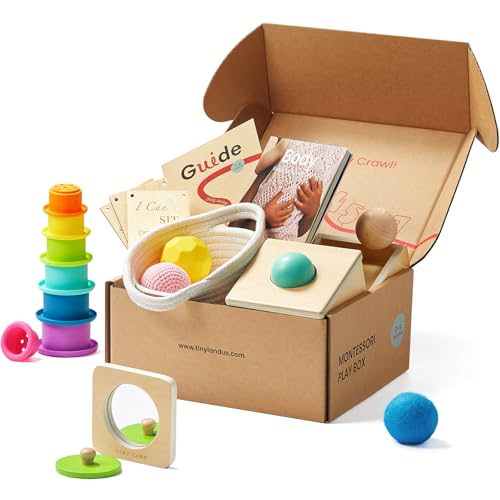
A 5-in-1 wooden design covers multiple developmental areas without cluttering your shelf with separate toys. For babies 7-9 months, the Object Permanence Box teaches cause and effect, the Sensory Ball encourages tactile exploration, and the Mirror Puzzle supports self-recognition. The included Body Awareness Board Book helps babies recognize hands, feet, and facial features, supporting early language and self-awareness development. The expert parenting guide provides practical tips and activities to enrich your baby’s learning journey. This set is a focused, age-targeted solution for early sensory and cognitive growth, not a generic toy bin.
The narrow age range is its main limitation: once your baby hits 10 months, many of these activities lose their challenge. The PlanToys Balancing Cactus is designed for toddlers up to age 3, so this kit has a shorter intended age window. But if you’re looking for a purpose-built introduction to Montessori play for a 7-9 month old, the sustainable wood construction and activities developed with Montessori experts make it a thoughtful choice. Just plan to rotate it out sooner than some broader sets.
Product photos
WOODMAM 9-in-1 Educational Play Kit

What We Like
- 9 different activities in one set
- Develops motor, sensory, and cognitive skills
- Made from durable natural wood
- Smooth finish with non-toxic paint
Trade-offs
- At 5.7 pounds, it's heavy for a toddler toy
- Targets 13-18 months, limiting use as child grows
Nine games in one box means you’re not cycling through single-purpose toys every few months. This set covers coin drop, carrot harvest, color matching, pounding bench, xylophone, shape puzzle, stacking blocks, and two mini books. That’s enough variety to keep a 13- to 18-month-old engaged while targeting vision, hearing, and fine motor skills at different stages. The natural wood construction with non-toxic paint gives me confidence it’ll survive the inevitable drops and throws without splintering. That’s exactly what I look for when outfitting a play space for toddlers who explore with their mouths as much as their hands.
Weight and longevity are the main drawbacks. At 5.7 pounds, this kit is hefty; a wobbly toddler could tip it over, and it’s not something they’ll carry around easily. And while the 9-in-1 approach is smart for that narrow 13-18 month window, the set is designed specifically for that stage. If you want a concentrated burst of developmental play for the second year, this kit delivers. If you’re hoping for something that stretches into preschool, you’ll be shopping again sooner.
Product photos
TOOKYLAND 8-in-1 Learning Set

What We Like
- 6 Montessori toys in one set
- Includes parent instruction manual
- Natural wood with non-toxic paint
- Targets sensory development stages
Trade-offs
- Only 6 toys, fewer than some 9-in-1 kits
- No xylophone or fishing game included
- Limited to 12-18 month developmental range
The set includes six basic toys, a shape puzzle, stacking cups, pound bench, 3-in-1 educational box, picture book, and wooden stacker, enough variety to keep a one-year-old engaged without overwhelming them. The included parent guide provides an introduction to product functions and how to play, which can help babies explore their environment. This educational toy set can develop skills at different stages, such as vision, sound, touch, motor skills, problem-solving, social emotional, and logical thinking, making it a practical choice for families seeking a structured play experience.
You get only six toys here, fewer than some 9-in-1 kits like the WOODMAM 9-in-1 Educational Play Kit, which includes more activities for a similar age. And because the toys are designed for babies 12-18 months, you might outgrow the set faster than a broader-range option. Still, the natural wood and non-toxic water paint ensure safety, and the parent guide helps you introduce each activity purposefully. It’s a straightforward starting point for Montessori-style play.
Product photos
Lovevery The Babbler Play Kit

What We Like
- 8 stage-based play products included
- Bonus board book builds fine motor skills
- Focuses on object permanence and spatial awareness
- Slide & Seek Ball Run teaches cause and effect
Trade-offs
- Targeted at 1-year-olds only, not older toddlers
- 8-piece kit requires more storage space than a single toy
The Lovevery The Babbler Play Kit includes eight stage-based play products, with the Slide & Seek Ball Run as a key toy that introduces object permanence. The Bunnies in a Felt Burrow helps toddlers practice bilateral coordination and containment, while the Circle of Friends Puzzle supports shape awareness. The bonus board book ‘Where is Crew’s Shoe?’ involves lifting flaps and using fine motor skills. This kit is designed for one-year-olds and offers a set of toys that target specific developmental skills at that age.
The Babbler Play Kit is rated as Lovevery’s #1 play kit, so it’s a top choice for parents of one-year-olds. It comes with eight play products, including the Slide & Seek Ball Run and a bonus board book, ‘Where is Crew’s Shoe?’, which helps toddlers practice fine motor skills by lifting flaps. The kit focuses on stage-based development, introducing concepts like object permanence through the ball run and bilateral coordination with the Bunnies in a Felt Burrow. For a parent who wants a single, thoughtful purchase that covers multiple developmental skills for a 12-month-old, it delivers.
Lovevery Montessori Organic Ball

What We Like
- Organic cotton construction
- Designed for 12+ weeks
- Supports tummy time development
- Easy-to-grasp segmented panels
Trade-offs
- Limited to very young babies only
- No sound or interactive features
The Lovevery Montessori Organic Ball is built for one job: helping babies from 12 weeks old build strength during tummy time. Its soft, segmented panels are sized for tiny hands, so your little one can practice grasping and holding while reaching, rolling, and lifting. Made from organic cotton and baby-safe materials, it gives you peace of mind during everyday play. This ball is a focused tool for early motor milestones, not a flashy distraction.
That focus means it won’t grow with your child the way a stacking toy or pattern set might. Compared to the PlanToys Balancing Cactus, which is designed for children ages 3 and up, this ball is a short-term helper for the first few months of tummy time. If you want something that lasts from infancy into toddlerhood, look elsewhere. But if you need a safe, simple way to make tummy time easier and more engaging for a newborn, this is exactly what it promises.
Product photos
PlanToys Wooden Baby Push Car

What We Like
- Soft, flexible body for tactile growth
- Rolling motion boosts gross motor skills
- Calming pastel colors reduce overstimulation
- Safe, earth-friendly materials
Trade-offs
- No sound or lights for babies who need audio stimulation.
A 0.3-pound car with a soft, bendable body means tiny hands can easily grip, squeeze, and release, building fine motor coordination through cause-and-effect play. The rolling motion encourages crawling and chasing, which strengthens large muscle groups and hand-eye coordination. This makes it a strong pick for parents who want a simple, sensory-driven toy that respects Montessori principles of self-paced discovery without flashing lights or noises.
The PlanToys Wooden Baby Push Car weighs just 0.3 pounds, so it’s light enough for a six-month-old to push around the floor without frustration. Its soft, flexible body compresses when squeezed and springs back, giving tiny hands rich tactile feedback that builds fine motor skills. The pastel colors are deliberately soft on developing eyes, creating a calm play environment rather than a visually overwhelming one.
How We Evaluated Montessori Toys
We built this list by examining manufacturer specifications, material safety data, and the developmental milestones each toy claims to support. Expert round-ups from early childhood educators and occupational therapists informed our criteria, and we looked for consistent patterns in owner feedback about durability, engagement, and whether children returned to the toy over time.
Four criteria mattered most. First, material safety: we prioritized toys made from natural wood, organic cotton, or non-toxic paints with smooth, polished edges. Second, open-ended play value: a Montessori toy should invite multiple ways to play rather than a single correct outcome. Third, age alignment: the toy must match the child’s fine motor, cognitive, and sensory stage without being too simple or too frustrating. Fourth, construction quality: pieces must survive drops, throws, and the enthusiastic handling of young children.
A research-led evaluation has limits. We cannot tell you how a specific child will react to a toy, and individual play preferences vary widely. What we can do is give you a clear framework for comparing options so you can choose an educational toy with confidence.
What To Look For In Montessori Toys
The right Montessori toy feels simple but teaches something real, balance, grip, cause and effect, without flashing lights or batteries. Here is what to check before you buy.
Focus on natural materials, open-ended play potential, and a clear match to your child’s developmental stage. Avoid anything that does most of the work for the child.
Material and Safety
Montessori philosophy favors natural materials, wood, cotton, wool, over plastic. Look for solid rubberwood, beech, or maple with non-toxic, water-based paints or organic stains. Edges should be smooth to the touch, and small parts must be large enough to pose no choking hazard for your child’s age. Many of our picks, like the PlanToys Balancing Cactus, use eco-conscious rubberwood with organic pigments.
Open-Ended Play Value
A toy with one correct answer teaches a single skill. A toy with no fixed outcome, like a set of pattern blocks or a balancing cactus, teaches problem-solving, creativity, and persistence. The best open-ended toys invite the child to experiment, fail, and try again without frustration. If a toy has a “right way” and a “wrong way,” it is less Montessori-aligned.
Age and Developmental Fit
A toy that is too advanced frustrates; one that is too simple bores. For babies under 12 months, focus on sensory input and grasp, the Lovevery Montessori Organic Ball or the PlanToys Wooden Baby Push Car work well. For toddlers, Montessori toys for 2 year olds like pattern boards or hammering sets build fine motor control. For preschoolers, Montessori toys for 3 year olds introduce practical life skills and more complex spatial challenges.
- Check the manufacturer’s age recommendation and compare it to your child’s current motor skills, not just their birthday.
- Look at the number of pieces, more pieces often mean more play variety but also more cleanup.
- Consider storage: does the toy come with a box, bag, or stand, or will you need to provide one?
- Read the “best for” and “not ideal for” notes in each review to see if the toy fits your space and play style.
A Montessori toy that matches your child’s current ability and invites them to stretch just a little is worth more than a shelf full of toys that do the thinking for them.
Montessori Toys Compared
The table below compares all 10 picks side by side so you can quickly see which toy fits your child’s age, skill focus, and your home’s space and storage needs.
| Product | Dimensions | Material | Age Range |
|---|---|---|---|
| PlanToys Balancing Cactus Wooden Toy | 9.3 x 9.3 x 8.6 in | Sustainably harvested rubberwood | 3+ years |
| Melissa & Doug Cleaning Pretend Play Set | 4.2 x 9.7 x 30.0 inches | Wooden | Ages 3+ |
| Melissa & Doug Pattern Blocks and Boards | 12.8 x 8.7 x 1.6 inches | N/A | N/A |
| Joyreal Wooden Montessori Hammering Toy | 10.4 x 5.9 x 5.6 in | Natural wood, non-toxic water-based paint | 12 months and up |
| Tiny Land Montessori Sensory Play Kit | 9.4 x 5.1 x 11.4 in | Sustainable wood | 7-9 months |
| WOODMAM 9-in-1 Educational Play Kit | L 16.3 x W 5.6 x H 8.8 in | Natural wood, non-toxic water paint | 13-18 months |
| TOOKYLAND 8-in-1 Learning Set | L 10.6 x W 5.5 x H 12.6 in | Natural wood, non-toxic water paint | 1+ year old |
| Lovevery The Babbler Play Kit | 8 x 8 x 10 inches | N/A | 1-year-olds |
| Lovevery Montessori Organic Ball | N/A | Organic cotton | 12+ weeks |
| PlanToys Wooden Baby Push Car | L 3.3 x W 3.9 x H 2.8 in | Sustainably harvested rubberwood | 6+ months |
Frequently Asked Questions
What makes a toy Montessori?
A Montessori toy is designed for self-directed, hands-on learning. It typically uses natural materials, has a single clear purpose or invites open-ended exploration, and lets the child discover the correct use through trial and error rather than instructions or electronic feedback.
At what age should I start Montessori toys?
Montessori play can begin as early as 12 weeks with sensory-safe items like the Lovevery Organic Ball. Most Montessori toys target specific windows, 7 to 9 months for sensory kits, 12 to 18 months for hammering and stacking sets, and 2 to 4 years for pattern work and practical life activities.
How many Montessori toys does a child need?
Fewer is better in Montessori philosophy. A small rotation of three to five well-chosen toys, each targeting a different skill, keeps a child engaged without overwhelming them. Swap toys every few weeks to renew interest.
Are Montessori toys only made of wood?
Wood is traditional and common, but Montessori materials also include organic cotton, metal, and natural rubber. The key is that materials feel real and varied, not plastic that mimics something else. The Lovevery Organic Ball and PlanToys Push Car both use soft, non-wood materials.
Can Montessori toys help with developmental delays?
Montessori toys support fine motor, sensory, and cognitive development through repeated practice, which can benefit children working through delays. Always consult your pediatrician or an occupational therapist for a plan tailored to your child’s specific needs.
The Bottom Line
The PlanToys Balancing Cactus Wooden Toy is our best overall pick for families who want a single, beautiful, open-ended toy that builds patience, fine motor control, and early STEM thinking. It works best for children age 3 and up who are ready for a gentle challenge.
If your child is younger or you need a more targeted approach, the right pick changes. For babies under 12 months, the Tiny Land Sensory Play Kit or the Lovevery Organic Ball offer safe, stage-specific play. For toddlers, the Joyreal Hammering Toy or the WOODMAM 9-in-1 Kit deliver variety in a compact footprint. And for budget-conscious parents, the TOOKYLAND 8-in-1 Learning Set covers the essentials without extras you will not use.
The single most important factor is age alignment. A toy that matches your child’s current developmental stage will engage them longer, teach them more, and earn its place in your home. Start there, and the rest follows.
