
10 Best Interactive Toys For Children’s Development in 2026
This post contains affiliate links. As an Amazon Associate, we earn from qualifying purchases.
The best interactive toy for children’s development is the LeapFrog 2-in-1 LeapTop Touch, which wins for its two-in-one keyboard and tablet modes that adapt as a child’s skills grow. For bilingual families, the VTech Genio Bilingual JuniorBook Learning Laptop offers 80+ activities in two languages, while the Melissa & Doug First Bead Maze is our budget-friendly pick for building fine motor skills.
Parents looking for toys that actually support development face a sea of flashy lights and vague claims. The real challenge is finding a toy that matches a child’s current stage, not so simple that it bores them, not so complex that it frustrates them.
This guide is research-based, drawing on manufacturer specifications, expert round-ups, and patterns in owner feedback. We evaluated each toy against the developmental milestones it claims to support, focusing on what real families report about engagement and durability.
Top 10 Interactive Toys For Children’s Development in the Market

Certain content that appears on this site comes from Amazon. This content is provided "as is" and is subject to change or removal at any time.
The Best Interactive Toys For Children’s Development, Reviewed
LeapFrog 2-in-1 LeapTop Touch

What We Like
- 2-in-1 keyboard and tablet modes
- Five learning modes cover ABCs, numbers, games, music, messages
- Customizable spelling for child's name
- Role-play e-mail activity with Scout
Trade-offs
- No bilingual or language-switching option
- Batteries included only for demo, not regular use
The flip screen that converts this toy from a keyboard to a touch tablet gives you two distinct play styles in one compact package. That 2-in-1 design means your child can practice letter and number typing on the keyboard side, then swivel it over for touch-based activities, keeping engagement fresh without needing a second device. With five learning modes covering ABCs, numbers, games, music, and messages, it covers the foundational skills that matter most for a preschooler’s development. The customizable name-spelling feature adds a personal touch that makes the learning feel like it’s just for them.
The included demo batteries are meant only for trying out the toy, so you will want to have fresh 3 AA batteries ready for regular use. Compared to the VTech Genio Bilingual JuniorBook, this LeapFrog is lighter at 1.3 pounds versus 1.9 pounds, which makes it easier for a toddler to carry. However, the compact design means the screen is smaller, and children near the top of the 2-5 age range may find it less comfortable for longer play sessions. It is a focused, well-rounded first laptop that hits the sweet spot for early learners.
VTech Genio Bilingual JuniorBook Learning Laptop
What We Like
- Full-size QWERTY keyboard
- 80+ bilingual activities pre-loaded
- No internet needed
- Includes calendar and music apps
Trade-offs
- Requires 4 AA batteries for regular use
- No internet means no content updates
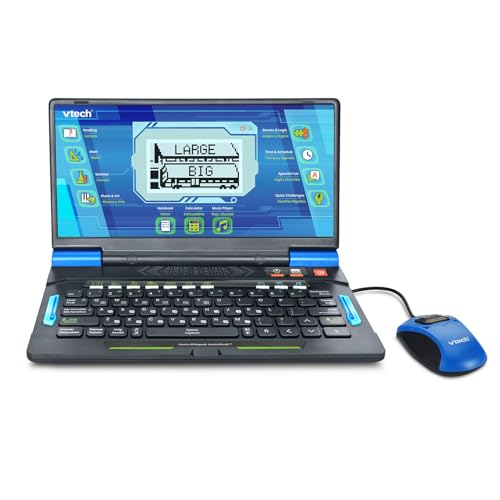
Over 80 pre-loaded activities in two languages mean a child can switch between English and Spanish without ever needing a Wi‑Fi signal. That’s the whole point of a bilingual laptop that works offline: immersion happens on the car ride, at the kitchen table, or during a rainy afternoon. The full‑size QWERTY keyboard and cursor controller mimic a grown‑up computer, so a five‑year‑old builds typing and navigation skills while exploring math, science, language arts, music, and even a weekly calendar app. It’s a self‑contained learning station for families who want consistent, screen‑free language practice without worrying about content filters or data caps.
The trade‑off is that all those activities are fixed, there’s no way to download new ones or connect to the internet for updates. If your child blazes through 80 games quickly, the laptop becomes a static toy rather than a growing library. The VTech Genio suits the parent who wants a dedicated, distraction‑free bilingual tool for a school‑age child, not a toy that expands over time. For that focused purpose, it delivers exactly what it promises.
LeapFrog Mr Pencil's Scribble Write and Read

What We Like
- Step-by-step uppercase and lowercase letter writing
- Numbers transform into countable objects
- Custom name entry for personal practice
- Sound-it-out bar for word sounding
Trade-offs
- Demo batteries only; fresh ones needed for regular use
- No reading or spelling beyond letter tracing
- Screen-based; no tactile letter formation feedback
A 0.9-pound interactive toy that guides kids through writing uppercase and lowercase letters one stroke at a time, then turns each letter into an animated animal or object. That transformation keeps the process playful rather than drill-like, which is exactly what a three-year-old needs to stay engaged. The ability to enter a child’s first, middle, and last name means they practice something personally meaningful, not just random letters. For parents focused on early writing skills, this is the tool that makes the connection between tracing and real writing click.
The learning is entirely screen-based, so there’s no physical pencil grip or paper resistance to build fine motor strength. It requires three AA batteries right out of the box, demo batteries are included, but you’ll want fresh ones for consistent use. If your child needs to build hand strength alongside letter recognition, consider supplementing with other activities.
VTech Busy Learners Activity Cube
What We Like
- 5 sides of play encourage exploration
- Motion sensor rewards crawling movement
- 25 songs and melodies keep kids engaged
- Volume control and auto shut-off
Trade-offs
- AAA demo batteries included, not long-life
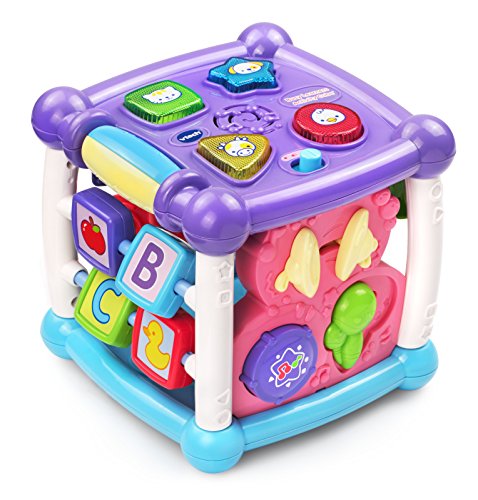
A motion sensor that triggers sounds when the cube is moved turns this into a crawling motivator, not just a sit-and-play toy. That sensor, combined with five sides of activities and 14 interactive features, makes it especially useful for babies learning to sit up and then take those first scoots across the floor. The four light-up buttons teach animal names, sounds, and shapes, while the 25 built-in songs keep little ones from losing interest after five minutes. For a child working on early motor milestones, this cube rewards movement instead of just passive button-pressing, which is a smarter design than many activity centers that stay put.
The cube measures 6.2 inches per side, so it’s compact enough for a baby to grab and carry. But the 6.5-inch height means it’s best for floor play rather than tabletop use. Compared to the Baby Einstein Ocean Explorers Go Opus Go 4-in-1 Crawl & Chase Activity Toy, which is designed for crawling and chasing play, this cube stays in one place and relies on the child’s own motion to trigger sounds. That makes it a gentler, more predictable option for early sitters and crawlers, but less of a chase game for kids already on the move.
Fisher-Price Little People Caring for Animals Farm Playset
What We Like
- 45+ songs and phrases for storytelling
- 3 Smart Stages adapt as child grows
- Multiple play points for fine motor skills
- Figures sized for small hands
Trade-offs
- At 23.4 inches wide, needs floor space
- No bilingual or Spanish language options
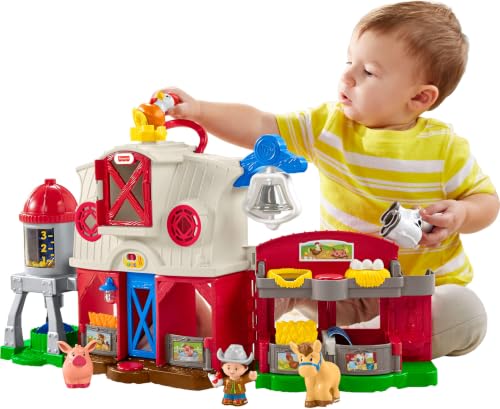
With 45+ songs, sounds, and phrases packed into a single playset, this farm keeps toddlers engaged without needing a parent to narrate every move. The Smart Stages feature adjusts the learning content as your child grows, teaching counting, opposites, animal sounds, and colors through fresh songs at each level. It’s ideal for little ones aged 1 to 5 who are ready to build fine motor skills by grasping the small farmer, animals, and food pieces. They can press buttons, drop figures through the hayloft, and spin the silo. The familiar farm setting gives them a natural stage for imaginative storytelling, and the interactive prompts keep the play moving forward.
At 23.4 inches long, this playset takes up a good amount of floor or table space, so it’s not a tuck-away toy for tight apartments. Compared to the compact LeapFrog 2-in-1 LeapTop Touch, which is only 10.1 inches wide, the farm is noticeably larger. But if your child loves animals and you want a toy that grows with them through three learning levels, the extra space is worth it. The multiple play points, barn door, hayloft, light, chicks, and corn silo, offer variety that can keep a toddler engaged.
Product photos
Grarain Busy Board for Toddlers
What We Like
- 23 vibrant LED lights and switches
- Montessori-inspired color and number recognition
- Compact 6.7 x 5.3 x 1.1 inch size
- Rounded edges and low-brightness lighting
Trade-offs
- Requires 2 AAA batteries (not included)
- No sound or music features for auditory learning
- Limited to visual and tactile interaction only
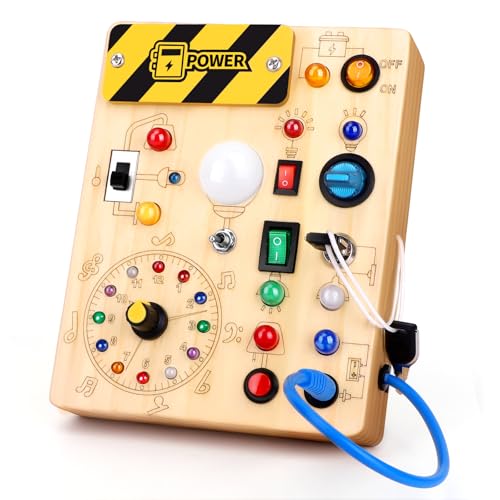
This busy board is compact enough to slip into a diaper bag or purse without a second thought, so you can keep a toddler occupied at a restaurant, on a plane, or during a long church service. The 23 LED lights and multiple switches give little fingers plenty to explore. The Montessori-inspired layout helps build color and number recognition while they fiddle. It’s a quiet, screen-free activity that travels well, though you’ll need to supply your own AAA batteries.
This board is purely visual and tactile: no sounds, songs, or spoken prompts, which means it won’t hold the attention of kids who crave audio feedback. If your child learns best through hearing and repeating, a toy with sound features might be a better fit. But if you value a durable, lightweight, no-fuss toy that fits in a coat pocket and keeps a curious 1-3 year old busy without batteries dying mid-trip, this wooden board delivers exactly that.
Product photos
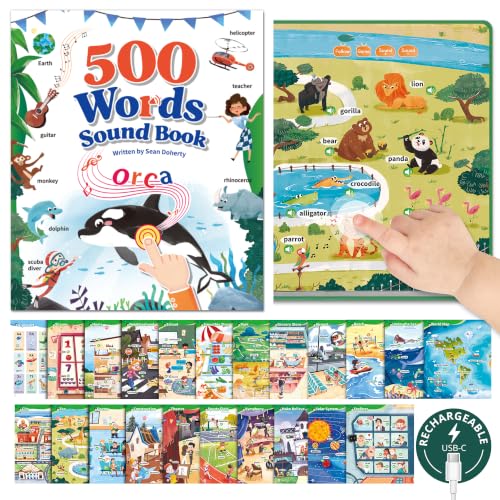
Timetome 500 Words Sound Book
What We Like
- 500 high-frequency core words
- Touch-activated sound and visual cues
- Screen-free interactive learning
- Structured progression from letters to usage
Trade-offs
- Must be used flat on a stable surface
- Requires power switch to be turned on manually
- No audio if page start button not pressed
500 carefully selected core words across 23 themes means this book doesn’t just throw random vocabulary at kids, it builds from letters to words to practical sentences. That structure makes it a real tool for language development, especially for ages 3 to 8 where kids are ready to move beyond passive listening. The touch-activated sound and visual cues let children explore independently, which is exactly what you want when you’re trying to encourage focus and memory without hovering over them every second.
It needs to sit flat on a table for the touch sensors to work well, so it’s not something you’ll toss in a backpack for car rides. If your child can sit at a table or desk for short learning sessions, the depth of content here is hard to beat for building real word recognition and pronunciation.
Product photos
Melissa & Doug First Bead Maze

What We Like
- Suction base holds steady on surfaces
- 18 beads and 3 rings for varied play
- Smooth wood and soft-coated wires
- Encourages pushing, pulling, grasping
Trade-offs
- Only one activity type limits extended engagement
- No lights or sounds for auditory feedback
A suction cup base that grips a high chair tray or tabletop means this bead maze stays put while little hands explore 18 beads and 3 rings across four looping wires. That steady platform is exactly what you want for a baby who’s still mastering controlled arm movements; the toy doesn’t slide away, so frustration stays low and focus stays on the sliding and spinning. It’s a straightforward, durable piece that targets fine motor control and cause-and-effect learning without any batteries or screens.
Babies explore four looping wires with 18 beads and 3 rings that slide and spin, encouraging pushing, pulling, and grasping motions. This single-activity design means once a child masters the bead paths, there is not much new to discover. The wooden beads and blocks are smooth, and the wires have a soft coating for safe sensory play. A secure suction base holds the toy steady on a table, high chair tray, or floor, keeping the beads within reach. Sliding and spinning actions strengthen fine motor control, hand-eye coordination, and problem-solving while introducing shapes, colors, and cause-and-effect learning. Melissa & Doug has inspired kid-powered play for over 35 years with toys like this one.
Baby Einstein Ocean Explorers Go Opus Go 4-in-1 Crawl & Chase Activity Toy
What We Like
- Four play modes grow with baby
- Teaches numbers, shapes, colors, opposites
- Sensor triggers chase mode
Trade-offs
- Requires 3 AA batteries (not included)
- Dance mode only has one song
The four modes. Tummy Time, Sit & Play, Chase, and Dance, let this toy grow with a child from infant tummy sessions to preschool dance parties. In Tummy Time, touching one arm makes Opus light up, spin, and play music, which encourages reaching and head lifting. With over 150 songs and phrases teaching numbers, shapes, colors, and opposites, the learning adapts as your child develops. The sensor in Chase mode makes Opus run away, turning crawling into an active game that builds motor skills.
This toy asks for batteries (three AAs, not included) and the dance mode only plays one song on repeat, which might test a parent’s patience. Compared to the VTech Busy Learners Activity Cube, which also targets similar ages but stays stationary, the Go Opus Go offers more physical interaction and movement. If your child is already crawling or walking and loves a chase, this is the more engaging pick. For families who prefer a quieter, sit-down activity, the cube might be a better fit.
Product photos
SAIMAND Interactive Crawling Crab Baby Toy

What We Like
- 40 songs and voice recording
- USB rechargeable, no batteries
- Soft plush material for safety
- Crawling motion encourages movement
Trade-offs
- No volume control mentioned for quiet play
- No adjustable volume for quiet playtimes
With 40 songs and a voice recording feature packed into a crawling, dancing plush toy, this crab turns tummy time into an active chase game that builds neck strength and hand-eye coordination. The soft fabric is gentle on little hands, and the USB rechargeable design means you won’t be hunting for batteries every week. It’s a great fit for babies who need motivation to crawl and explore, especially during early sensory play sessions where sound and movement spark curiosity.
The plush fabric is soft and safe for cuddling, but unlike hard plastic toys, it may require more frequent cleaning to keep it fresh. It’s best suited for babies who are just starting to crawl and need motivation to move.
Product photos
How We Evaluated Interactive Toys For Children’s Development
We started by reviewing manufacturer specifications and developmental claims for each toy, then cross-referenced those against expert round-ups from pediatric play specialists and early childhood educators.
The three criteria that mattered most were age-stage alignment, depth of engagement, and skill variety. A toy that claims to teach letters but only offers one mode won’t hold a child’s attention long enough to build real familiarity. We prioritized toys with multiple play modes or progressive difficulty, like the LeapFrog 2-in-1 LeapTop Touch, which switches between keyboard and tablet learning.
A research-based evaluation has limits. Our recommendations come from comparing specs, studying expert consensus, and weighing what hundreds of owners report. For deeper dives into specific categories, check our guide to interactive toys for more options.
What To Look For In Interactive Toys For Children’s Development
Choosing the right interactive toy means matching the toy’s features to your child’s current developmental stage and your own priorities around screen time, noise, and portability.
Look for toys that offer multiple ways to play, grow with your child through adjustable difficulty, and target specific skills like fine motor control, vocabulary, or cause-and-effect understanding.
Age-Stage Alignment
The single most important factor is whether the toy fits your child’s current developmental window. A toy that is too advanced will frustrate; one that is too simple will be ignored. For babies 6 to 18 months, toys like the VTech Busy Learners Activity Cube use motion sensors and cause-and-effect responses to encourage crawling.
For preschoolers, the LeapFrog Mr Pencil’s Scribble Write and Read targets letter formation step by step. Always check the manufacturer’s age range, but also watch for adjustable difficulty levels, the Fisher-Price Little People Farm uses Smart Stages technology to change content as your child grows.
Depth of Engagement
The best developmental toys keep a child coming back. A single-mode toy may hold attention for a few minutes, but toys with multiple play modes or progressive challenges sustain engagement over weeks. The LeapFrog 2-in-1 LeapTop Touch offers five learning modes, from ABCs to games to pretend e-mail, giving a toddler new things to discover as their skills advance. The Timetome 500 Words Sound Book structures vocabulary from simple letters to full usage, so a 3-year-old and an 8-year-old can both find value.
Skill Variety and Sensory Input
A good interactive toy should engage more than one sense and more than one skill. The Baby Einstein Ocean Explorers 4-in-1 toy transitions from tummy-time lights to chase-mode motion, teaching numbers, shapes, colors, and opposites along the way. For purely tactile and visual learning, the Grarain Busy Board offers 23 LED lights and switches in a compact, screen-free format. Consider whether your child needs auditory feedback (songs, spoken words), visual stimulation (lights, colors), or tactile exploration (buttons, beads, switches).
- Does the toy offer at least two distinct modes or activities?
- Can the difficulty adjust as your child’s skills improve?
- Does the toy require batteries, and are they included for regular use or just demo?
- Is the toy portable enough for car rides or restaurant outings?
- Does the toy’s sound level have a volume control or mute option?
A toy that a child can master completely in one sitting is not a developmental toy, it is a distraction. Look for something they will need to grow into.
Interactive Toys For Children’s Development Compared
The table below compares all ten interactive toys side by side, highlighting their best use, key features, and who each one suits best.
| Product | Age Range | Dimensions | Weight |
|---|---|---|---|
| LeapFrog 2-in-1 LeapTop Touch | 2-5 years | 2.0 x 10.1 x 6.0 inches | 1.3 pounds |
| VTech Genio Bilingual JuniorBook Learning Laptop | 5+ years | 11.3 x 7.5 x 7.5 inches | 1.9 pounds |
| LeapFrog Mr Pencil's Scribble Write and Read | 3+ years | 2.0 x 7.7 x 8.6 in | 0.9 pounds |
| VTech Busy Learners Activity Cube | 6 months, 3 years | 6.2 x 6.2 x 6.5 in | 1.4 lb |
| Fisher-Price Little People Caring for Animals Farm Playset | 1+ years | 23.4 x 5.3 x 7.3 inches | 1.0 pounds |
| Grarain Busy Board for Toddlers | 1-3 Year Old | 6.7 x 5.3 x 1.1 inches | N/A |
| Timetome 500 Words Sound Book | Ages 3-8 | 16.3 x 12.3 x 0.1 inches | N/A |
| Melissa & Doug First Bead Maze | Ages 1+ | 8.7 x 8.1 x 4.1 inches | 1.2 pounds |
| Baby Einstein Ocean Explorers Go Opus Go 4-in-1 Crawl & Chase Activity Toy | 3 months to 5 years | 9.4 x 9.4 x 9.0 inches | 1.6 pounds |
| SAIMAND Interactive Crawling Crab Baby Toy | N/A | 8.7 x 5.9 x 5.9 inches | N/A |
Frequently Asked Questions
What is the best interactive toy for a 2-year-old?
The LeapFrog 2-in-1 LeapTop Touch is the best choice for a 2-year-old because it switches between a keyboard and a tablet, offering five learning modes that cover ABCs, numbers, games, and pretend e-mail. It also lets parents customize the spelling of the child’s name, making the learning personal and engaging.
Are interactive toys good for brain development?
Yes, when chosen correctly, interactive toys support cognitive development by encouraging problem-solving, cause-and-effect reasoning, and fine motor skills. Toys that offer multiple modes or progressive difficulty, like the Fisher-Price Little People Farm with its Smart Stages, are especially effective because they adapt to a child’s growing abilities. For a deeper look, read our article on toys for brain development.
What is the difference between interactive toys and electronic toys?
All electronic toys are interactive, but not all interactive toys are electronic. Interactive toys respond to a child’s actions, a bead maze requires pushing beads along a wire, while a sound book plays words when a page is touched. Electronic toys specifically use batteries, lights, and speakers, like the VTech Busy Learners Activity Cube, which plays songs when motion sensors are triggered.
How do I choose an interactive toy for a child with sensory sensitivities?
Look for toys with adjustable volume, dimmable lights, or no sound at all. The Grarain Busy Board uses low-brightness LED lights with no audio, making it a good option for children who are easily overwhelmed by noise. The Melissa & Doug First Bead Maze is completely silent and tactile, relying on wooden beads and a suction base rather than electronic feedback.
Can interactive toys replace traditional play?
No, interactive toys are a supplement to, not a replacement for, traditional play like building blocks, drawing, and outdoor play. The best approach is a balanced mix: interactive toys can teach specific skills like letter recognition or cause-and-effect, while unstructured play builds creativity, social skills, and physical coordination. For more on choosing the right mix, see our guide to educational toys.
The Bottom Line
For most families, the LeapFrog 2-in-1 LeapTop Touch is the best overall interactive toy because it adapts from a keyboard to a tablet. It offers five learning modes and grows with a child from age 2 to 5. It is the one toy that covers the widest range of early academic skills in a single, durable package.
If your family needs bilingual learning, the VTech Genio Bilingual JuniorBook Learning Laptop provides 80+ activities in two languages without needing internet access. For parents on a tight budget, the Melissa & Doug First Bead Maze proves that a simple, well-made wooden toy can build fine motor skills just as effectively as a flashy electronic one.
The single most important factor when buying an interactive toy is age-stage alignment. A toy that matches your child’s current developmental window will engage them, teach them, and earn its place in your home. One that does not will sit in a corner.
