
10 Best Educational Toys For Kids in 2026
This post contains affiliate links. As an Amazon Associate, we earn from qualifying purchases.
The LeapFrog 100 Animals Book is our Best Overall pick because it teaches animal names, sounds, and facts across 12 categories in both English and Spanish, making it a truly screen-free learning tool for toddlers. For older kids who love building, the Snap Circuits Explorer SC-100 offers over 100 electronic projects, while the ThinkFun Gravity Maze challenges critical thinking through marble-run logic puzzles.
The hardest part of choosing an educational toy is matching the right challenge level to your child’s age and interests. A toy that is too simple bores quickly; one that is too advanced collects dust. We focused on picks that grow with a child or offer enough variety to stay engaging.
This guide is research-based, drawing on manufacturer specifications, expert round-ups, and patterns in owner feedback. We organized 10 picks by award so you can find the right fit for your child’s stage and learning style.
Top 10 Educational Toys For Kids in the Market
Certain content that appears on this site comes from Amazon. This content is provided "as is" and is subject to change or removal at any time.
The Best Educational Toys For Kids, Reviewed
LeapFrog 100 Animals Book
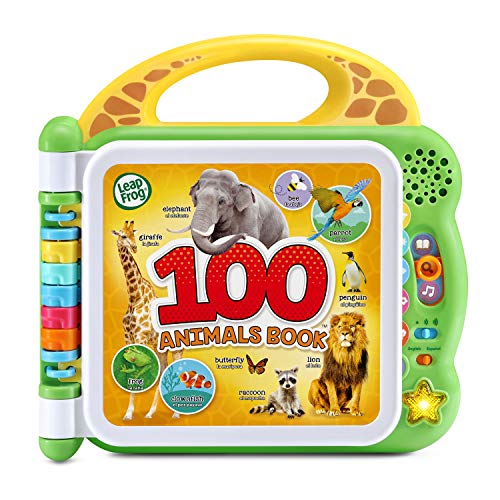
What We Like
- 12 animal categories across six pages
- Three play modes teach names, sounds, facts
- Fully bilingual English and Spanish
- Early science concepts through fun facts
Trade-offs
- Demo batteries included; new ones needed for regular use
- Limited to animal themes, no other subjects
- Targets only 18+ months, not older toddlers
Six double-sided pages cover 12 animal categories, giving a toddler a broad range of creatures to explore. Three play modes teach names, sounds, and fun facts, turning page-turning into an active learning experience. It is fully bilingual in English and Spanish, so it works naturally in homes raising little ones in either language or both. For parents looking for a first educational toy for a child 18 months and up, this book offers a solid, screen-free way to learn about animals.
The biggest trade-off is that the demo batteries are just for trying it out; you will want fresh ones before handing it over, or the fun stops fast. Compared to the Aullsaty Talking Flash Cards, which are lighter at 0.5 pounds, this book is heavier at 1.5 pounds, so it is best used on a lap or table. Ideal for toddlers who love animals and need a bilingual learning toy.
LeapFrog 2-in-1 LeapTop Touch

What We Like
- Flipping screen converts to tablet mode
- Keyboard covers A-Z and numbers 1-10
- Customizable name spelling for child
- Five learning modes for varied play
Trade-offs
- Demo batteries included; new ones needed for regular use
- Limited to preschool age range 2-5 years
A 2-in-1 design that flips from keyboard to tablet mode gives preschoolers two ways to play and learn, all in one toy. The keyboard covers letters A-Z and numbers 1-10, while the touch tablet mode offers a more modern feel. Five learning modes. ABCs, numbers, games, music, and messages, keep things fresh, and parents can customize the toy to help their child spell their own name. For a child just starting to explore letters and numbers, this laptop toy offers a structured, screen-based experience that mimics what they see parents using, without the complexity of a real device.
This toy is designed for ages 2-5, so it fits a preschooler’s learning stage perfectly, no need to worry about it being too advanced or too babyish. Batteries are included for demo purposes, but you’ll want fresh ones for regular play. It delivers a focused, age-appropriate experience that feels grown-up without overwhelming a young child.
Snap Circuits Explorer SC-100
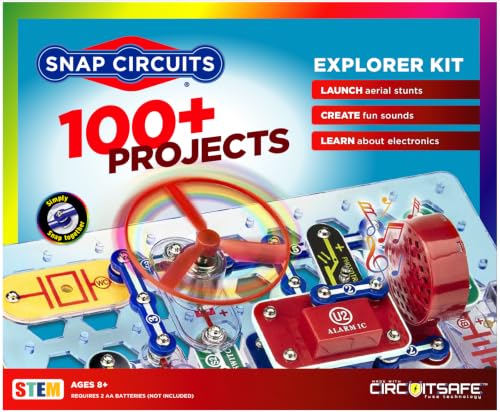
What We Like
- Build 100+ electronic projects
- No soldering or tools needed
- Color-coded, numbered snap parts
- Award-winning STEM kit
Trade-offs
- Batteries not included
- Projects require adult supervision for beginners
With 100+ projects packed into a single box, this kit turns abstract circuitry into something you can actually snap together and watch work. The 28 color-coded parts click onto a plastic grid without any soldering or tools, so an 8-year-old can build a flying saucer that lifts off or an alarm that sounds, and understand why it happens. That hands-on, immediate feedback is what makes it click for kids who learn by doing, especially those who might glaze over at a textbook diagram.
The trade-off is that this is a guided kit: you follow the manual’s projects rather than inventing your own circuits from scratch, which means creative exploration comes later. If your child is ready to follow instructions and enjoys the satisfaction of making something that actually works, this is where the real learning happens.
ThinkFun Gravity Maze

What We Like
- Builds critical thinking and problem-solving
- Endless marble run design possibilities
- Collaborative play with friends and family
- STEM-focused engineering challenges
Trade-offs
- Too challenging for children under 8
- Only 3 marbles included for play
With 9 towers, 3 marbles, and a target piece, Gravity Maze turns abstract logic into a hands-on engineering puzzle. Kids design marble runs that actually work, which means they’re learning cause and effect, spatial reasoning, and planning, all while chasing that satisfying clack of a marble hitting its target. It’s a STEM toy that builds critical thinking through play, aimed at kids ages 8 to 12.
The age floor is 8-12, so younger kids who want to join in are out of luck. Compared to the Snap Circuits Explorer SC-100, which also targets ages 8 and up, Gravity Maze focuses on building marble runs rather than electronic circuits. If your child prefers creative construction over step-by-step kits, this is the better fit.
Melissa & Doug Self-Correcting Alphabet Puzzle
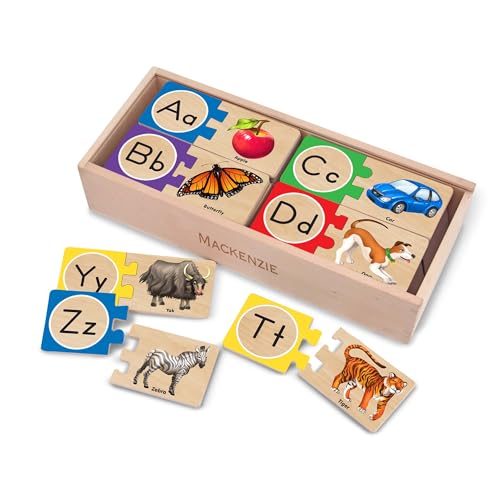
What We Like
- Self-correcting pieces build confidence
- Includes capital and lowercase letters
- Supports fine motor and problem-solving
- Comes with portable storage box
Trade-offs
- At 2.0 lb, less portable than lighter toys
- Focuses on letters only, not numbers or shapes
Fifty-two wooden pieces, each with a capital or lowercase letter and a labeled image, only fit with their correct match. So a child can test, try again, and discover the right answer without needing an adult to correct them. That self-correcting design makes this puzzle ideal for kids who are just starting to recognize letters and want to build confidence through repeated matching and sorting. It also supports vocabulary building, fine motor control, and problem-solving, all in one screen-free activity that packs away neatly in its own storage box for travel or cleanup.
Weight is a factor here: at two pounds, this is heavier than a set of flashcards or a tablet, so it’s better suited for tabletop play at home than for tossing in a diaper bag. Compared to the LeapFrog 100 Animals Book, which is lighter and battery-powered for on-the-go learning, the Melissa & Doug puzzle offers a more tactile, screen-free experience that encourages repeated matching and sorting. If you want a toy that builds letter recognition through physical manipulation and doesn’t require batteries, this is a strong pick.
Product photos
Melissa & Doug Shape Sorting Cube
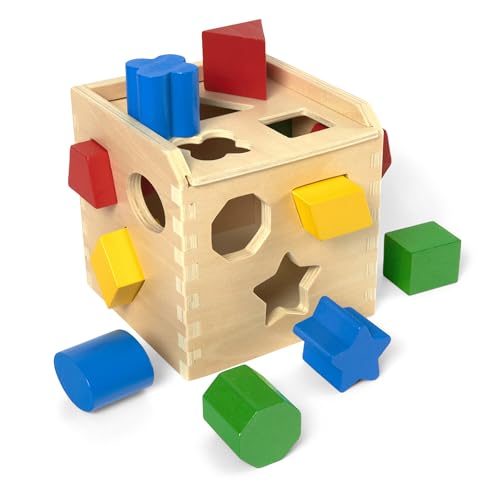
What We Like
- Sturdy wooden construction for long-lasting play
- 12 bright, easy-to-grip shapes for little hands
- Classic shape and color matching activity
- Promotes problem-solving and recognition skills
Trade-offs
- Only 12 shapes limits variety for older toddlers
- Cube is small (5.5 inches) for larger hands
A 5.5-inch wooden cube with 12 chunky shapes might sound simple, but that simplicity is exactly what makes this a staple for early learning. Each shape is designed to fit through only one matching hole, so your child gets immediate feedback on their sorting attempts. This builds color and shape recognition while also teaching problem-solving through trial and error. For a two-year-old just starting to make sense of categories, that direct cause-and-effect is pure gold. The sturdy wood construction means it can survive being dropped, thrown, or sat on, which, if you’ve ever watched a toddler play, you know matters. It’s a screen-free activity that asks nothing more than a child’s curiosity, and that’s a rare thing these days.
One limitation here is that once your child masters the 12 shapes, there’s no expansion pack or advanced level. You’re getting exactly what’s in the box: 13 pieces, one cube, one way to play. Compared to something like the LeapFrog 100 Animals Book, which offers hundreds of sound and word interactions, this toy has a narrower arc of engagement. That’s not a flaw, it’s a design choice. For the 2-to-4 age range, repetition is how skills stick. But if your child is at the younger end of that range, you might find yourself wanting more complexity sooner. It’s a classic for a reason, just know that its strength is depth, not breadth.
Aullsaty Talking Flash Cards
What We Like
- 224 words across 12 themes
- Screen-free speech therapy play
- Includes 3 nursery rhymes
- USB rechargeable and portable
Trade-offs
- No volume control mentioned for quiet environments
- Card-based play requires adult setup initially
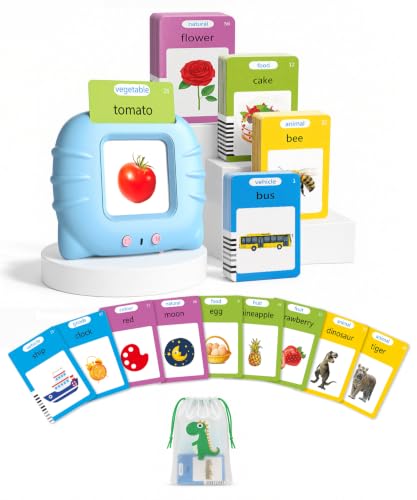
With 224 words across 12 everyday themes, this talking flash card reader gives toddlers a structured, screen-free way to build vocabulary and practice speech. The clear audio paired with colorful pictures lets kids hear a word, see the image, and repeat it at their own pace, a setup that works well for late talkers and early learners alike. It’s lightweight and USB rechargeable, so you can toss it in a diaper bag for car rides or restaurant waits without hunting for batteries.
One limitation is that the 12 themes are fixed, so once your child masters the 224 words, there’s no way to add more cards or switch categories. Compared to the LeapFrog 100 Animals Book, which is a different type of learning toy, this one is more focused on vocabulary building through card-based play. If your goal is targeted vocabulary building with sensory play, this is a solid tool, but if you want a more open-ended exploration toy, you might outgrow it faster.
Product photos
Momo & Nashi Grooved Writing Practice
What We Like
- 48 fun learning activities included
- Reusable with disappearing ink pens
- Grooved lines guide handwriting
- Spiral binding for durability
Trade-offs
- Ink disappears, so no permanent record
- Weighs 2.3 pounds, which is heavy for a toddler to carry
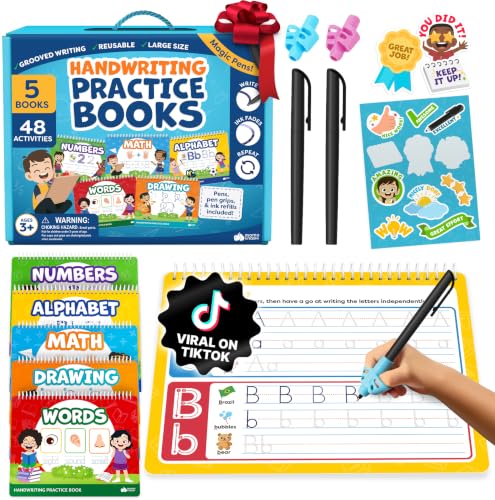
With 48 activities packed into five reusable books, this set gives a preschooler plenty of variety without needing a new toy every week. The grooved channels physically guide a child’s hand as they trace letters, numbers, and shapes. That is exactly what many kids need when they’re first figuring out how to hold a pencil and control their strokes. The disappearing ink means the books can be used over and over, so a child can practice the same letter until it clicks without wasting paper. That makes it a practical choice for parents who want something that lasts beyond the first few tries.
The set weighs 2.3 pounds, so it’s sturdy enough to stay put on a desk or table while a child works. That extra heft comes from the spiral-bound books and the included accessories, meaning it’s not something a toddler will carry around easily on their own. Also, because the ink fades, there’s no finished page to show off or keep as a record of progress. For a child who loves seeing their work stay put, that might be a small letdown. But for parents focused on building muscle memory and fine motor skills through repetition, this is a well-thought-out system.
Product photos
Learning Resources STEM Explorers Brainometry
What We Like
- 34 tactile puzzle blocks
- 10 progressive challenge cards
- Screen-free solo play
- Portable storage box
Trade-offs
- Only 10 challenge cards limit variety
- Solo play only, no multiplayer mode
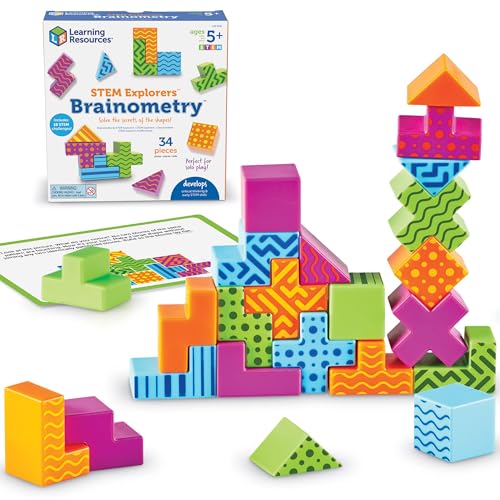
Thirty-four tactile blocks and ten double-sided challenge cards mean this puzzle game grows with your child’s developing spatial reasoning and logic skills. It’s designed for solo screen-free play that builds concentration and fine motor control, making it a strong pick for kids who enjoy working through problems at their own pace. The progressive difficulty levels keep it engaging without overwhelming younger players, and the compact storage box makes it easy to take along on trips or to the classroom.
Once your child works through all ten challenge cards, the replay value depends on their willingness to revisit puzzles from memory. That said, the lightweight blocks and durable coated cards hold up well to travel and regular use, and the self-contained design means no loose pieces scattered around the house.
Product photos
3Doodler Start+ Essentials 3D Pen Set
What We Like
- No hot parts, completely safe for kids
- Slimmer, easier-to-hold design
- Includes 72 strands of filament
- Screen-free STEM learning tool
Trade-offs
- Only works with 3Doodler Start plastic filaments
- Requires proprietary 3Doodler Start filament only
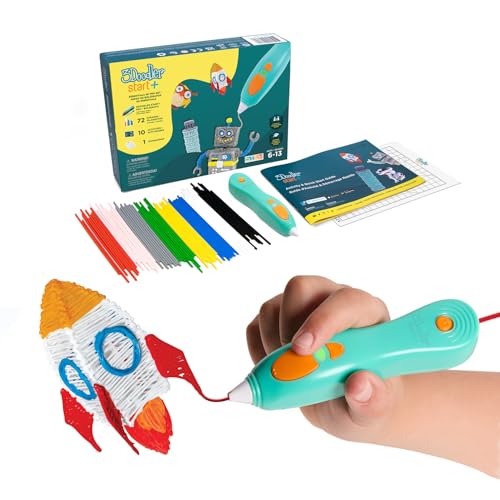
No hot parts mean a child can touch the nozzle and plastic without any burn risk, which is the core safety feature of the 3Doodler Start+. It’s designed so kids can focus on creating, not on avoiding hot parts. The slimmer grip and faster USB-C charging make it easier to hold and quicker to recharge, and the kit includes 72 strands of mixed-color filament to get started. This pen is a safe introduction to 3D design, especially for parents who want a screen-free learning tool.
Compared to the Snap Circuits Explorer SC-100, which builds electronics projects, the 3Doodler offers a more creative, hands-on approach to STEM. If your child prefers building in three dimensions, this pen gives them that freedom without the heat hazard.
Product photos
How We Evaluated Educational Toys For Kids
Each toy was evaluated against its stated age range, skill goals, and construction quality using manufacturer documentation and expert round-ups. Owner feedback helped identify common praise and consistent trade-offs, such as battery life or setup difficulty.
The four criteria that mattered most were developmental fit, durability, replay value, and screen-free design. A toy must match a child’s motor and cognitive stage, survive normal play, offer enough variety to stay interesting, and avoid passive screen time. For example, the Melissa & Doug Shape Sorting Cube uses solid wood construction that lasts through years of trial-and-error play.
A research-led evaluation has limits: we cannot speak to how a specific child will react, and owner experiences vary widely. Our goal is to give you a clear, honest picture of what each toy offers so you can match it to your child’s personality.
What To Look For In Educational Toys For Kids
The best educational toy meets your child where they are developmentally and leaves room to grow. Focus on age range, skill goals, materials, and whether the toy encourages independent or collaborative play.
Choose toys that match your child’s current abilities while offering one or two stretch challenges. Avoid toys that do everything for the child.
Age Range and Developmental Stage
A toy’s recommended age range is the single most important filter. A shape sorter designed for 2-year-olds uses large, easy-to-grip pieces, while a logic puzzle for 8-year-olds demands spatial reasoning and patience. Pushing a child into a toy too early creates frustration; buying a toy too late means it gets ignored. Look for toys that offer adjustable difficulty or multiple play modes, like the LeapFrog 2-in-1 LeapTop Touch, which covers letters, numbers, and spelling across five learning modes.
Durability and Materials
Children are hard on toys. Wooden construction, like the Melissa & Doug Self-Correcting Alphabet Puzzle, typically outlasts thin plastic. Check for non-toxic finishes, rounded edges, and parts that cannot be swallowed. For electronic toys, verify that battery compartments are secured with screws. A toy that breaks in the first week is not educational at all.
Replay Value and Open-Ended Play
The best educational toys do not solve themselves. The ThinkFun Gravity Maze offers endless marble-run configurations from a single set of pieces, while the Learning Resources STEM Explorers Brainometry includes 10 progressive challenge cards that can be solved in different ways. Avoid toys with a single correct answer and no variation.
- Does the toy offer multiple ways to play or a progression of challenges?
- Are the materials safe, non-toxic, and built to withstand drops and throws?
- Is the toy screen-free or does it require a tablet or phone to function?
- Can the toy be used independently after initial setup, or does it require constant adult involvement?
- Does the toy match your child’s current interests (animals, building, puzzles, letters)?
A toy that a child returns to again and again teaches more than a toy that is “educational” on paper but collects dust.
Educational Toys For Kids Compared
The table below compares all 10 picks across key features, age ranges, and best-use scenarios so you can see at a glance which toy fits your child.
| Product | Age Range | Weight | Dimensions |
|---|---|---|---|
| LeapFrog 100 Animals Book | 18+ months | 1.5 pounds | L 9.2 inches, W 9.4 inches, H 1.9 inches |
| LeapFrog 2-in-1 LeapTop Touch | 2-5 years | 1.3 pounds | L 2.0 inches, W 10.1 inches, H 6.0 inches |
| Snap Circuits Explorer SC-100 | 8+ | 1.4 pounds | L 12.0 inches, W 9.5 inches, H 1.8 inches |
| ThinkFun Gravity Maze | 8-12 years | 1.1 pounds | L 9.4 inches, W 2.8 inches, H 10.5 inches |
| Melissa & Doug Self-Correcting Alphabet Puzzle | 4+ | 2.0 pounds | L 13.0 inches, W 6.0 inches, H 3.0 inches |
| Melissa & Doug Shape Sorting Cube | 2 to 4 years | 1.4 pounds | L 5.5 inches, W 5.5 inches, H 5.5 inches |
| Aullsaty Talking Flash Cards | 1-3 years | 0.5 pounds | L 4.2 inches, W 3.5 inches, H 0.8 inches |
| Momo & Nashi Grooved Writing Practice | 3-5 years | 2.3 pounds | L 11.6 inches, W 9.3 inches, H 0.1 inches |
| Learning Resources STEM Explorers Brainometry | 5+ | 0.6 pounds | L 10.0 inches, W 9.0 inches, H 4.5 inches |
| 3Doodler Start+ Essentials 3D Pen Set | 6+ | 0.7 pounds | L 9.1 inches, W 6.0 inches, H 2.6 inches |
Frequently Asked Questions
What is the best educational toy for a 2-year-old?
The LeapFrog 100 Animals Book is an excellent choice for toddlers 18 months and up. It teaches animal names, sounds, and fun facts through three play modes, and it works in both English and Spanish. It is screen-free and encourages independent exploration.
Are STEM toys suitable for girls?
Absolutely. STEM toys like the Snap Circuits Explorer SC-100 and the ThinkFun Gravity Maze are designed for any child who enjoys building, logic, and problem-solving. The skills they teach, critical thinking, spatial reasoning, and engineering basics, benefit all kids regardless of gender.
How do I choose a toy that matches my child’s skill level?
Start with the manufacturer’s recommended age range, then consider what your child already enjoys. If they love animals, the LeapFrog 100 Animals Book is a natural fit. If they enjoy puzzles, the ThinkFun Gravity Maze or Learning Resources Brainometry offers progressive challenges. Our guide to picking educational toys walks through this step by step.
What are the best screen-free educational toys?
Screen-free options in this guide include the Melissa & Doug Shape Sorting Cube, the Snap Circuits Explorer SC-100, and the 3Doodler Start+ 3D Pen Set. Each relies on hands-on interaction rather than a screen. The Aullsaty Talking Flash Cards are also screen-free, using audio playback for word learning.
Can educational toys really help with brain development?
Yes, when chosen thoughtfully. Toys that support cognitive skills like problem-solving, memory, and spatial reasoning can strengthen neural pathways through repeated, engaged play. The key is choosing a toy that challenges without frustrating and that your child actually wants to play with.
The Bottom Line
The LeapFrog 100 Animals Book is our Best Overall pick for toddlers who love animals and need a bilingual, screen-free learning tool. It covers 12 animal categories with three play modes, making it a toy that stays engaging through the toddler years.
For older kids, the Snap Circuits Explorer SC-100 is the best STEM pick for ages 8 and up, offering over 100 electronic projects without soldering. The ThinkFun Gravity Maze is our top choice for logic-loving kids ages 8 to 12 who enjoy open-ended puzzle challenges.
The single most important factor in choosing an educational toy is developmental fit. A toy that matches your child’s current stage and interests will teach more than any expensive gadget that sits unused on a shelf.
