
10 Best Educational Toys For 6 Year Olds in 2026
This post contains affiliate links. As an Amazon Associate, we earn from qualifying purchases.
The best educational toy for a 6-year-old is the ThinkFun Roller Coaster Challenge STEM Game, which blends logic puzzles with physical building to strengthen engineering and planning skills. For creative kids who want to design in 3D, the Best Creative STEM Toy is the 3Doodler Start+ Essentials 3D Pen Set. The Blue Marble NGMICROST Educational Toys wins for budding scientists who need a real microscope.
A 6-year-old’s brain is wired for cause and effect, pattern recognition, and hands-on experimentation. The best educational toys at this age don’t just entertain, they stretch a child’s ability to reason, plan, and persist through a challenge without a screen in sight.
This guide ranks 10 educational toys based on specifications, manufacturer documentation, expert round-ups, and patterns in owner feedback. We focused on skill-building value, age-appropriateness, and replayability so you can buy with confidence.
Top 10 Educational Toys For 6 Year Olds in the Market

Certain content that appears on this site comes from Amazon. This content is provided "as is" and is subject to change or removal at any time.
The Best Educational Toys For 6 Year Olds, Reviewed
ThinkFun Roller Coaster Challenge STEM Game

What We Like
- Builds engineering, reasoning, and planning skills
- Combines logic puzzle with building set
- Over 50 million ThinkFun games sold worldwide
Trade-offs
- Only one car limits multiplayer racing
Forty challenge cards mean this isn’t a build-once-and-forget toy. Each puzzle asks your six-year-old to design a working roller coaster from the same set of posts and tracks, so the replay value is baked right into the box. The mix of logic and construction gives kids who enjoy figuring out how things fit together a steady stream of new problems, and the included solution cards keep frustration from killing the fun. It’s a stealthy way to develop planning and reasoning skills without feeling like homework.
3Doodler Start+ Essentials 3D Pen Set
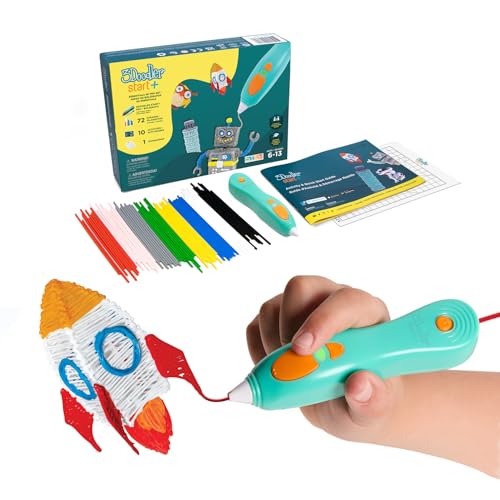
What We Like
- Child-safe with no hot parts
- Includes 72 strands of filament
- Comes with stencils and activity guide
- Promotes screen-free STEM learning
Trade-offs
- Only works with proprietary 3Doodler Start filament
- Requires USB-C cable for charging, not included
The 3Doodler Start+ is the only 3D printing pen designed with no hot parts, so a six-year-old can touch the nozzle and plastic without any burn risk. That safety-first engineering makes it the obvious pick for parents who want to introduce 3D design without hovering over a hot glue gun. It comes with 72 strands of filament and ten new stencils, plus a DoodlePad and activity guide, so the box alone gives you hours of structured play. For a kid who loves building and drawing, this turns abstract STEM concepts into something they can hold in their hands.
The trade-off is that it only works with 3Doodler’s own Start filament, so you’re locked into their refill system. That’s not a dealbreaker for most families, but if you’d rather buy generic plastic, something like the ThinkFun Roller Coaster Challenge uses standard building pieces you can mix with other sets. Still, for a screen-free creative toy that teaches spatial reasoning and design, this pen delivers a lot of value. It’s lightweight at 0.7 pounds and charges via USB-C, so it’s easy to pack for car trips or move from the kitchen table to the playroom.
Blue Marble NGMICROST Educational Toys

What We Like
- Three levels of magnification
- Lights above and below specimens
- Includes prepared slides and blank slides
- Comes with pipette, dish, tweezers
Trade-offs
- Requires adult help for younger kids
- Requires a sturdy table due to 1.8-pound weight
Up to 400x magnification means a child can zoom in on a leaf vein or a grain of sand and actually see the tiny structures that make up our world. That kind of detail turns a casual look into a real discovery session. This kit comes with six prepared plant slides, six rocks and minerals, and six blank slides, so there’s plenty to explore right out of the box. The large focus knobs and soft-touch eyepiece make it easy for small hands to adjust without frustration, and the lights above and below the stage mean you can see specimens clearly whether they’re solid or translucent. For a curious kid who wants to understand how things work at the smallest scale, this is the kind of tool that turns a rainy afternoon into a genuine science experiment.
Kids will love this microscope because large focus knobs and a soft-touch eyepiece make it easy to keep specimens positioned just right. Three levels of magnification with lights above and below ensure a clear view every time. The kit includes six prepared plant slides, six rocks and minerals, and six blank slides for home exploration. A pipette, specimen dish, tweezers, and easy-to-follow instructions let kids conduct science experiments like real scientists. The included lab guide offers viewing activities for different specimens, a super scientist game, and merit badge stickers to reward their work. Blue Marble, winner of the Toy Association’s Toy of the Year Award, develops products that foster education and creativity.
Product photos
Snap Circuits Beginner SCB-20 Electronics Kit

What We Like
- Childproofed for ages 5+
- 21 step-by-step experiments included
- Color-changing fan adds excitement
- Award-winning STEM kit design
Trade-offs
- Only 21 projects limit long-term replay
- No advanced components for older 9-year-olds
Twenty-one snap-together projects mean a child can build a working circuit in minutes, not hours. The child-friendly pieces snap together without tools, so little fingers stay safe while they learn how switches and lights actually work. The kit includes a lighted color-changing fan, which adds a fun visual element to the builds. This kit suits the beginner who wants real results fast, not a lecture on Ohm’s law.
Longevity is the main concern: once your child finishes all 21 builds, the kit loses some replay value unless they start experimenting on their own. Compared to the ThinkFun Roller Coaster Challenge, which offers track design, Snap Circuits Beginner is more structured and guided. That makes it perfect for the kid who needs clear steps and immediate success, but less ideal for the tinkerer who wants to invent from scratch.
Learning Resources Pixel Art Challenge
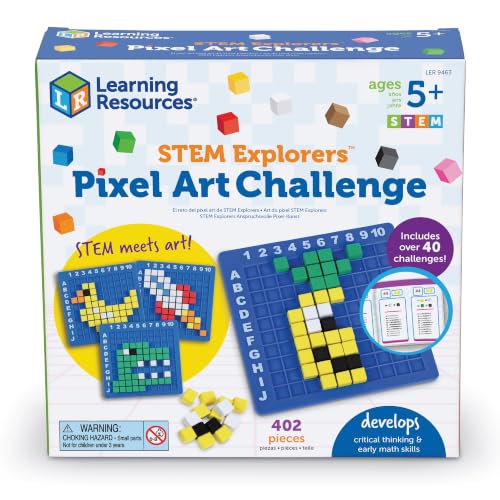
What We Like
- 40 progressive challenges build skills
- 400 durable foam pieces included
- Teaches coding concepts without screens
- Strengthens fine motor skills
Trade-offs
- 5.5-inch tray limits large designs
- No digital feedback for coding logic
With 40 creative challenges that ramp up in difficulty, this kit turns pattern building into a real thinking workout. The 400 foam pixel pieces snap into a 5.5-inch tray, so your child gets hands-on practice with spatial reasoning and problem-solving without staring at a screen. It’s a natural fit for kids who love puzzles or building, especially if you want to introduce early coding concepts in a tactile, low-pressure way. The fine motor work is a bonus, placing those tiny pieces strengthens dexterity while they focus on the picture.
The tray size caps how elaborate a design can get, so kids who crave huge builds might feel limited. It’s best for structured, guided play rather than free-form creativity, the challenge booklet drives the activity, not open-ended exploration. If your six-year-old enjoys following a puzzle to a satisfying finish, this delivers focused, screen-free learning.
Product photos
Clever Fox Play Number Hunter Math Board Game
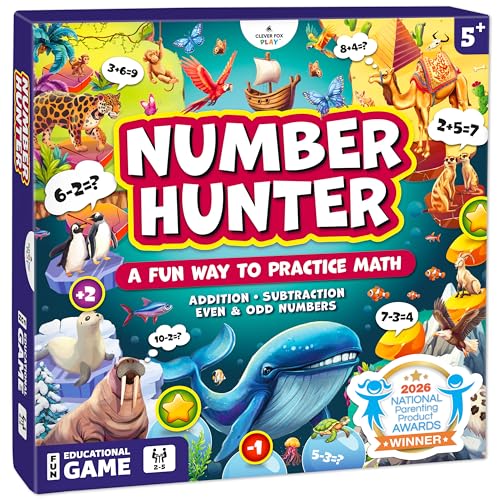
What We Like
- Teaches addition and subtraction through play
- Includes fun action and math challenges
- Non-toxic, durable materials
- Screen-free STEM activity
Trade-offs
- No advanced math concepts like multiplication or division
- Requires at least two players for full experience
A 9.2-inch square board means this game fits easily on a coffee table or classroom desk, so you can set it up without rearranging the whole room. It turns math practice into a global adventure: kids roll dice, add or subtract to move forward, and land on star tiles that trigger silly actions or extra math challenges. That hands-on, screen-free approach builds early STEM skills like critical thinking and problem-solving without the groan that usually follows a worksheet. For a child ages 5-7 who needs to cement basic addition and subtraction, this is a playful way to drill those facts while still feeling like a game.
The math stays at a first-grade level, so there’s no multiplication, division, or place value. A child who’s already confident with sums up to 20 might lose interest after a few rounds. Compared to the ThinkFun Math Dice Junior Game, which is also a math skills builder for kids aged 6+, the Number Hunter board game offers a more structured, race-to-the-finish format that works best with siblings or classmates. If your kid thrives on competition and still needs practice with the basics, this is a durable, well-built option that keeps them off devices and engaged with real people.
Creativity for Kids Grow 'N Glow Terrarium Kit
What We Like
- Seeds grow in 3-4 days
- Glow-in-the-dark stickers and figurines
- Complete kit for planting twice
- Combines arts and crafts with science
Trade-offs
- Seeds require consistent watering to thrive
- Glow effect needs light exposure before dark
The included chia and wheatgrass seeds sprout in just 3-4 days, which means a six-year-old sees results fast enough to stay engaged without losing patience. That quick payoff is the whole point here: this kit turns the abstract idea of an ecosystem into something they can watch happen, day by day, in their own room. It’s a gentle introduction to botany and responsibility, wrapped in a craft project that lets them arrange colored sand and glow-in-the-dark stickers however they like. For a child who’s more interested in creating than following rigid steps, this is a low-pressure win.
The most important thing to know about this terrarium kit is that it’s a living project, not a one-and-done toy. If the child forgets to water it or leaves it in the dark, the glow effect fades and the seeds won’t sprout. Compared to a building game like the ThinkFun Roller Coaster Challenge, which needs no ongoing care, this kit asks for more follow-through from both kid and parent. Still, the glow-in-the-dark figurines and stickers give a nighttime reward that makes it a memorable pick for a child who enjoys both nature and a little magic.
Learning Resources STEM Explorers Brainometry
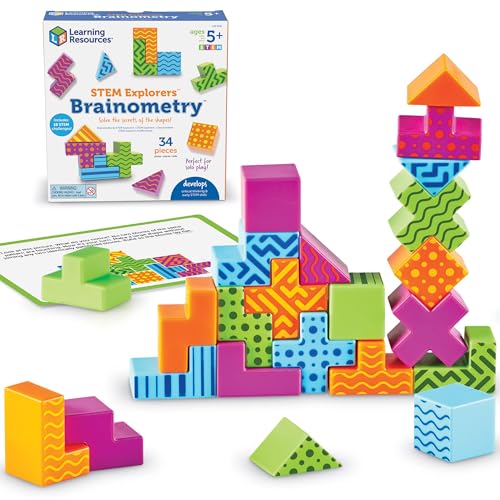
What We Like
- 34 tactile puzzle blocks for hands-on play
- 10 double-sided cards with progressive difficulty
- Portable storage box keeps pieces organized
- Screen-free solo brain game
Trade-offs
- Small pieces require careful supervision for younger kids
- Solo play means no built-in multiplayer option
With 34 tactile blocks and 10 double-sided challenge cards that ramp up in difficulty, this puzzle set turns abstract spatial reasoning into something a child ages 5 and up can actually hold and solve. It’s the kind of toy that rewards patience and pattern-matching without needing a screen or a partner, making it a strong pick for quiet afternoons or car rides. The portable storage box keeps everything together, so you’re not hunting for lost pieces under the couch cushions. If your child enjoys figuring out how shapes fit together and doesn’t mind working solo, this delivers real mental workout in a compact package.
Once those ten cards are mastered, the novelty can fade faster than with a more open-ended building set. The blocks themselves are sturdy and the cards are coated for durability, but the puzzle format is inherently finite. That said, for a focused, screen-free brain teaser that builds fine motor skills and spatial awareness, this is a smart, affordable addition to a toy shelf. It’s not a social game, but for the right kid, it’s a satisfying solo challenge.
Product photos
ThinkFun Math Dice Junior Game

What We Like
- Enhances mental math agility
- Toy of the Year nominee
- Easy to learn with clear manual
- Develops early math skills stealthily
Trade-offs
- Limited to kids aged 6 and up
- No expansion packs or additional challenges included
The ThinkFun Math Dice Junior Game weighs just 0.3 pounds, so it slips easily into a backpack or travel bag for math practice on the go. Designed for kids aged 6 and up, it sharpens mental math and cognitive skills through quick dice challenges. The clear instruction manual makes it simple to pick up, turning arithmetic into a fast-paced game rather than a chore. Parents and teachers appreciate how it builds early math confidence without feeling like homework.
The dice are small and can roll off a table if you’re not careful, so younger kids might need a tray or a contained play area. Compared to the Snap Circuits Beginner SCB-20, which focuses on building electronic circuits, this game is all about quick mental math with dice. It’s best for families who want a portable, no-mess way to boost number skills, but less suited for kids who prefer building or tactile activities.
Product photos
BeAndge STEM Robotics Kit

What We Like
- Five different robot builds
- Solar and wind powered models
- Step-by-step manual included
- Safety materials used
Trade-offs
- AA batteries not included
- No projects for kids under age 6
This kit includes five separate builds, a solar-powered car, a wind-powered car, an obstacle-avoidance robot, a transmission tank, and a glider, so a child can work through different projects without needing another set. The included mini screwdriver and step-by-step manual let kids take the lead with some adult help, which can keep them engaged across multiple sessions. It’s a practical choice for families who want a STEM kit that offers variety and builds skills over time.
You’ll need to supply AA batteries yourself, and some of the smaller components can be fiddly for younger hands. Compared to the Snap Circuits Beginner SCB-20, which is designed for ages 5-9 and uses snap-together pieces for simple circuit builds, the BeAndge kit requires more assembly time and fine-motor precision. That makes it better suited for a child who enjoys focused building rather than quick, snap-together play.
Product photos
How We Evaluated Educational Toys For 6 Year Olds
We started by reviewing manufacturer specifications and safety certifications for every toy, then cross-referenced those details against expert round-ups from child development specialists and educator recommendations. Owner feedback patterns, what parents actually said worked or fell short, helped us separate marketing claims from real-world performance.
Four criteria mattered most for this age group. Skill alignment asked whether the toy teaches a specific, age-appropriate skill like logic, fine motor control, or early math. Replay value measured how many challenges or projects a toy offers before a child masters it. Independence level considered how much adult help is needed for setup and play. Screen-free design was a priority. That’s because 6-year-olds benefit most from tactile, hands-on learning.
This is a research-led evaluation, not a hands-on test. We cannot tell you how a toy feels in the hand or how long a battery lasts in real use. What we can offer is a thorough, honest assessment of what each toy promises and what experienced owners report.
What To Look For In Educational Toys For 6 Year Olds
Choosing the right educational toy means matching the challenge level to your child’s current abilities while leaving room to grow. The best picks feel like play, not homework.
Look for toys that teach one clear skill, offer progressive difficulty, and require minimal adult setup. Avoid anything that promises too many skills at once, focused toys deliver better results.
Skill Alignment and Progressive Difficulty
A 6-year-old’s attention span and frustration tolerance are still developing. The best educational toys for 6 year olds offer challenges that start easy and ramp up gradually. ThinkFun Roller Coaster Challenge, for example, includes puzzles that grow in complexity, so a child feels successful early and stays motivated to tackle harder levels. Look for toys with multiple difficulty tiers or numbered challenge cards rather than a single activity.
Screen-Free, Hands-On Engagement
Six-year-olds learn best when they touch, move, and manipulate objects. Screen-free toys like building toys and construction sets develop fine motor skills and spatial reasoning in ways that apps cannot replicate. The Learning Resources Pixel Art Challenge teaches coding concepts using foam pieces on a grid, no tablet required. If a toy claims to teach STEM skills, check that the primary interaction is physical, not digital.
Real Materials and Durability
Educational toys take more abuse than display items. Look for non-toxic materials, reinforced joints, and pieces that survive drops. The Blue Marble NGMICROST microscope weighs 1.8 pounds and needs a sturdy table, which tells you it uses real glass optics and metal components rather than flimsy plastic. Owner feedback patterns consistently show that durable toys outlast cheaper alternatives and hold resale value.
- Check that all small parts are large enough to avoid choking hazards for younger siblings.
- Verify that batteries or charging cables are included or clearly listed as not included.
- Read the recommended age range on the box, some toys labeled for 6+ are too complex for the younger end.
- Look for a storage solution built into the packaging, like the STEM Explorers Brainometry box.
- Confirm that replacement parts or refills are available for consumable items like filament or seeds.
A toy your child can play with independently for 20 minutes is worth more than one that requires constant adult intervention.
Educational Toys For 6 Year Olds Compared
The table below compares all 10 educational toys side by side, highlighting each one’s primary skill focus, best use case, and key trade-off so you can find the right match quickly.
| Product | Age Range | Weight | Dimensions | Piece Count |
|---|---|---|---|---|
| ThinkFun Roller Coaster Challenge STEM Game | 6 and Up | 1.3 pounds | L 11.0 inches, W 2.8 inches, H 11.6 inches | 36 posts, 39 tracks, 1 car |
| 3Doodler Start+ Essentials 3D Pen Set | Ages 6+ | 0.7 pounds | L 9.1 inches, W 6.0 inches, H 2.6 inches | 72 strands mixed-color |
| Blue Marble NGMICROST Educational Toys | Ages 6+ | 1.8 pounds | L 11.0 inches, W 6.7 inches, H 12.0 inches | 6 prepared slides, 6 blank slides, 6 rock & mineral specimens |
| Snap Circuits Beginner SCB-20 Electronics Kit | 5-9 years | 0.5 pounds | 11.7 × 2.0 × 7.4 inches | 21 unique builds |
| Learning Resources Pixel Art Challenge | 5+ | 0.6 pounds | L 8.0 inches, W 8.0 inches, H 2.5 inches | 400 foam pixel pieces |
| Clever Fox Play Number Hunter Math Board Game | 5-7 years | 1.4 pounds | 9.2 x 9.2 x 0.0 in | N/A |
| Creativity for Kids Grow 'N Glow Terrarium Kit | 6-8+ | 1.1 pounds | 10.5 x 3.0 x 12.0 inches | Chia and wheatgrass seeds |
| Learning Resources STEM Explorers Brainometry | 5+ | 0.6 pounds | 10 x 9 x 4.5 inches | 34 puzzle pieces, 10 double-sided challenge cards |
| ThinkFun Math Dice Junior Game | 6+ | 0.3 pounds | 5.1 x 1.8 x 7.0 inches | N/A |
| BeAndge STEM Robotics Kit | 6-8 8-12 | 0.9 pounds | 8.4 x 5.7 x 2.0 inches | 5 builds |
Frequently Asked Questions
What is the best educational toy for a 6-year-old who loves building?
The ThinkFun Roller Coaster Challenge STEM Game is the top choice for building-minded kids. It combines a logic puzzle with a construction set, so children must plan and build a working roller coaster that meets specific challenge requirements. The structured objectives keep them focused while still allowing creative freedom.
Are STEM toys for 6-year-olds worth the money?
Yes, when you choose a toy that matches your child’s current skill level. The best STEM toys for this age teach cause and effect, problem-solving, and fine motor control through play. Look for kits with multiple projects or progressive difficulty so the toy stays engaging for months, not days.
What is the best screen-free coding toy for a 6-year-old?
The Best Screen-Free Coding Toy is the Learning Resources Pixel Art Challenge. It uses 400 durable foam pieces and 40 progressive challenge cards to teach sequencing and pattern recognition without any digital device. The tactile pieces also strengthen fine motor skills, which is a bonus for early handwriting development.
How do I choose between a science kit and a building set for a 6-year-old?
Consider your child’s natural curiosity. If they ask “why” constantly and love examining bugs or leaves, a science kit like the Blue Marble NGMICROST microscope will feed that curiosity with real tools. If they prefer taking things apart and rebuilding, a construction set or building toy will better match their learning style.
What math skills should a 6-year-old learn with toys?
At age 6, children are typically learning addition and subtraction up to 20, number sequencing, and basic pattern recognition. The Clever Fox Play Number Hunter Math Board Game teaches these skills through turn-based play, while the ThinkFun Math Dice Junior Game builds mental math agility. Both are screen-free and designed for repeated play.
The Bottom Line
For most families, the ThinkFun Roller Coaster Challenge STEM Game is the best overall educational toy for a 6-year-old. It teaches engineering reasoning, planning, and persistence through a single, well-designed activity that grows with the child. If your kid prefers creative expression over logic puzzles, the 3Doodler Start+ Essentials 3D Pen Set offers a safe, screen-free introduction to 3D design.
Budget-conscious parents should look at the Snap Circuits Beginner SCB-20 Electronics Kit for a low-cost entry into electronics. Or consider the ThinkFun Math Dice Junior Game for a portable math booster that costs less than a board game. Both deliver strong skill-building value without the premium price tag.
The single most important factor when choosing an educational toy for a 6-year-old is whether the challenge level matches your child’s current frustration tolerance. A toy that is too hard collects dust; one that is too easy gets boring. Read the challenge card count and difficulty progression before you buy, and do not be afraid to start with a simpler option if your child is new to structured play.
