
10 Best Board Games For Family Night in 2026
This post contains affiliate links. As an Amazon Associate, we earn from qualifying purchases.
The best board game for family night is CATAN Board Game 6th Edition. Its modular board and resource trading mechanics keep every session fresh, making it our top pick for families with 3-4 players ages 10 and up. For classic strategy, Ticket to Ride offers accessible train-building fun, while Hues and Cues brings creative color guessing to groups as large as ten.
Family night needs games that everyone can learn quickly but still enjoy after multiple plays. You need something that bridges age gaps, holds attention spans, and doesn’t leave anyone sitting out for too long. The right game makes the difference between a night of groans and a night of “one more round.”
We built this guide by studying manufacturer specs, expert recommendations, and patterns in owner feedback across ten top-rated family games. Each pick earned its spot for a specific reason, whether it’s speed, player count, or teaching teamwork. You’ll find the right match for your family’s style below.
Top 10 Board Games For Family Night in the Market
Certain content that appears on this site comes from Amazon. This content is provided "as is" and is subject to change or removal at any time.
The Best Board Games For Family Night, Reviewed
CATAN Board Game 6th Edition

What We Like
- Modular board ensures high replayability
- Teaches resource management and trade
- Supports 3-4 players for family nights
Trade-offs
- No 2-player mode without expansion
- Requires 3-4 players, no solo or 2-player mode
A modular hexagonal board means every game of CATAN unfolds differently, no two playthroughs ever feel the same. That built-in replayability is the reason it’s earned its place as a family night staple. Designed for 3 to 4 players ages 10 and up, it asks you to gather brick, wood, wheat, ore, and sheep to build roads, settlements, and cities while racing to 10 victory points. The trade-and-build loop is simple enough to teach in a few minutes but deep enough to keep strategy enthusiasts engaged for years. If your family enjoys a little friendly competition and thinking ahead, this one delivers consistently.
The trade-off is that CATAN demands a full hour or more, and it only supports 3-4 players out of the box. That makes it a less flexible pick than Ticket to Ride, which accommodates 2-5 players and plays in 30-60 minutes.
Days of Wonder Ticket to Ride

What We Like
- Easy to learn, hard to master
- Multiple ways to win
- Beautiful map and miniature trains
- Fun for all ages 8+
Trade-offs
- Not suitable for groups larger than 5 players
With a 30-60 minute playtime and simple rules, this game fits neatly into a family game night without dragging into bedtime. The giant North American map and colorful miniature trains make the table look alive. The mix of collecting train cards, claiming routes, and completing tickets gives everyone a real shot at winning, even if they’re new to strategy games. That’s why this refresh of a modern classic keeps its reputation as the go-to family strategy game: it balances depth with accessibility so well that both kids and adults stay engaged from start to finish.
With only 2-5 players, it can’t accommodate larger groups. And while the 30-60 minute playtime is just right for most families, the recommended age is 8 and up. For a family night where you want a satisfying strategic challenge that still feels light and inviting, this is the pick. If your group regularly hits six or more players, you’ll want a party game as backup.
Product photos
USAOPOLY Hues and Cues
What We Like
- 480 vibrant color squares
- Quick to learn rules
- Unique play each round
- Supports 3-10 players
Trade-offs
- No competitive scoring tension for strategy lovers
- Relies on subjective color perception
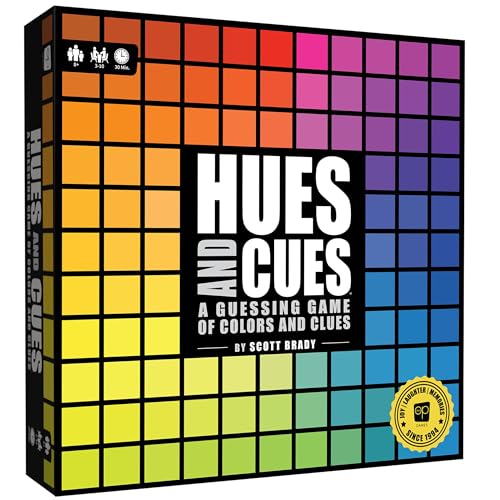
With 480 distinct color squares, Hues and Cues turns color guessing into a creative conversation starter that works for groups of 3 to 10 players. Each round feels fresh because you give one- or two-word clues to guide others to a specific hue, and no two guesses play out the same way. The rules are quick to learn, which makes it a natural fit for mixed-age family gatherings where you want everyone engaged quickly.
With 480 color squares and one- or two-word clues, this game turns every round into a creative guessing challenge rather than a points-driven race. Reviewers note it sparks laughter and conversation because players describe hues in wildly different ways, making each playthrough feel fresh. If your group enjoys subjective wordplay over trading and building, this is a relaxed alternative to a strategy game like CATAN.
Product photos
Big Potato Herd Mentality
What We Like
- Supports 4-20+ players
- Easy to learn and quick to play
- Includes 20 extra questions
- Fun for families, teens, and adults
Trade-offs
- Ages 10+ limits younger kids
- No solo or two-player mode
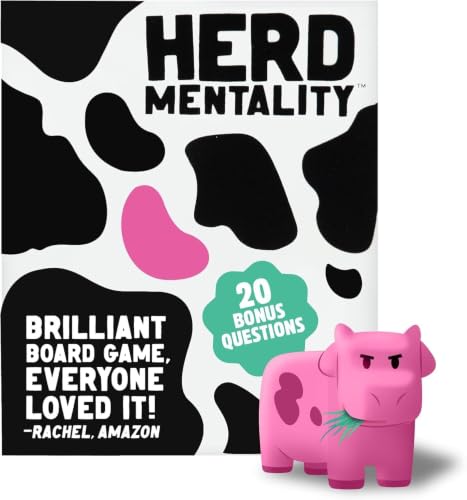
A player count of 4 to 20+ means this game can handle everything from a small family to a full holiday gathering without leaving anyone out. That flexibility makes it a strong pick for large groups, and the quick-to-learn rules mean nobody’s stuck reading a manual while the fun starts. If your family night regularly includes cousins, grandparents, and neighbors, this is the one that keeps the whole room engaged.
The recommended age of 10+ rules out younger siblings who might want to join in, so if you’ve got a mix of ages including kids under ten, a game like Ticket to Ride (ages 8+) could be an alternative. But for a group of teens and adults who love a laugh and a little competition, the ‘pink cow of doom’ mechanic adds a hilarious twist that keeps everyone on their toes.
Product photos
USAOPOLY Tapple Original

What We Like
- Portable wheel stores all category cards
- Built-in timer keeps rounds fast
- 36 cards offer 144 categories
Trade-offs
- No expansion packs for additional categories
A built-in timer and 144 categories across 36 cards mean this game delivers quick, high-energy rounds that keep everyone on their toes. The portable wheel stores all category cards inside, so you can take it anywhere without losing pieces. It works well for groups that enjoy fast-paced word games and don’t want a long setup or cleanup. The speed rewards quick thinking over deep strategy, making it a natural pick for gatherings where short, repeatable fun is the goal.
Word games can leave younger or less confident readers feeling left out during pressure-filled turns. Compared to other party games like Ticket to Ride, which focuses on strategy and planning, Tapple demands vocabulary recall under a ticking clock. That tension is exactly what makes it exciting for word lovers, but it may frustrate players who need more time to think. If your group enjoys speed and verbal challenges, this is a compact, easy-to-carry option that delivers consistent entertainment.
Product photos
Spin Master Family Feud Deluxe
What We Like
- Includes dry erase scoreboard and marker
- Supports 3 or more players
Trade-offs
- No expansion cards available
- Single buzzer unit must be shared between teams
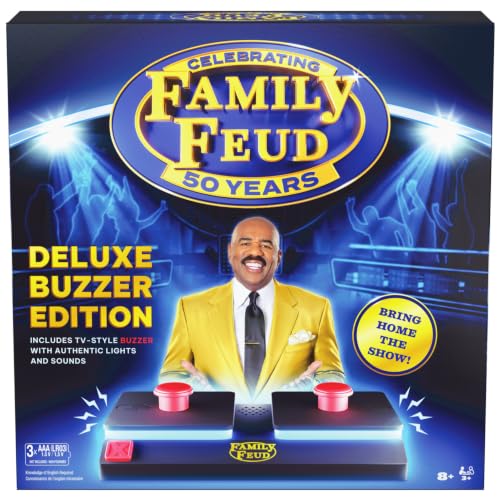
It’s ideal for groups of three or more who want a party game that rewards quick thinking and knowing what the crowd thinks, rather than deep strategy or trivia knowledge.
Compared to a game like Herd Mentality, which handles up to 20 players with simple voting, this one works best with smaller teams and a clear host. The included dry erase scoreboard helps keep track, but you’ll want a flat, stable surface since the box is fairly light at 2.4 pounds.
Hasbro Trivial Pursuit Family Edition

What We Like
- 1200 trivia questions across 6 categories
- Separate adult and kid cards
- Quick-play board earns wedges on any space
- Play individually or in teams
Trade-offs
- 2+ player minimum limits solo or small groups
- Questions are fixed, so replay value depends on memory
This is a pure trivia game, so if your family prefers building or racing, something like Ticket to Ride offers a different kind of interaction. The questions are fixed, meaning repeat players might start remembering answers after several rounds. Still, for a trivia challenge that gives kids and adults their own questions, this is a strong pick.
Product photos
Ravensburger Labyrinth Board Game

What We Like
- Shifting maze changes every turn
- Builds critical thinking and planning skills
- Easy to learn for all ages
- Includes 24 treasure cards for variety
Trade-offs
- Limited to 2-4 players per game
- Not recommended for children under age 7
A 20-30 minute play time means this shifting maze game fits neatly into a busy family night without dragging on. The maze rearranges every turn, so you’re constantly planning new routes to grab treasures while blocking opponents. That dynamic board keeps everyone engaged, and the simple rules let kids as young as 7 jump right in. It’s a smart pick for families who want a quick, strategic challenge that rewards thinking ahead rather than luck.
The biggest limitation is the player count: with only 2-4 players, larger groups will need to take turns or split into teams. Compared to Ticket to Ride, which handles up to 5 players and runs 30-60 minutes, Labyrinth offers a shorter play time and a more tactical focus. If your family night regularly includes more than four people, you might want a game that scales up, but for smaller groups this maze provides engaging fun as the maze is rearranged with every turn.
Mattel Ghost Fightin' Treasure Hunters

What We Like
- Winner of Kinderspiel des Jahres 2014
- Two game modes: cooperative and one vs all
- Basic and advanced cooperative options
- Teamwork to escape haunted house
Trade-offs
- Limited to 2-5 players
- Requires reading for advanced mode
A 2014 Kinderspiel des Jahres winner, this cooperative board game puts everyone on the same side against the ghosts. You work as a team to collect eight treasure jewels and escape a haunted house before six rooms become haunted. The basic and advanced cooperative options let you adjust difficulty as kids get better, so it grows with your group without feeling stale.
Winner of the 2014 Kinderspiel des Jahres (Children’s Game of the Year), this cooperative board game lets everyone work together to beat ghosts and escape a haunted house with 8 Treasure Jewels before 6 rooms become haunted. It offers two ways to play: Cooperative Mode (with Basic and Advanced options) and Head Haunter Mode, where one person controls the ghosts against up to 4 other players. That means families can choose a shared challenge or a one-versus-all twist, though the heart of the game is teamwork.
Product photos
The GAME CHEF Speed Charades
What We Like
- 1400 charades keep rounds fresh
- Head-to-head racing creates instant energy
- 2-minute learn time for quick setup
- Works for teens, college, and parents
Trade-offs
- No solo or two-player mode without teams
- Box size (10.2×8.5×2.6 in) takes table space
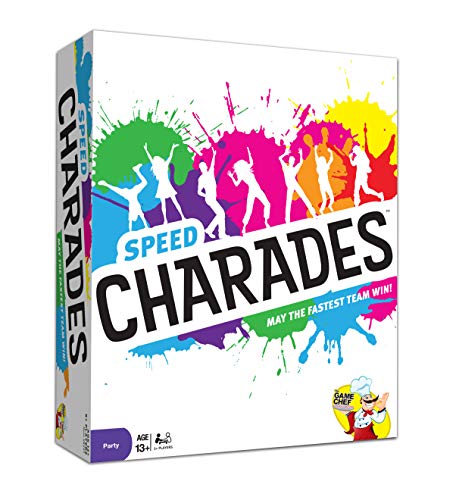
With 1,400 charades packed into 280 cards, this game keeps rounds fresh long after other party games run out of prompts. The head-to-head racing format means both teams act at the same time, so nobody sits waiting. The first team to guess four out of five words wins the round. That simple twist turns a familiar classic into a high-energy sprint that fits family game night without dragging on: a full game wraps in 25-30 minutes, and you can learn the rules in two minutes flat. It suits groups where teens, college students, and parents all want to play together, because the acting challenge scales naturally with the team’s creativity.
You need at least four people split into two teams to play; there’s no solo or two-player mode. That’s fine for most family nights, but if your group is smaller, something like Hues and Cues offers a color-guessing approach for 3-10 players ages 8 and up. For medium-to-large gatherings that want a fast, loud, and laugh-filled game, Speed Charades delivers exactly what the name promises without overstaying its welcome.
Product photos
How We Evaluated Board Games For Family Night
We started by looking at what families actually need from a game night pick. That meant examining player counts, age ratings, play times, and replayability from official manufacturer data and box specifications. We also read through hundreds of owner experiences to see which games held up after the fifth or tenth playthrough.
The four criteria that mattered most were player count flexibility, age range accessibility, rules complexity, and replay value. A game that only works for exactly four players is less useful than one that scales from two to six. Games that take twenty minutes to teach lose momentum fast. And if a game feels solved after three plays, it won’t earn a spot on the shelf.
This is a research-led evaluation, not a hands-on test. We rely on documented specs, expert consensus from hobbyist round-ups, and patterns in what owners consistently report. That gives you a reliable starting point, but every family is different, so we encourage you to check the player count and age rating against your own group before buying.
What To Look For In Board Games For Family Night
Choosing a family game starts with knowing your group’s size, ages, and attention span. The best pick for a family of four with teens will differ from one with a seven-year-old and grandparents visiting.
Look for a game that fits your exact player count, matches the youngest player’s reading level, and finishes in under an hour. Replayability matters more than flashy components.
Player Count and Age Range
The most common family night frustration is a game that doesn’t fit the group. Check the box for minimum and maximum players, and take the minimum seriously. A game that needs three players won’t work for a household of two. Age ratings are equally important. Games rated 10+ often involve reading or complex strategy that younger kids can’t follow. For mixed-age groups, look for games with separate kid and adult cards or cooperative modes that let everyone contribute.
Rules Complexity and Teach Time
A game that takes thirty minutes to explain will kill family night energy before it starts. The best family games teach in under five minutes and let players learn by doing. Look for games with a “first turn” example or a quick-start card. Cooperative games often have simpler rules because players can help each other. Competitive games should have clear, one-page rulebooks that don’t require constant checking.
Replayability and Game Length
A family game needs to stay interesting after the tenth play. Replayability comes from variable setups, multiple paths to victory, or randomized elements like card draws or tile placements. Game length matters too, forty-five minutes is a sweet spot for most families. Games under thirty minutes work well for younger kids or as warm-ups. Anything over ninety minutes risks losing attention unless your family is already hooked on longer strategy sessions.
- Check the box for “2-4 players” if you have a small household; “3-10” if you host large gatherings.
- Look for age ratings that match your youngest regular player, not your oldest.
- Read the teach time estimate on the box or in reviews, five minutes or less is ideal.
- Ask whether the game has variable setup or fixed scenarios before buying for long-term use.
A family game that gets played is better than a perfect game that sits in the closet. Prioritize what your group will actually enjoy.
Board Games For Family Night Compared
The table below compares each game’s player count, age rating, play style, and best use case so you can match the right game to your family’s needs.
| Product | Players | Ages | Weight |
|---|---|---|---|
| CATAN Board Game 6th Edition | 3-4 | 10+ | 2.6 pounds |
| Days of Wonder Ticket to Ride | 2-5 | 8+ | 2.8 lbs |
| USAOPOLY Hues and Cues | 3-10 | 8+ | 2.7 pounds |
| Big Potato Herd Mentality | 4-20+ | 10+ | 1.0 pounds |
| USAOPOLY Tapple Original | N/A | N/A | 0.5 pounds |
| Spin Master Family Feud Deluxe | 3 or more | 8 & Up | 2.4 pounds |
| Hasbro Trivial Pursuit Family Edition | 2+ | 8+ | 1.4 pounds |
| Ravensburger Labyrinth Board Game | 2-4 | 7-10 and older | 2.1 pounds |
| Mattel Ghost Fightin' Treasure Hunters | 2-5 | 8+ | 1.6 pounds |
| The GAME CHEF Speed Charades | 2+ (teams) | N/A | N/A |
Frequently Asked Questions
What is the best board game for a family of four?
CATAN works well for exactly four players and offers deep replayability through its modular board. If you have younger kids, Ticket to Ride supports 2-5 players ages 8 and up and has simpler rules that still reward strategy.
How do I choose a board game for a large family gathering?
Look for games that support six or more players. Herd Mentality handles up to 20 players and has nearly zero teach time. Hues and Cues works for 3-10 players. It relies on creative guessing rather than reading or complex rules.
What is the best cooperative board game for families?
Ghost Fightin’ Treasure Hunters is our top pick for cooperative play. It won the Kinderspiel des Jahres award and offers two game modes so families can play together against the haunted house or try a one-vs-all variant.
Are there board games that work for both kids and adults?
Yes. Trivial Pursuit Family Edition includes separate adult and kid question cards so everyone can play on a level field. Labyrinth is easy enough for ages 7 and up but still challenges adults with its shifting maze mechanics.
What is the fastest board game to learn for family night?
Speed Charades has a two-minute teach time and gets players acting and guessing immediately. Tapple also teaches in under a minute, players press the wheel letter and shout answers before the timer runs out.
The Bottom Line
The CATAN Board Game 6th Edition is our best overall pick because it balances deep strategy with high replayability for families with 3-4 players ages 10 and up. If your group is larger or includes younger kids, Ticket to Ride offers a more accessible classic strategy experience that still rewards multiple plays.
For budget-conscious families or those with specific needs, the award picks point you in the right direction. Large groups should look at Herd Mentality. Families with mixed-age kids will appreciate Trivial Pursuit Family Edition or Ghost Fightin’ Treasure Hunters for cooperative play. Word game fans will love Tapple for its portability and speed.
The single most important factor is knowing your group’s size and age range before you buy. A game that fits your table and your youngest player’s attention span will earn repeat plays. Everything else, components, theme, box art, is secondary to that match.
