
10 Best Board Games For 5 6 Year Olds in 2026
This post contains affiliate links. As an Amazon Associate, we earn from qualifying purchases.
The best overall board game for 5 and 6 year olds is Gamewright Outfoxed Cooperative Board Game, a cooperative whodunit that gets kids working together to solve a mystery before the fox escapes. For families who prefer no-reading path-building, Peaceable Kingdom Race to the Treasure is our top cooperative pick, while the Hasbro Gaming Operation Bluey Edition wins for Bluey superfans.
Shopping for this age group means finding games that hold a five-year-old’s attention but still challenge a six-year-old’s growing logic skills. The sweet spot is a 15-20 minute round with simple rules that don’t need a grown-up to referee every turn.
We evaluated these games by studying manufacturer specs, expert round-ups from child development sources, and patterns in parent feedback. This guide covers 10 games that balance fun, learning, and the right difficulty level for kids ages 5 and 6.
Top 10 Board Games For 5 6 Year Olds in the Market
Certain content that appears on this site comes from Amazon. This content is provided "as is" and is subject to change or removal at any time.
The Best Board Games For 5 6 Year Olds, Reviewed
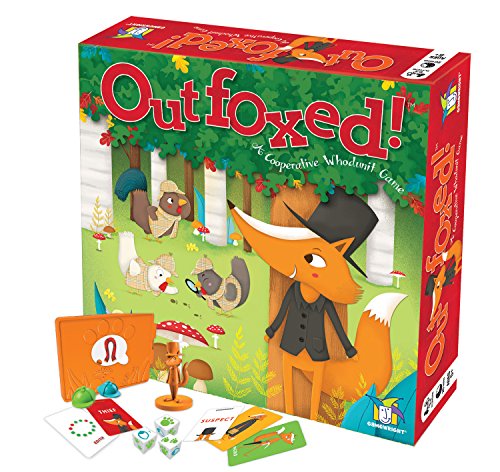
Gamewright Outfoxed Cooperative Board Game
What We Like
- Cooperative team play builds social skills
- Dice and decoder keep kids engaged
- Quick setup and easy rules
- Screen-free family fun
Trade-offs
- Only supports up to 4 players
- Short 15-20 minute rounds limit depth
A cooperative mystery that supports exactly 4 players means every child has a role in catching the fox, and nobody gets eliminated or sits out. The dice and decoder turn clue solving into a hands-on activity that feels more like a game than a lesson. That keeps a 5- or 6-year-old engaged for the full 15-20 minute round. That short playtime is a feature, not a flaw: it fits attention spans and makes repeat plays easy, so the game can come out again right after dinner.
The trade-off is that 4-player limit. If you regularly have a fifth child or a second adult joining in, you will need to rotate turns or pick a different game. For families with exactly two to four players who want a true whodunit that preschoolers can actually solve together, this is the one.
Peaceable Kingdom Race to the Treasure

What We Like
- No reading required for play
- Teaches strategy and social skills
- Award-winning cooperative design
Trade-offs
- Only 2-4 players limits larger groups
- No solo play option
With a cooperative path-building design that requires no reading, this game lets 2 to 4 kids ages 5 and up work together to outpace the Ogre and reach the treasure. The shared goal means every player contributes to strategy and decision-making, building social skills naturally as they plan their route. It’s a smart pick for families who want a screen-free activity that encourages teamwork over competition, especially for children still developing reading confidence.
The cooperative format won’t satisfy every child’s urge to win solo. If your group leans toward head-to-head competition, something like Hasbro Trouble offers a more traditional race-to-the-finish dynamic. But for parents focused on fostering collaboration and reducing in-game frustration, this award-winning design delivers exactly that experience without the pressure of individual winners or losers.
Product photos
Peaceable Kingdom Mermaid Island Game

What We Like
- Cooperative play for 2-6 players
- No reading required for gameplay
- Won Good Housekeeping's Best Toy Award
Trade-offs
- Spin and move limits strategic depth
- Thematic appeal narrow to mermaid fans
A 15-minute cooperative game for up to six players means this is one of the quickest ways to get a group of young kids working together without anyone feeling left out. It suits families who want a low-stress introduction to board games, especially if you have a mix of ages or kids who get competitive easily.
The spin-and-move mechanic keeps strategy light, so children looking for more complex decision-making might lose interest after a few rounds. Compared to Outfoxed, which has a similar playtime range, Mermaid Island is simpler and more focused on pure cooperation. Not ideal for families who want longer sessions or more tactical choices, but for a quick, feel-good game that teaches shared decision-making, it delivers exactly what it promises.
Product photos
Hasbro Gaming Operation Bluey Edition

What We Like
- Authentic character voices from the show
- Portable doctor case with built-in storage
- Two play modes for variety
- 12 Bluey-themed silly ailments
Trade-offs
- Requires 3 AA batteries, not included
- Ages 6+ excludes younger 5-year-olds
A portable carrying case that folds into a handled doctor’s kit means this game travels easily to Grandma’s or a playdate, and the built-in drawer keeps all 12 ailments from getting lost. The game features music and funny phrases from favorite episodes in the voices of Bluey, Bingo, and Dad, pulling kids straight into the show’s world. With two ways to play, following cards in Hospital mode or racing the clock in Emergency mode, it offers enough variety to keep a single child or a small group engaged during short play sessions.
At 10 minutes per round, this is a quick activity rather than a deep board game session, so it works best as a warm-up or between longer games. Compared to Outfoxed, which plays in 15-20 minute rounds, Operation Bluey Edition is more about dexterity and silliness than strategy. It’s officially for ages 6+, so younger children may not be able to play independently.
Product photos
Hasbro Trouble Board Game

What We Like
- Pop-O-Matic die roller keeps die secure
- Includes Power Up Spaces for added challenge
- Quick setup and easy to learn
- Classic family game for ages 5+
Trade-offs
- No cooperative play option for younger kids
- Limited to 2-4 players only
The Pop-O-Matic bubble is the star here, that satisfying pop and the die staying put means no lost pieces under the couch mid-game. For a five- or six-year-old, the tactile press-and-pop action turns rolling into an event, and the simple goal of moving all four pegs around first keeps attention where it belongs. Trouble suits families who want a quick, no-reading-required race that even the youngest player can grasp after one round. The Power Up Spaces option adds a dash of strategy for when the basic game gets too predictable, stretching its shelf life without overcomplicating things.
Trouble is purely competitive, so if your child struggles with losing or needs a collaborative experience, Outfoxed’s cooperative whodunit might feel more inclusive. Trouble also caps at four players, which can leave a fifth sibling or friend on the sidelines, not ideal for bigger playdates. Still, for a straightforward, tactile race that gets everyone popping and laughing, it’s hard to beat the original bubble mechanic. Just know you’re trading group flexibility for that iconic pop.
Product photos
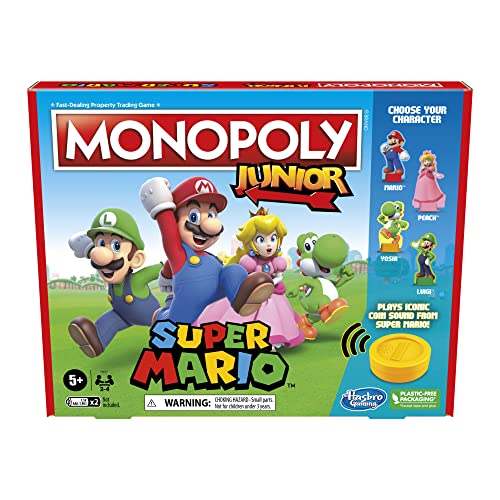
Monopoly Junior Super Mario Edition
What We Like
- Super Mario characters and artwork
- Interactive coin sound unit
- Fast, fun introduction to Monopoly
- Themed properties from Mushroom Kingdom
Trade-offs
- Cooperative play not supported
- Limited to 4 players max
Rolling the power-up die tells players whether they can press the Coin Sound Unit, which plays the iconic Super Mario coin sound, a simple hook that keeps younger kids engaged. The board features familiar Mushroom Kingdom locations like Yoshi’s Hill and Rock-Candy Mines, and players move as Mario, Peach, Yoshi, or Luigi. Designed to be fast and exciting for ages 5 and up, this junior version focuses on collecting coins rather than bankrupting opponents, making it a gentle introduction to property trading.
The player with the most coins wins, so this is a competitive game that teaches kids about counting and strategy. The power-up die can trigger a coin sound effect, which reviewers note adds excitement but may tempt younger players to press it repeatedly. For families with a Super Mario fan, this board game delivers familiar characters and themed properties like Yoshi’s Hill and Rock-Candy Mines.
Product photos
Jax Sequence for Kids

What We Like
- No reading required to play
- Develops logical thinking skills
- Simple matching gameplay for kids
- Classic Sequence adapted for children
Trade-offs
- Only supports 2-4 players
- No cooperative play option
The ‘no reading required’ design means a 5-year-old who hasn’t mastered letters yet can jump right in, just match a card to the character on the board and place a chip. That simplicity makes it a rare strategy game that actually works for this age group, building logical thinking without frustration. It suits families with younger siblings or mixed-age play, because the matching mechanic is intuitive enough for a 3-year-old to grasp, yet the four-in-a-row goal gives a 6-year-old something to plan around. No text, no waiting for someone to sound out instructions, just pattern recognition and a little forward thinking.
With only 2-4 players, larger gatherings or classroom use will leave someone out. Compare that to Peaceable Kingdom’s Race to the Treasure, which also targets ages 5+ but adds cooperative team play for up to four kids. That is a better fit if your group tends to squabble over who wins. Jax Sequence for Kids is a competitive game, so if your child struggles with losing, the direct head-to-head format might cause more tears than cheers. For a no-reading strategy game that gets kids thinking without requiring literacy, though, this one delivers on its stated features.
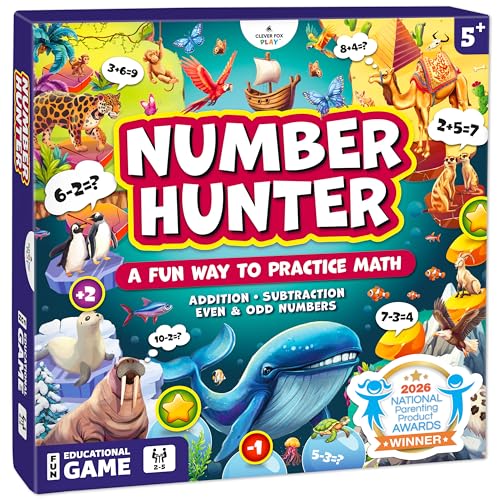
Clever Fox Play Number Hunter Math Game
What We Like
- Teaches addition, subtraction, even/odd numbers
- Screen-free STEM activity for kids 5-7
- Durable, non-toxic child-safe materials
- Includes fun action and math challenges
Trade-offs
- No cooperative play option for hesitant learners
- Limited to 2-4 players, not for larger groups
This math board game helps kids ages 5-7 practice addition, subtraction, and even/odd numbers through a screen-free activity that builds early STEM skills. The durable, non-toxic materials make it suitable for repeated family game nights, and the roll-dice-and-move mechanic keeps play simple for young learners.
The game is designed for 2-4 players and focuses on competitive play, which may not suit children who prefer cooperative games. For families who want to incorporate math practice into game night, the straightforward rules help maintain a 5-year-old’s attention.
Hasbro Gaming Clue Junior

What We Like
- Classic Clue gameplay for younger kids
- Teaches strategy and elimination
- Supports 2 to 6 players
Trade-offs
- Age listed 5+ but box says 8+
- Amazon listing says ages 8 and up
Clue Junior scales the classic whodunit down for ages 5 and up, with a broken-toy mystery that asks who, what, and when. Up to six players can join, so it works for play dates or family game night without leaving anyone out. The process-of-elimination mechanic builds logical thinking in a way that feels like a puzzle, not a lesson.
The Amazon listing says this game is for ages 8 and up, but the box itself says 5 and up, so double-check before you buy if you have a younger child. Compared to Gamewright Outfoxed, which is cooperative and plays in 15-20 minute rounds, Clue Junior is competitive. If your child gets frustrated by losing, Outfoxed’s team approach might be a better fit.
Product photos
Ravensburger Bugs in the Kitchen Board Game

What We Like
- Includes a special HEXBUG Nano
- Easy learn-and-play rules
- High-quality components last hundreds of sessions
- Quick 15-minute rounds
Trade-offs
- Board is thin at 0.1 inches
- Only 2-4 players limits larger groups
A real HEXBUG Nano scurries across the board, making each round unpredictable and genuinely exciting for a 5-year-old. The rules are simple: roll the die, create a path, trap the bug. That straightforward loop means kids can jump in without frustration, and the 15-minute playtime keeps attention spans from wandering. It’s a clever blend of dexterity and luck that rewards observation and quick thinking without requiring reading or complex strategy.
How We Evaluated Board Games For 5 6 Year Olds
Our research started with manufacturer specifications and age recommendations, then we cross-referenced those against expert round-ups from play-focused publications and child development resources. We also analyzed patterns in parent feedback to understand which games actually hold up after the 20th play session.
The four criteria that mattered most were age-appropriate complexity, playtime length, player count flexibility, and whether the game supports cooperative or competitive play. Rules should be simple enough for a 5-year-old to grasp but still engaging for a 6-year-old. Playtime needs to be short for limited attention spans. For this age, cooperative games often win because they remove the sting of losing.
A research-led evaluation has limits: we haven’t sat down with every game for a dozen rounds, so we rely on documented specs, expert consensus, and what real families report in their reviews. This approach gives you a reliable starting point, not a testing lab’s verdict.
What To Look For In Board Games For 5 6 Year Olds
The best games for this age group use simple rules, short rounds, and themes that click with a five or six-year-old’s world. Look for games that build skills without feeling like homework.
Age-Appropriate Complexity
A game that works for both a five-year-old and a six-year-old needs a narrow difficulty gap. Look for games that say “ages 5+” and have rules you can explain in under two minutes. Games that require reading are fine for some six-year-olds but will frustrate a five-year-old who isn’t there yet, our picks like Peaceable Kingdom Race to the Treasure and Jax Sequence for Kids require zero reading.
Playtime and Attention Span
Fifteen to twenty minutes is the sweet spot for this age. Any longer and you’ll lose half the table to wandering. The Ravensburger Bugs in the Kitchen game finishes in about 15 minutes, while Gamewright Outfoxed wraps up in 15 to 20. Games that drag past half an hour are better saved for the next age bracket.
Cooperative vs. Competitive Play
Five and six-year-olds are still learning how to lose gracefully. Cooperative games where everyone wins or loses together remove that pressure entirely. Our cooperative board games guide covers more options, but the short version is: if your child struggles with losing, start with cooperative games like Outfoxed or Peaceable Kingdom Mermaid Island.
- Check the box for “ages 5+” or “ages 6+”, not just the marketing copy.
- Count the player limit: many games cap at 4, which matters for larger families.
- Look for games with no small pieces that could be a choking hazard.
- Read the rulebook online before buying to see if setup is quick.
- Consider whether siblings of different ages can play together.
A good rule of thumb: if you can’t explain the rules during a single commercial break, the game is too complex for this age group.
Board Games For 5 6 Year Olds Compared
The table below compares all 10 games side by side so you can see at a glance which one fits your family’s needs.
| Product | Players | Ages | Weight |
|---|---|---|---|
| Gamewright Outfoxed Cooperative Board Game | 4 | 5 and up | 1.1 lb |
| Peaceable Kingdom Race to the Treasure | 2 to 4 | 5+ | 1.0 pounds |
| Peaceable Kingdom Mermaid Island Game | 2 to 6 | 5+ | 1.0 pounds |
| Hasbro Gaming Operation Bluey Edition | 1+ | 6+ | N/A |
| Hasbro Trouble Board Game | 2-4 | 5 and up | 0.8 pounds |
| Monopoly Junior Super Mario Edition | N/A | 5 and up | 1.2 pounds |
| Jax Sequence for Kids | 2-4 | 3-6 | 1.5 pounds |
| Clever Fox Play Number Hunter Math Game | 2-4 | 5-7 years | 1.4 pounds |
| Hasbro Gaming Clue Junior | 2-6 | 5 and up | 1.2 pounds |
| Ravensburger Bugs in the Kitchen Board Game | 2-4 | 5 and up | 1.9 pounds |
Frequently Asked Questions
What is the best cooperative board game for 5 and 6 year olds?
Gamewright Outfoxed Cooperative Board Game is our top pick because it lets kids work together to solve a mystery without competing against each other. For a simpler, no-reading option, Peaceable Kingdom Race to the Treasure is excellent for building teamwork and strategy.
How long should a board game last for a 5 year old?
Fifteen to twenty minutes is ideal for this age. Games like Ravensburger Bugs in the Kitchen finish in about 15 minutes, while Outfoxed runs 15-20. Longer games risk losing a child’s attention before the game ends.
What board games for 5 and 6 year olds don’t require reading?
Several of our top picks require no reading at all. Peaceable Kingdom Race to the Treasure, Peaceable Kingdom Mermaid Island, and Jax Sequence for Kids all use picture-based or color-matching mechanics that pre-readers can play independently.
Are there good board games for 5 and 6 year olds that teach math?
Yes. The Clever Fox Play Number Hunter Math Game teaches addition, subtraction, and even/odd numbers through action challenges and math prompts. It’s designed specifically for ages 5-7 and uses durable, non-toxic materials.
What is a good board game for a 5 year old who loves Bluey?
The Hasbro Gaming Operation Bluey Edition features authentic character voices from the show and 12 Bluey-themed silly ailments. It comes in a portable doctor case with built-in storage, though it requires 3 AA batteries and is listed for ages 6 and up.
The Bottom Line
For most families with 5 and 6 year olds, Gamewright Outfoxed Cooperative Board Game is the best choice. Its cooperative mystery format keeps kids engaged without the tears of competitive play, and the quick 15-20 minute rounds fit perfectly into a weeknight evening. It works best for groups of 2-4 kids.
If your child struggles with reading or you want a game that builds teamwork without any text, grab Peaceable Kingdom Race to the Treasure. For Bluey-obsessed families, the Operation Bluey Edition is a guaranteed hit. And if you need educational value, the Clever Fox Number Hunter game sneaks in math practice without feeling like a lesson.
The single most important factor when choosing a board game for this age is matching the complexity to your child’s current skill level. A game that’s too hard frustrates, one that’s too easy bores, but the right fit creates a lifelong love of tabletop play.
