
How to Set up Loose Parts Play: Step-by-Step
This post contains affiliate links. As an Amazon Associate, we earn from qualifying purchases.
To set up loose parts play, start with a few larger, safe materials and add more over time. Head Start’s guidance says to begin slowly, choose big parts first for easier use and cleanup, and place them near the areas where kids already play. Then step back.
That last instruction is the one everyone skips. Loose parts only do their job when nobody is standing over them handing out assignments, and the rest of the setup exists to make that possible: safe materials, sensible placement, and an adult who knows when to sit down.
What follows is the material list, the safety screen, and the six-step sequence I use on real play spaces, plus the places where the published guidance openly disagrees with itself.
Key Takeaways
- Start with larger parts, a few at a time. Head Start’s guidance is explicit about pace, while Play Wales recommends introducing one type of resource at a time; both exist because use and cleanup get easier when the first batch is manageable.
- Screen every part for choking size, mouthing, and sharp edges before it goes out. Head Start names all three.
- Zoning and scattering are both valid. Play Wales says protect a dedicated area; Head Start says tuck parts into existing play zones. Pick by setting.
- Play Wales says intervene only as necessary; Head Start says monitor closely at the start. Read both, then decide for your space.
- Plan storage and replenishment before you collect anything. Play Scotland lists both as getting-started tasks.
What Counts as Loose Parts (and What’s Just a Toy)
The theory behind loose parts is older than most of the toys in your playroom. Play Wales traces it to Simon Nicholson, who proposed it in the 1970s and argued that the loose parts in an environment are what empower creativity.
Loose parts are materials with no specific set of directions. They can be used alone or combined with other materials, moved, carried, redesigned, lined up, taken apart, and put back together in multiple ways. Loose parts can be natural or synthetic. Play Wales credits the theory to Simon Nicholson, who proposed it in the 1970s.
Read that definition again and notice what’s missing. There’s no correct answer and no finished product at the end. A toy with one job teaches one thing; a crate of bottle caps teaches whatever the kid decides to test.
Head Start makes the same case from the other side. Its guidance notes that close-ended toys often have a single purpose, and that this single purpose limits children’s imagination and thinking. Open-ended materials let children explore and discover many types of outcomes instead.
That’s the whole argument for open-ended toys: the material has to be blank enough that a kid supplies the purpose.
The Six Material Families Worth Collecting
Head Start sorts loose parts into six families, and the examples below come from its list. Play Wales uses a similar spread.
- Natural: pine cones, tree cookies, seedpods, stones, seashells, acorns, leaves.
- Wood: smooth scrap wood, clothes pins, wood rings, game pieces, pegs, empty wood boxes.
- Metal: tin cans with smooth edges, washers, canning rings, napkin rings, plus donated pots and pans.
- Plastic: shower rings, bottle caps in various sizes, film canisters, cups, bowls, hair curlers.
- Paper and packaging: cardboard boxes, cardboard molding, postcards, envelopes, scrap paper, paint swatches.
- Textiles: fabric, yarn, carpet squares, scarves, ribbons, soft rope, cloth napkins.
Play Wales names extras too: corks, wooden cotton reels, lollipop sticks, curtain rings, egg cups, and empty picture frames.
A bought wooden block set is the commercial version of the wood family. I’d still take the crate of scrap wood and canning rings over it.
One rule I’d add: if you can’t say what a part is made of, it doesn’t go out. Unknown plastic from a curb pile is how you end up with a bin of something that breaks easily.
Should Loose Parts Live in One Zone or Every Zone?
Ever watched a football game swallow the loose parts corner? That’s the exact problem the published guidance argues about, and the two biggest sources land on opposite answers.
Play Wales recommends identifying a designated area within the grounds so children can get absorbed in loose parts play without being displaced by other interests, and it notes that tidying up might be quicker that way. Head Start takes the other road: set parts up near the areas where they’d be used, like boxes in dramatic play or acorns and pine cones in a science area.
| The question | Play Wales says | Head Start says |
|---|---|---|
| Where parts live | One designated area | Tucked into existing play zones |
| Adult role | Intervene only as necessary | Monitor closely at the start |
| Pace of adding | One resource type at a time | A few options at a time |
| Session shape | Weekly, small mixed-age group | Any time, any group size |
| Who sets the rules | Children, fully involved | Adults screen for safety |
The honest answer to how to set up loose parts play starts with one question: who else uses the space?
Neither approach is wrong, and I’d push back on anyone who tells you there’s a single answer. I get why the zoned route gets recommended first. It’s tidier, and it protects the parts.
But a designated corner nobody visits is worse than a scattered setup that actually gets used.
For a school with a football pitch and a few hundred kids, take the Play Wales route. For a home, a family child care setting, or a small preschool with no competing users, Head Start’s approach squeezes more use out of parts you already own.
The benefits of loose parts show up fastest when the parts sit where the play already happens. Tuck a crate of cardboard boxes into the pretend play area and watch the first ten minutes.
The Safety Screen Play Wales Says to Run First
Play Wales lists the hazards to screen for, and several of them have nothing to do with the part itself. Storage, weather, and second-hand clothing all show up on that list.
| What to check | What it looks like | The fix |
|---|---|---|
| Sharp edges and splinters | Rough sawn ends, flaking paint | Sand smooth or bin the part |
| Loose bits and choking risk | Anything that fits a choke tube | Keep away from mouthing children |
| Finger or head entrapment | Gaps that catch and hold | Reject the part, not the gap |
| Protruding wires, staples, nails | Metal poking through timber | Pull them out before use |
| Splintering and shattering | Cracks after a cold snap | Retire it, don’t glue it |
| Damp or wet storage | Rust bloom, standing water | Dry storage, wash and clean |
A tin can that’s been sitting in a damp crate comes out with rust and a smell like old pennies. That’s the chemical and bacterial risk showing up where you can see it.
Head Start’s version of the same screen is shorter: review every material for choking hazards, the potential for children to mouth items, and smooth edges.
If you want a repeatable method instead of a gut check, here’s how to test toys for loose parts before anything goes in the bin.
Who Actually Sets the Rules?
Play Wales says children should be fully involved in setting up the agreements and expectations about playing with and managing the parts, and it warns that complex, hard-and-fast rules help less than simple prompts. Head Start puts the safety screening in adult hands: materials have to be safe for the age and developmental level of the children using them.
Both positions hold at once. Kids write the rules about use; adults hold the veto on what goes out in the first place.
Common mistake: Screening a bin once and calling it done. Play Scotland’s guidance says to check loose parts regularly, because parts crack, split, and shed pieces as they get used.
How to Set Up Loose Parts Play in Six Steps
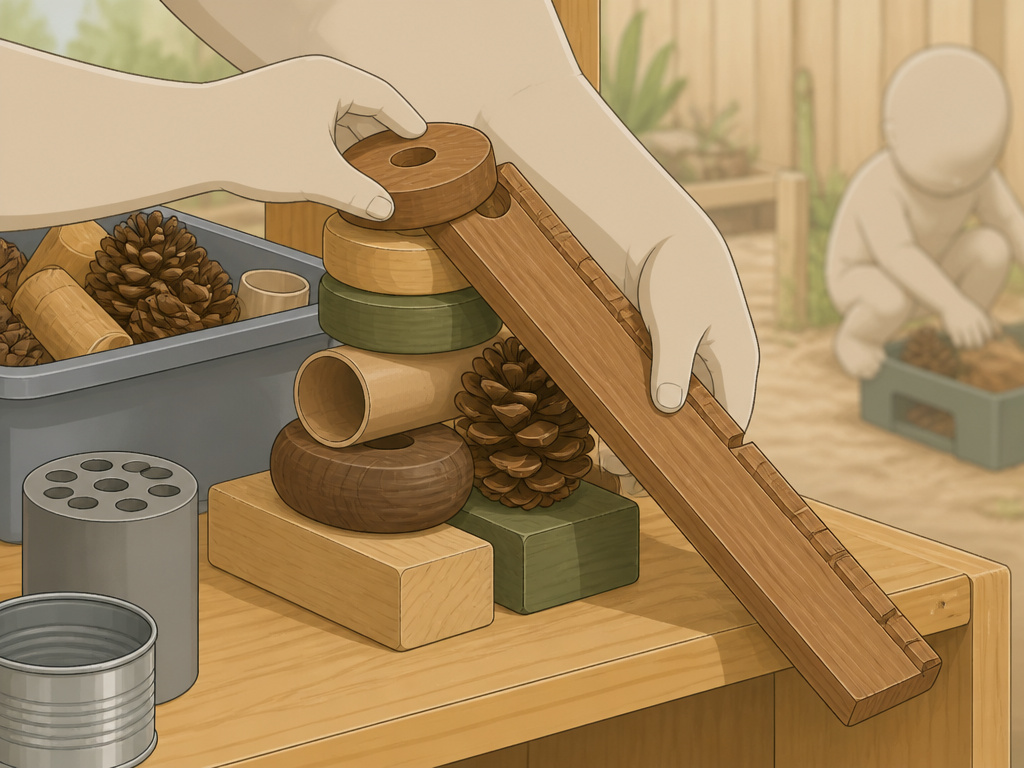
Six steps is the whole thing. I’ve run this sequence on school yards and on one family’s back garden, and the order matters more than the materials.
I once set out a pile of cardboard tubes, pinecones, and a few boards right beside a battery-operated toy with more buttons than a TV remote. The kids ignored the cube for forty minutes and built a ramp with the boards. Loose parts won, and it wasn’t close.
Before you start: Check every part for choking size and sharp edges before it goes out, and keep anything that fits a choke tube away from children who still mouth objects. Tin cans need their cut rims sanded smooth. Protruding nails, staples, and wires come out before the part goes in the bin, not after.
- Plan it before you collect anything. Head Start’s guidance says to plan with your teaching team or families, and Play Scotland lists an action plan as a getting-started task. Skip this and you end up with a shed full of stuff nobody agreed to store.
- Start with larger parts, and only a few at a time. Head Start recommends beginning slowly and choosing big parts first. Go straight to a hundred bottle caps and the sound they make hitting a tile floor will end the experiment inside a week.
- Put the parts where the play already happens. Boxes in the dramatic play area, acorns and pine cones in the science area. Parts on a shelf in a corridor get used by nobody.
- Arrange them so they suggest a use. Head Start’s examples are a wooden track in the block area, or wooden rings partly stacked on a stacking board. A tidy pile reads as finished; a half-built one reads as an invitation.
- Screen everything and watch closely at the start. Head Start says adults should monitor children’s use closely as they begin engaging with new materials. Ease off once the routines settle.
- Sort out storage and replenishment on day one. Play Scotland lists both as getting-started tasks, and Play Wales adds a pre-use site check outdoors: clear hazards and cordon off anything you can’t manage.
I’d rather see a yard with three good materials than twenty. The setups that fail are the ones where an adult collected everything at once, ran out of storage, and quietly stopped putting things out by the second month.
How Do You Introduce Loose Parts Without Losing the Room?
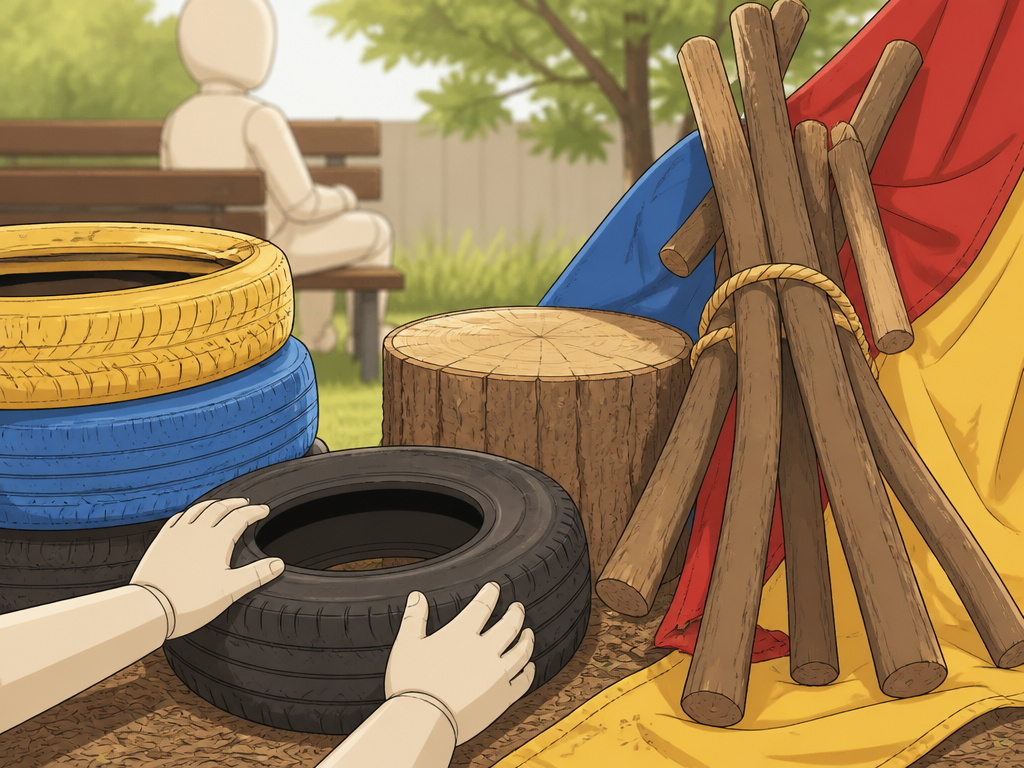
Adding everything at once is the fastest way to make the whole thing boring. The guidance splits on pace, and both sides are worth hearing.
Head Start says to start slowly by adding a few loose parts options at a time. Play Wales goes further and says to introduce one type of resource at a time, and it names a common sequence: tyres first, then stumps, then den building kits. Both sides are describing pace, just at different scales.
The two sources also split on who goes first. Play Wales suggests starting with the older children and working down through the setting, because older kids who feel ownership become eager to help the younger ones. Head Start’s version is to start with larger parts, not older children.
Access is the other split. Play Wales says children should reach the parts when they wish rather than being restricted by a rota, and that all ages playing together is a feature. Head Start’s version is to introduce parts throughout the day in large groups, small groups, or with individual children.
The practical version of “step back” is encouraging independent play: set the invitation, then find something to do within earshot.
Set the parts out like you mean it, then go sit down. If I hover and start suggesting things, it turns into my project. If I park on a bench nearby, it turns into theirs.
The part nobody mentions: The first days of a new setup look like nothing is happening. Head Start’s guidance says to give children plenty of time to adjust to new materials and open-ended play, and some children need longer than others to work out how to handle a material.
If a material needs you to explain how to use it, it isn’t a loose part yet. Put it back and pick something more open-ended.
Storage, Replenishment, and the Job I Always Forget
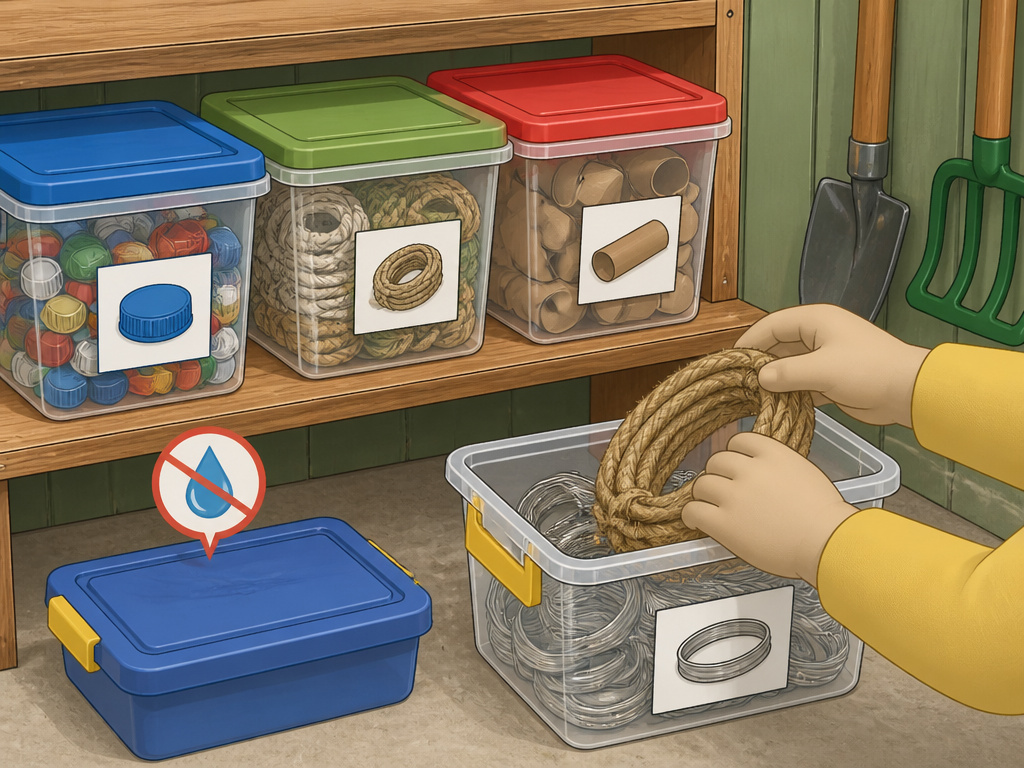
The shed door opens, three crates come out, and by four o’clock there’s a wet pile of rope and cardboard against the wall. Every setting I’ve worked with has that corner. Storage is usually the culprit.
Play Scotland lists storage as a getting-started task: work out where and how you’ll store your loose parts, and figure out how they’ll be replenished before you gather the first batch. It also wants procedures in place for sourcing, managing, and using the parts, reviewed as time goes on.
Play Wales flags the failure mode directly. Damp or wet storage and stagnant water create a bacterial risk, and that’s a hazard category in its own right, not a housekeeping complaint.
Where the Parts Live When They’re Not Out
- Dry first. A covered bin that never dries out is a bacterial risk, not a storage solution.
- Visible beats tidy. Clear bins let a child see the bottle caps without pulling the whole shelf apart.
- Label with pictures, not just words. Younger children can’t read a label, but they can match a photo of canning rings to a bin.
- Plan the refill before the first collection. Play Scotland’s guidance says to work out replenishment up front, and to figure out how you’ll source more.
Clear bins beat opaque ones, and the same logic runs through organizing building blocks in a playroom. Picture labels work better than words for younger children, which is the whole idea behind labeling toy storage.
I’m bad at this part. I get excited about the setup and forget that parts wear out and need replacing.
Play Scotland’s answer is to build maintenance into your procedures from the start. Do that and the shed stays usable longer.
What Changes When the Weather Turns?
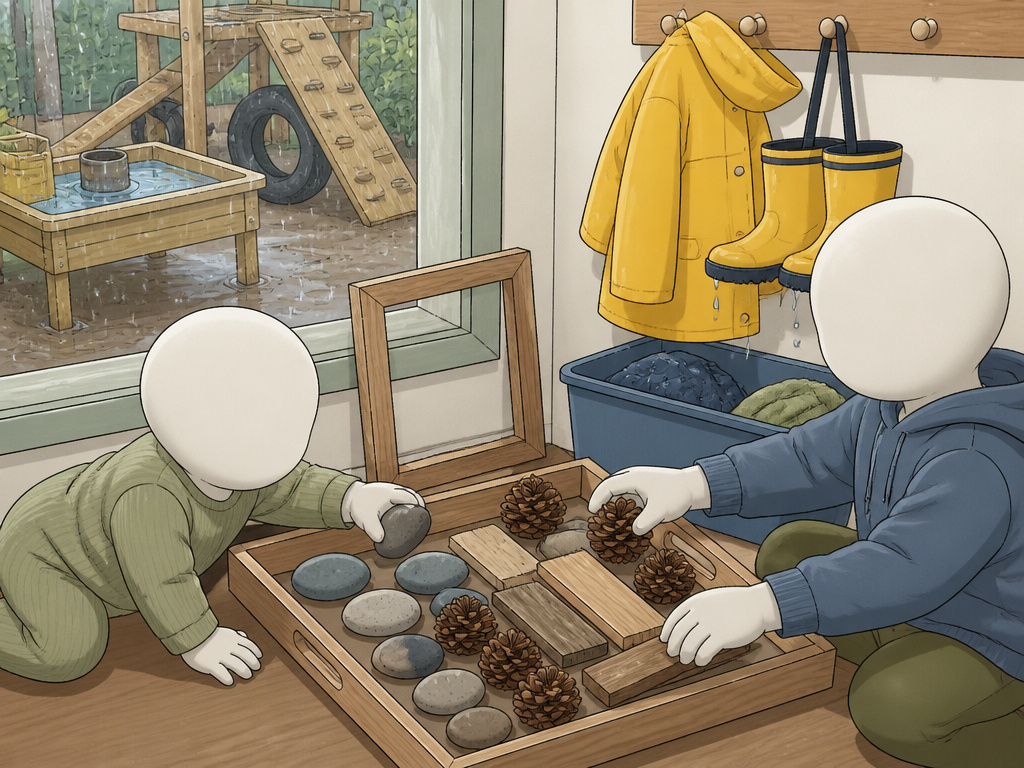
Cold and rain are where loose parts setups quietly die. Play Wales wants the parts outside in every season, not just the dry ones, because weather gives children something else to experiment with.
It also asks you to think ahead about clothing, footwear, and the management of wet gear. That’s a planning job, not an afterthought.
If your setting has no outdoor shelter, Play Wales suggests opening a room indoors so children who want to stay inside still have a choice. That’s where a playroom setup earns its keep: mirror the outdoor materials on trays and let the choice be real.
Head Start’s indoor version is more specific. It suggests placing loose parts on trays and empty picture frames to contain fine motor play on tables, and putting similar safe items on the floor for babies who are sitting or crawling.
The wet gear pile by the door is part of the setup. Plan where it goes before the first rainy session, or you’ll be stepping over it all season.
A water table handles the wet side outdoors without hauling the indoor bins into the rain. For the big-motor end, a climber plus a pile of planks and tyres gives kids a wider spread of challenge than one fixed structure.
The Starting Age Question
Head Start says loose parts are useful in all types of settings and for all children except the very youngest. Play Wales takes a narrower view of that youngest group, suggesting cobble stones too large to swallow can hold a baby’s interest for a long time if the child investigates heavy items or explores by mouthing.
That’s a real disagreement, and it turns on size and supervision rather than a birthday.
Frequently Asked Questions
What age can children start with loose parts?
Head Start’s guidance says loose parts suit all types of settings and all children except the very youngest. Play Wales is more specific about that youngest group, noting that cobble stones too large to swallow can hold a baby’s interest for a long time. Size and supervision decide it, not a birthday.
How many loose parts should go out at once?
Head Start says to start slowly and add a few options at a time. Play Wales recommends introducing one type of resource at a time, with tyres, then stumps, then den building kits as a common sequence. Both describe a gradual approach rather than a fixed number.
Do I need a rota for loose parts play?
Play Wales says no. Its guidance recommends that children access the loose parts when they wish rather than being restricted by a rota, and that all ages play together. Head Start’s version is to introduce parts throughout the day in large groups, small groups, or with individual children.
How do I store loose parts so they don’t go mouldy?
Play Scotland’s guidance says to work out where and how you’ll store your parts as a getting-started task. Play Wales names damp and wet storage and stagnant water as a bacterial infection risk, so covered and dry beats sealed and damp. Wash and clean parts as part of your routine.
Should adults join in loose parts play?
Play Wales says adults should let children play and intervene only as necessary, and it calls unobtrusive observation an essential skill. Head Start says adults should closely monitor children’s use as they begin engaging with new materials. The two are describing different approaches to the same setup.
Where do I get loose parts without spending much?
Head Start suggests talking to community organizations and businesses to request donations or purchases, and notes that programs can get many items for free or at a big discount. It also suggests involving families in the process. Natural parts come from a walk outside.
The Bottom Line
Start this week with one crate and one spot. Put the crate where kids already play, fill it with a few big parts you’ve screened, and then go sit somewhere within sight of it. That’s how to set up loose parts play in one paragraph: one crate, one spot, screened parts, and an adult who sits down.
None of this works in a setting where adults get judged on how tidy the yard looks at three o’clock. If that’s your reality, take the Play Wales route and protect a designated area, because a zoned setup tidies faster and keeps the parts out of everyone else’s way.
Head Start, Play Scotland, and Play Wales disagree about zoning, pace, and who writes the rules. They agree on the part that matters: the adult builds the conditions, and the child builds the play.
And I’ll say the unpopular thing. If your loose parts bin is still full at the end of the month, look at where you put it before you buy anything else.
