
Risky Play Pros and Cons: What the Research Shows
This post contains affiliate links. As an Amazon Associate, we earn from qualifying purchases.
Risky play pros and cons are both real: climbing, roughhousing, and roaming build judgment, balance, and confidence, and the injuries they cause are mostly minor. Canadian injury surveillance data puts tree climbing at 195 injuries per 100,000 records and playground falls at 4,090.
Those two numbers sit at opposite ends of the same list, and the activity adults most often ban on sight is the safer one. The useful question is which risks are worth keeping.
What follows is the injury data, the two studies that contradict each other on equipment height, and the honest limits of the benefit research. Then the part that matters most: how to build a play space where the risk is real and the landing is soft.
Key Takeaways
- Tree climbing sits at 195 injuries per 100,000 records, the lowest of five activities in Canadian hospital surveillance from April 2011 to January 2023, against 4,090 for playground falls.
- The benefit evidence is real but thin. A 74-study review rated overall quality low-to-moderate and said its findings preclude firm conclusions.
- Rough-and-tumble play is the exception. That same review found a negative association with aggression, meaning more aggression, not better self-control.
- Height and fracture risk are genuinely disputed. A New Zealand study found no link; a separate review found higher fracture odds above 1.5 m.
- Check the landing zone before anything else. The surface under the climber decides whether a fall is a scare or a fracture.
What the Injury Data Actually Says About Risky Play
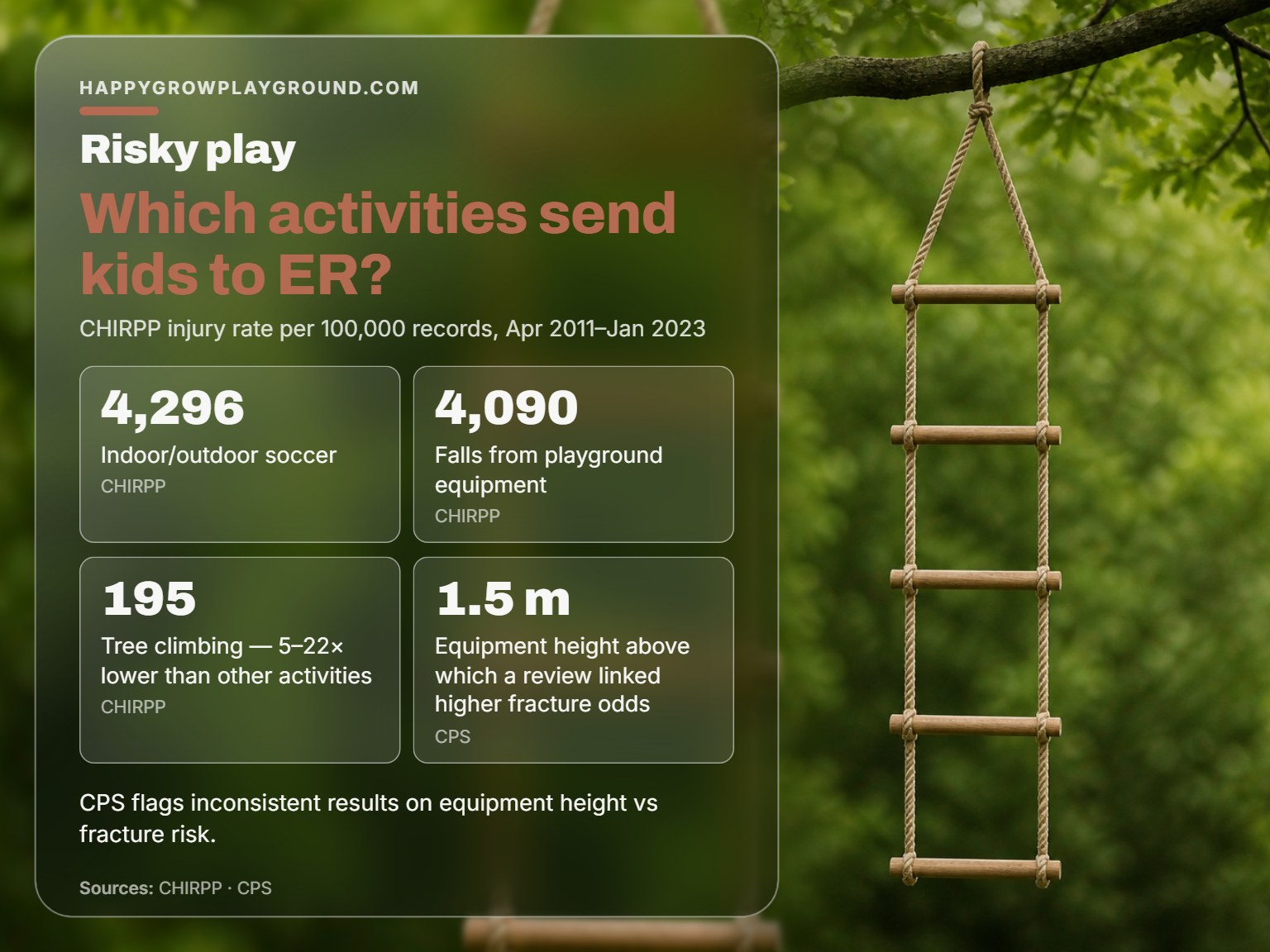
Tree climbing produced 195 injuries per 100,000 records in Canadian pediatric surveillance. Playground falls produced 4,090. That gap is the entire argument in two numbers.
CHIRPP, the Canadian Hospitals Injury Reporting and Prevention Program, logged pediatric injuries from April 2011 through January 2023. Tree climbing produced 195 injuries per 100,000 records. Skateboarding produced 881, cycling 2,816, falls from playground equipment 4,090, and indoor or outdoor soccer 4,296. Tree climbing ranked last of the five tracked activities.
| Activity | Injuries per 100,000 records | Where it ranks |
|---|---|---|
| Tree climbing | 195 | Lowest |
| Skateboarding | 881 | Second |
| Cycling | 2,816 | Third |
| Falls from playground equipment | 4,090 | Fourth |
| Indoor or outdoor soccer | 4,296 | Highest |
Tree climbing’s rate runs 5 to 22 times lower than the other four activities in that same dataset. Canada recorded two playground-related fatalities between 2007 and 2017. Tree falls produced zero fatalities in Canada across 20 years.
I’ve walked a lot of yards where the tree got fenced off and the trampoline stayed. That trade never made sense to me.
Packed dirt rings hollow under a heel. Loose engineered wood fiber gives a dull thud and a small puff of dust. That difference is the whole safety conversation in one sound.
None of this makes tree climbing risk-free. It makes the ranking different from what most people assume. The playground safety rules for kids that actually prevent fractures are about surfacing depth and fall zones, not about banning height.
The 1.5-Meter Rule Two Studies Can’t Agree On
Ask whether height causes fractures and you get confident answers with no consensus behind them. The Canadian Paediatric Society’s 2024 position statement flags the results as inconsistent, and it names both sides.
A New Zealand study found fracture frequency and severity, mostly distal forearm, were unrelated to playground equipment height. A separate systematic review found that falls from equipment above 1.5 m were linked to higher fracture odds.
| Source | Finding | What it changes for you |
|---|---|---|
| New Zealand study, cited in CPS 2024 | Fracture frequency and severity unrelated to equipment height | Taller climbers are not automatically more dangerous |
| Systematic review, cited in CPS 2024 | Falls above 1.5 m linked to higher fracture odds | Height starts to matter past roughly five feet |
| CPS 2024 position statement | Calls the two results inconsistent | Neither finding is settled science |
Where this goes sideways: Treating 1.5 m as a hard cutoff. A five-foot drop onto packed dirt and a five-foot drop onto loose engineered wood fiber are different events, and the surface is the variable you control.
1.5 m is the threshold the systematic review identified. That threshold lands in the middle of what most families already own.
I get why people want a number. Numbers are easy to enforce. But a fracture threshold that two peer-reviewed reviews disagree about is not a number you build a rule on.
Neither finding is settled.
Risky Play Pros and Cons: Where the Benefit Evidence Actually Lands
The strongest single result in this literature is small and specific. A Norwegian children’s wellbeing and risky play study across 8 early childhood institutions found risky play positively linked to well-being, involvement, and physical activity.
Then the picture gets messier. A PROSPERO-registered mixed-methods review (CRD42023488023) pulled together 74 studies: 48 quantitative, 19 qualitative, and 7 mixed-methods. Its initial search ran in December 2023. Here is how the evidence splits by exposure type:
- General risky play: 13 studies. Thin.
- Risky-play-supportive environments: 21 studies.
- Independent mobility: 19 studies, and the only domain with a clear positive link, which was to physical activity alone.
- Rough-and-tumble play: 21 studies.
The review rated overall quality low-to-moderate and stated that its findings preclude firm conclusions. A 2015 systematic review of risky outdoor play reached the same verdict a decade earlier and called for more good-quality studies.
That is worth sitting with. The outdoor play benefits most articles list as settled are, in the research, provisional.
In my experience, kids who get to test their own limits come back calmer and more focused. But I would be lying if I told you the studies prove that. The studies suggest it, then admit they cannot be sure yet.
Why Do Rough-and-Tumble and Monkey Bars Get Lumped Together?
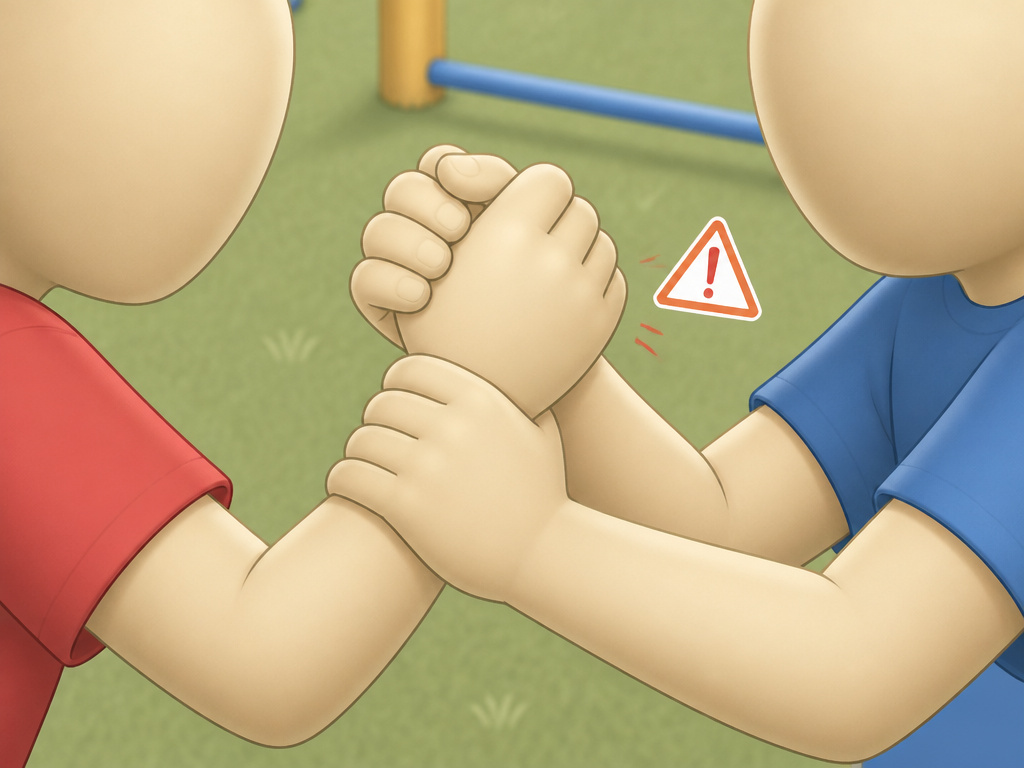
Rough-and-tumble play is where the pro-risky-play argument has a hole in it. The 74-study review found evidence inconsistent across every domain except one: a negative association with aggression.
Translation: rough-and-tumble play was linked to more aggression, not less. That runs against the broader pro-risky-play framing, which tends to treat every subtype as beneficial.
The part nobody mentions: Rough-and-tumble is the one subtype where the research points the wrong way. If your kid wrestles every afternoon and you are seeing more hitting at school, that finding is the one to take seriously.
What the 74-Study Review Actually Found
The mixed-methods review of risky play is more cautious than the advocacy position statements, and the caution is useful. Independent mobility showed a positive link to physical activity only. For every other outcome, the review reported insufficient evidence.
That is a narrower claim than “risky play makes kids healthier.” It is also the claim the data supports. If you want the independent play that builds judgment, the kid has to be out of arm’s reach sometimes.
Monkey bars get blamed for the injuries. The fixed rung height deserves more of the blame, because a kid who can reach it at six will be bored of it at eight and will start inventing ways to make it harder.
Kids drop off a correctly sized monkey bars rung with a soft thump onto their feet. They come off an oversized one with a hard palm slap and a slip.
Most Play Spaces Are Designed for the Insurance File
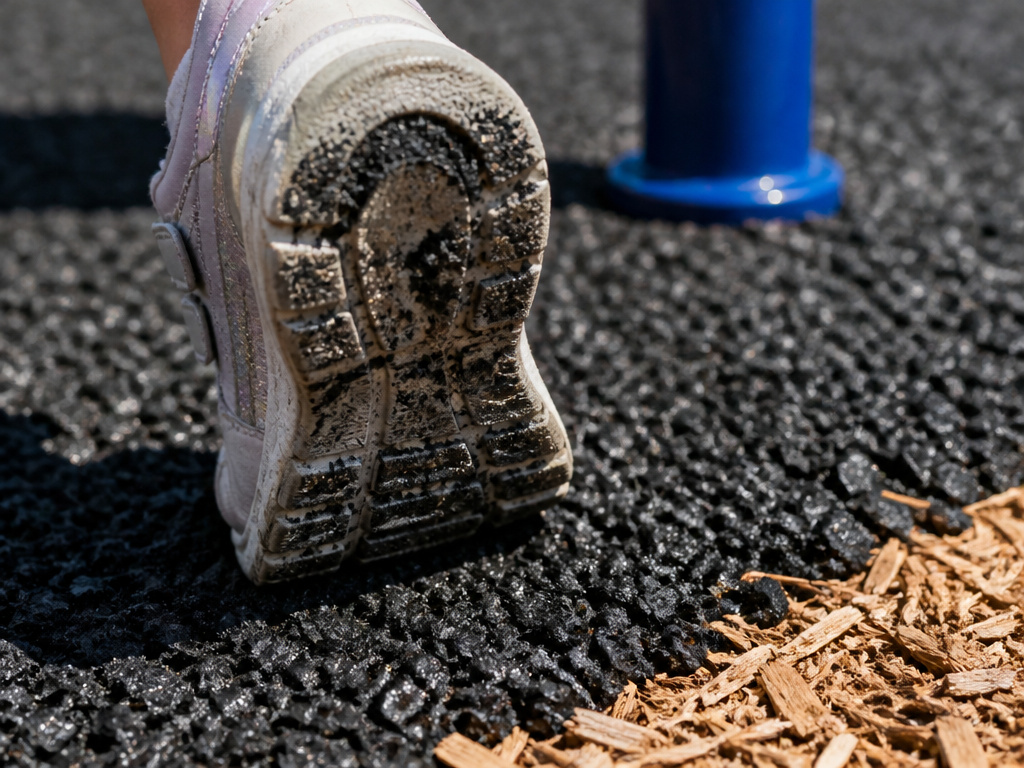
Synthetic surfacing is the clearest case. The Canadian Paediatric Society suggests that unnatural surfaces may drive inappropriate equipment use and greater risk-taking, which inverts the standard safety logic.
Read that twice. The surface installed to reduce injury may be encouraging the behavior that causes injuries.
Why Synthetic Surfacing May Backfire
The mechanism is simple enough. A uniform rubber surface reads to a child as a floor, not as terrain. There is no mud, no slope, no give, no variation to read and adjust to. So the challenge has to come from somewhere, and kids find it in the equipment.
Every rubber-mulch yard I’ve walked in July smells faintly of tires and holds heat through a thin shoe sole. Engineered wood fiber, installed at the right depth, does neither.
The ECEC outdoor play spaces study found that the materials in a yard predict how much risky play happens there, which puts the design decision squarely on the adult.
ISO 4980:2023 is the standards-side version of the same shift. Published in 2023, it is described as a departure from the traditional view of risk management, moving toward benefit-risk assessment rather than hazard removal. The balancing priorities for child development argument runs the same way: injury prevention and developmental benefit get weighed against each other.
If a play space has no surface a kid can read, the challenge moves up into the equipment. The risk has just relocated to somewhere you cannot see.
How to Set Up a Play Space With Real Risk and a Soft Landing
A four-year-old gets to the third rung of a rope ladder, stops, and looks down. What happens in the next four seconds is the whole design brief.
Before you start: Loose fill surfacing compacts and loses depth where feet land most, so measure at the wear spots under the ladder and the slide exit, not the edges. A climber on a slope needs extra clearance downhill, because that is where a falling body actually travels. And check for buried debris before you spread anything; broken glass and old stakes surface after a season of freeze-thaw.
- Check the landing zone before you buy anything. Walk the ground under every climber and tap it with a heel. Packed dirt rings hollow and needs loosening or replacing, and skipping this is how a two-foot fall becomes a wrist fracture.
- Set the fall zone to twice the deck height in every direction. Set the fall zone to twice the deck height in every direction. Skip it and the swing’s arc ends on a hard edge.
- Match the challenge to the kid, not the age on the box. I once picked a structure for a toddler group that was built for older kids, and the little ones just stood there frustrated while the bigger kids hogged it. Age labels are marketing. Watch where a kid hesitates and adjust from there.
- Leave one zone deliberately unfinished. Loose planks, crates, and tires give kids something to rearrange, and the loose parts play research is the reason that zone exists at all.
- Build in a quiet corner. A bench, a shade tree, a low platform. Kids who need a break will take one instead of melting down.
For a first climber, a structure with a low deck keeps a fall in scare territory. A bucket of loose planks does more for executive function than one big tower.
Supervision is the other half. The playground supervision guidelines that work are the boring ones: stay close enough to intervene, far enough that kids solve their own problems.
Who Gets Left Out of the Risky Play Conversation?
Whose risky play is anyone actually studying? Mostly kids in well-resourced neighborhoods, and the gaps are not small.
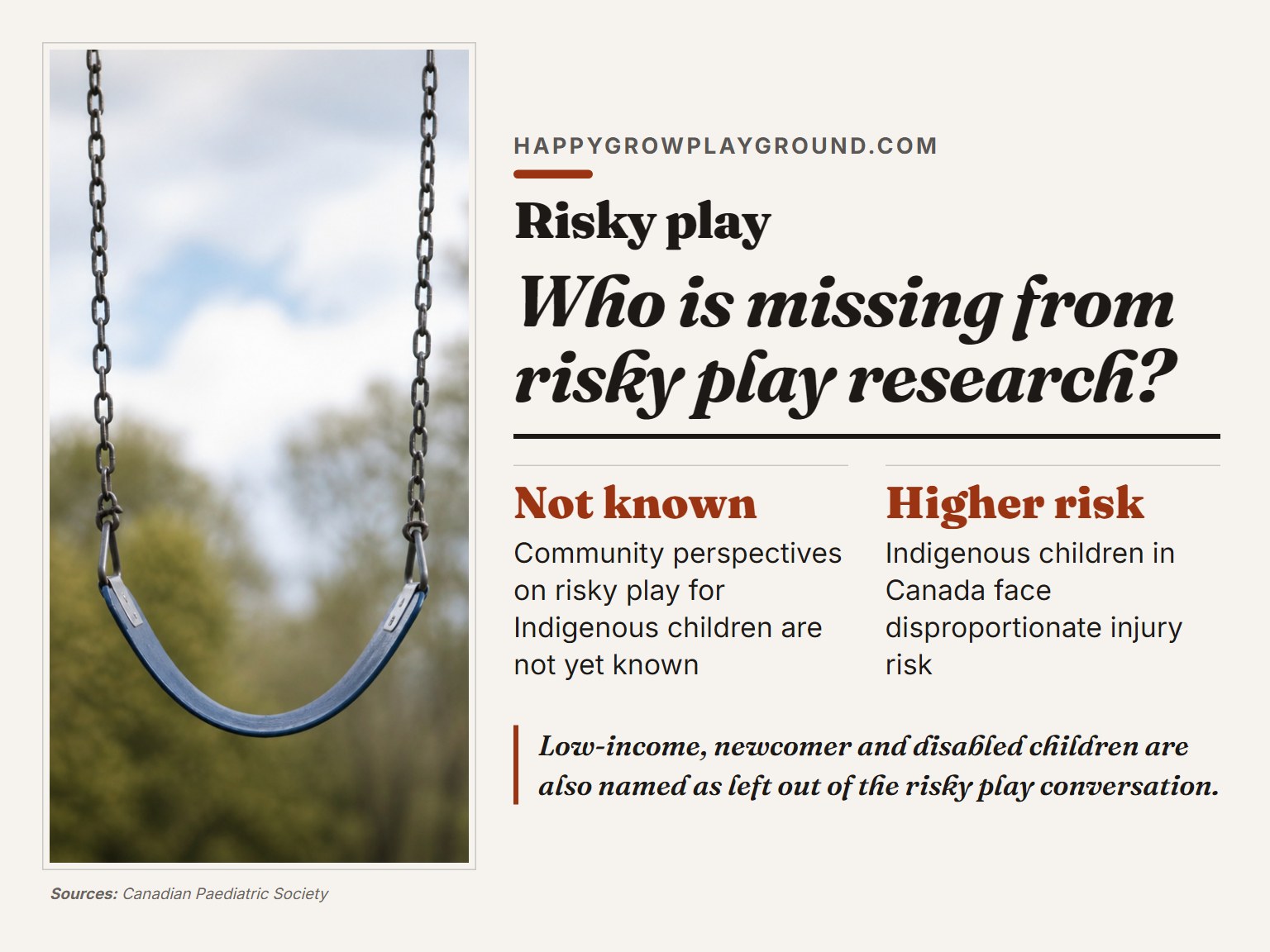
The Canadian Paediatric Society notes that Indigenous children in Canada face much higher injury risk. A literature search for the same position statement found no ongoing project and no published study assessing risky play effects in First Nations, Inuit, and Metis children. Community perspectives are not yet known.
- Children in low-income neighborhoods. A Canadian study found parents worried about having no extra money for their children’s play and about the physical safety of play spaces.
- Newcomer families. A focus group of mothers new to Canada named discarded needles and homeless encampments as the reason they kept kids close.
- Children with disabilities. Over-protection and lowered expectations reduce self-esteem and belonging, while manageable risk-taking promotes independence.
Children With Disabilities and the Over-Protection Trap
That last bullet is the one I think about most. The instinct to shield a kid with a disability from every bump is understandable, and the CPS position statement is blunt that it backfires.
The unstructured play that most kids get by default often has to be deliberately built for a child with a disability. That is a design problem, not a parenting failure.
Frequently Asked Questions
Is risky play actually safe for young children?
Safe is the wrong frame. Canadian injury surveillance puts tree climbing at 195 injuries per 100,000 records, the lowest of five tracked activities, and most of those injuries are minor. Risky play carries a low but real injury rate, and the surface underneath decides how bad a fall turns out.
What is the difference between a risk and a hazard?
Risk is something a child can see, judge, and choose to take on, like a climbing wall with visible holds. A hazard is something they cannot see or judge, like a loose bolt or a buried stake. The first builds judgment. The second just hurts people.
Does risky play make kids more aggressive?
For most subtypes, the evidence is inconsistent. Rough-and-tumble play is the exception: a 74-study review found a negative association with aggression, meaning more aggression rather than better self-control. If wrestling is followed by more hitting, that finding is the one to act on.
How high should a climber be for a five-year-old?
There is no agreed number. A New Zealand study found fracture frequency and severity unrelated to equipment height, while a separate review linked falls above 1.5 m to higher fracture odds, and the Canadian Paediatric Society calls those results inconsistent. Pick a height your child can climb down from without help.
What should go under a climbing structure?
Loose engineered wood fiber at the depth your local code requires, spread across a fall zone around the structure. Measure depth at the wear spots under the ladder and the slide exit, because that is where it compacts.
The Bottom Line
The risky play pros and cons do not resolve into a tidy answer, and anyone who tells you otherwise is selling something. What the evidence supports is narrower and more useful: the injuries are mostly minor, the benefits are real but not yet proven to the standard researchers want, and the surface under the equipment matters more than the height of it.
If you do one thing this week, walk your yard and tap the ground under every climber with your heel. Hollow means compacted. Compacted means a short fall lands like a much longer one.
Here is my honest concession. Everything above assumes you have a yard, a budget for surfacing, and the spare attention to supervise. If you do not, the math changes, and the parents in that focus group who named needles and encampments were not being overprotective. They were reading their street accurately.
And one stance I will defend: I would rather see a kid halfway up a tree with an adult watching than a kid who has never been allowed to find out what their own body can do. The tree is not the danger. The ground under it is.
