
How Much Weight Can a Playset Hold? Model-by-Model Numbers
This post contains affiliate links. As an Amazon Associate, we earn from qualifying purchases.
How much weight a playset can hold varies by model: published per-child limits run from 105 lb on Propel’s 9-station swing set to 150 lb for individual use on Backyard Discovery’s Cedar Cove. Multi-child use drops that to 120 lb per child.
That multi-child drop is the how much weight can a playset hold number parents miss. Two kids on one glider share a single station, so the 150 lb figure on the box stops applying the moment a friend climbs on. Read only the headline number and you’ll buy a set that felt solid in the showroom and starts flexing at the joints by the second summer.
What follows: the real per-child and combined-load numbers by model, the two standards that decide which number applies to your yard, and the hardware check that tells you whether your set still deserves its rating.
Key Takeaways
What the Weight Sticker on the Box Actually Governs
ASTM F1148-24 is the standard a residential playset is built and labeled against. It defines what counts as home playground equipment and which activities the standard covers.
ASTM F1148-24, the consumer safety specification for home playground equipment, covers children over 18 months through 10 years. Its scope covers climbing, swinging, sliding, rocking, spinning, crawling, and creeping equipment. Weight capacity varies by manufacturer: each publishes its own per-child rating, and that rating governs the set it ships to a home.
The standard leaves the capacity number to the manufacturer, and the manufacturers don’t agree with each other.
Those last two numbers describe different situations, and that’s the part that catches families out. A per-child rating covers one child on one activity at a time. A multi-child rating covers several children spread across the set, each activity loaded separately.
Common mistake: Reading the per-child number as a total for the whole structure. Put four kids on the same glider and you’re past the multi-child limit before anyone starts swinging, and the brackets feel it inside a season.
A zinc-plated bolt that’s been through two winters comes out with fine orange dust on the threads. That dust is your capacity leaving.
Here’s what a per-child rating actually covers:
- One child, one activity. The number applies to a single user on a single station at a single moment.
- A set in good repair. Loose bolts, split wood, and missing caps all reduce what a joint can take.
- The set as assembled. Under-torqued hardware changes the real limit, which is why KidKraft’s manual budgets 12 to 18 hours of two-person assembly time.
Why Do Two Playsets of the Same Size Have Different Limits?
The gap comes from two things: which standard the manufacturer built to, and which age group it was aiming at.
Home manuals cite ASTM F1148, the residential standard. Commercial product pages cite ASTM F1487, plus CAN/CSA-Z614 and CPSC Pub. 325. Same word on the box, different rulebook underneath.
| What Changes | Residential (ASTM F1148) | Commercial (ASTM F1487) |
|---|---|---|
| Governing standard | ASTM F1148-24 | ASTM F1487, CAN/CSA-Z614, CPSC Pub. 325 |
| Age range printed | 3 to 10 (KidKraft), 2 to 10 (PlayStar) | 5 to 12 (Playworld) |
| Capacity math | Per-child limit per activity | Per-station limit, 48 to 54 users |
| Legal installation | Home yards only | Schools, parks, public assembly |
The age range is the other half of the answer. ASTM F1148-24 covers children over 18 months through 10 years, and the standard stops at ten. That’s why playsets for older kids sit outside it entirely and lean on a different set of numbers.
The misuse framing matters too. PlayStar states that installing the product in a place of public assembly, such as a school or park, is a misuse of it. KidKraft’s manual puts it in capitals: residential home use only, with multi-unit residences, schools, churches, nurseries, day cares, and parks named as off-limits.
The Child-Care Carve-Out Most Owners Never Read
ASTM F1148-24 §1.2 makes one exception that surprises people. A child-care center run out of a private home is exempt from the residential standard, provided the provider cares for no more than six children under ten who don’t live in the household, and the total number of children under ten stays at ten or fewer counting the provider’s own.
So a home daycare with five visiting kids passes. One with nine doesn’t, even when the equipment is identical to the set next door.
The same section exempts electrically operated constant-air inflatables, and free-standing play houses where the child stands or sits with feet on the ground and no climbing, sliding, or swinging happens.
How Much Weight Can a Playset Hold? Model-by-Model Numbers
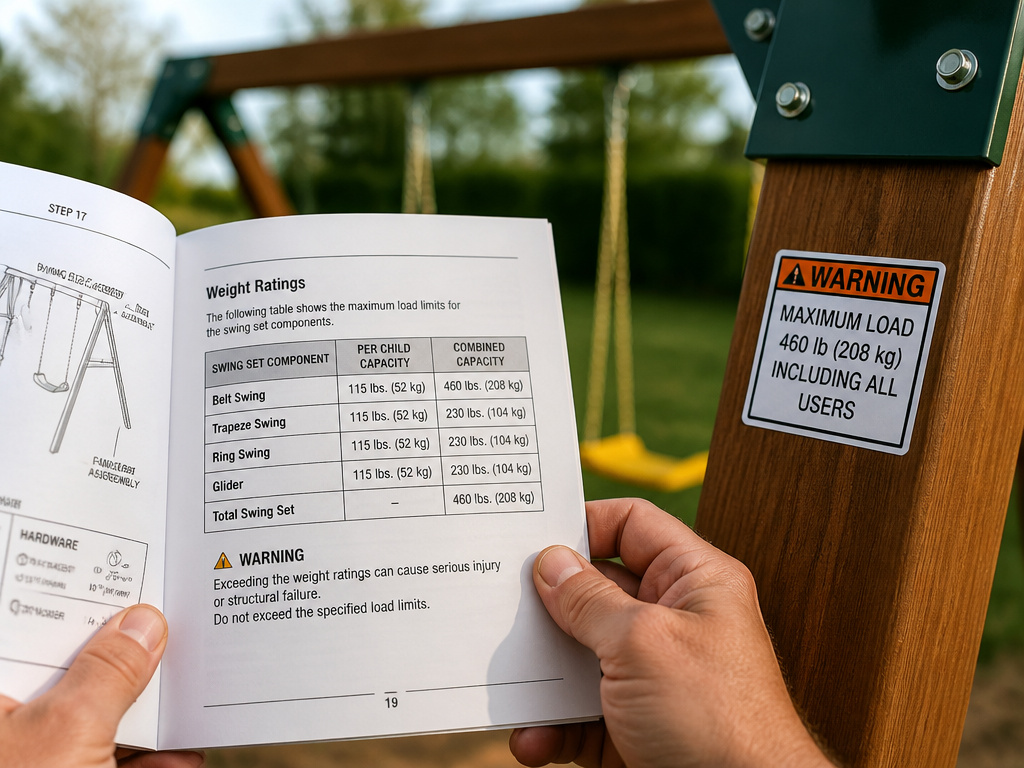
The first set I ever sourced, I picked on price and never checked the weight rating. One busy weekend showed me the difference: the top rail gave a soft, spongy flex under my hand with a queue of kids on it, and I spent the following month learning to read a load spec before I read anything else.
That lesson goes to every family I sell to now. The rating that applies to your set is printed in the manual, not on the marketing page, and it varies more than most people expect.
| Model | Per-Child Limit | Multi-Child Limit | Combined Capacity |
|---|---|---|---|
| Propel P9-SS-19 (9 stations) | 105 lb | 105 lb per station | 945 lb total |
| Backyard Discovery Cedar Cove #2400269 | 150 lb | 120 lb | 9 children |
| Backyard Discovery Sterling Point #2400252 | 150 lb | 120 lb | 9 children |
| KidKraft Swing Set 9409920 | 110 lb | Not stated | 13 users, ages 3 to 10 |
| PlayStar LT_5760 tower and swing beam | 105 lb | One child per station | Not stated |
Read that table by column, not by row. The per-child column tells you who can get on. The multi-child column tells you what happens when a friend joins in. The combined column tells you what the frame and the anchors are rated to carry at once.
Cedar Cove and Sterling Point carry the same 150 lb individual rating and the same 120 lb multi-child rating. Sterling Point also publishes a maximum fall height of 6 ft 11 1/4 in (2112 mm) and a safe play height of 17 ft 5 in (5309 mm), which is the number I actually want before I sell a set to a family with a climbing kid.
How Do You Add Up a Combined Load?
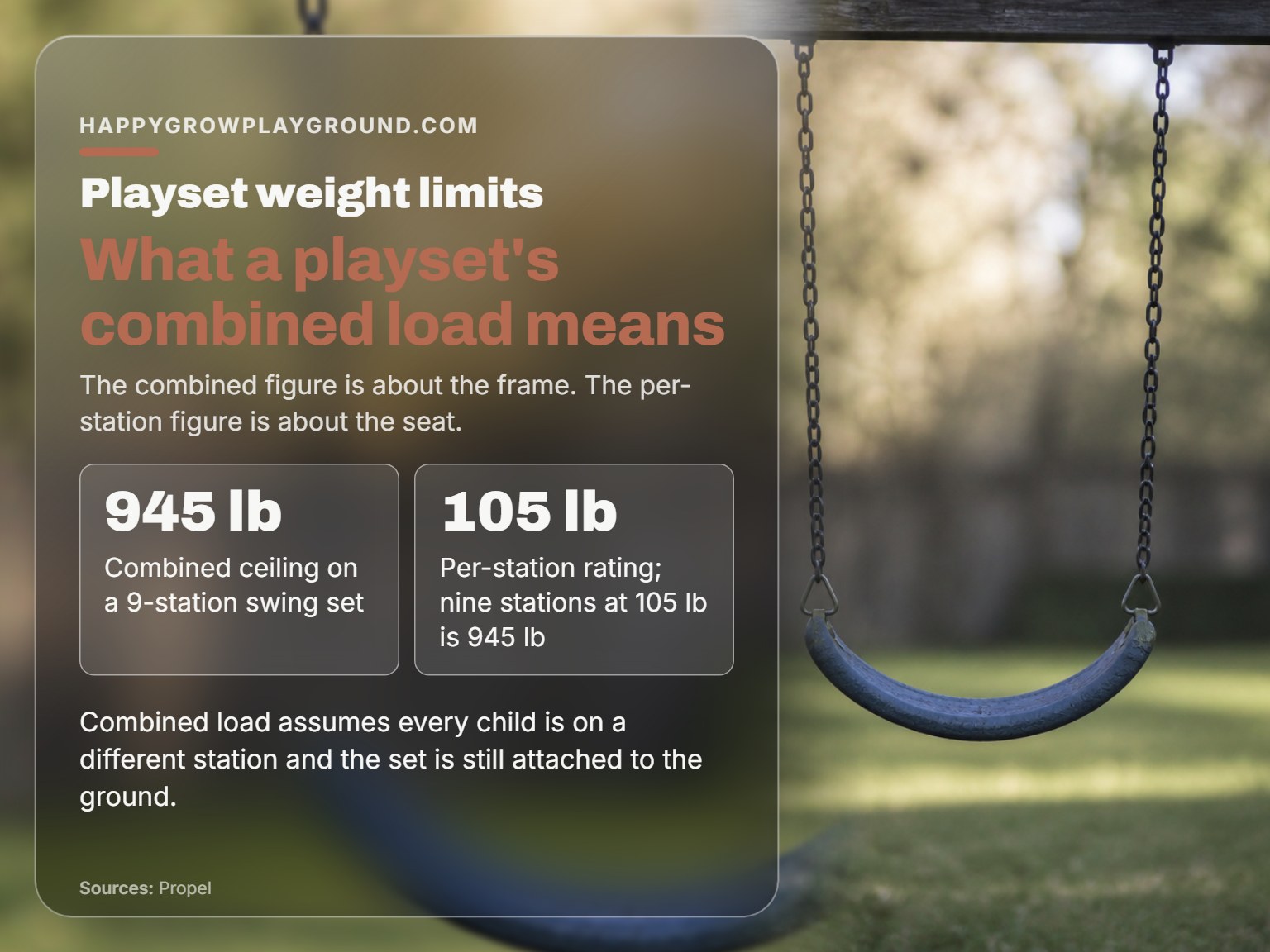
945 pounds is the number Propel prints as the combined ceiling on its 9-station swing set. That total sits on top of the per-station rating, not inside it.
Nine stations at 105 lb each is 945 lb, which means a full set of kids can be within the per-station limit and still be sitting at the very top of what the frame is rated to carry. The combined figure is about the frame. The per-station figure is about the seat.
That distinction matters most on swing beams, where the structure is rated separately from the swings hanging on it. Whichever number is lower is the one that governs.
Combined load also assumes the set is still attached to the ground.
The part nobody mentions: The combined number assumes every child is on a different station. Two kids sharing one swing seat put their combined weight on a single station rated for one child, and that’s how a set that looks within spec still bends a hanger.
When the Rating Stops Being True
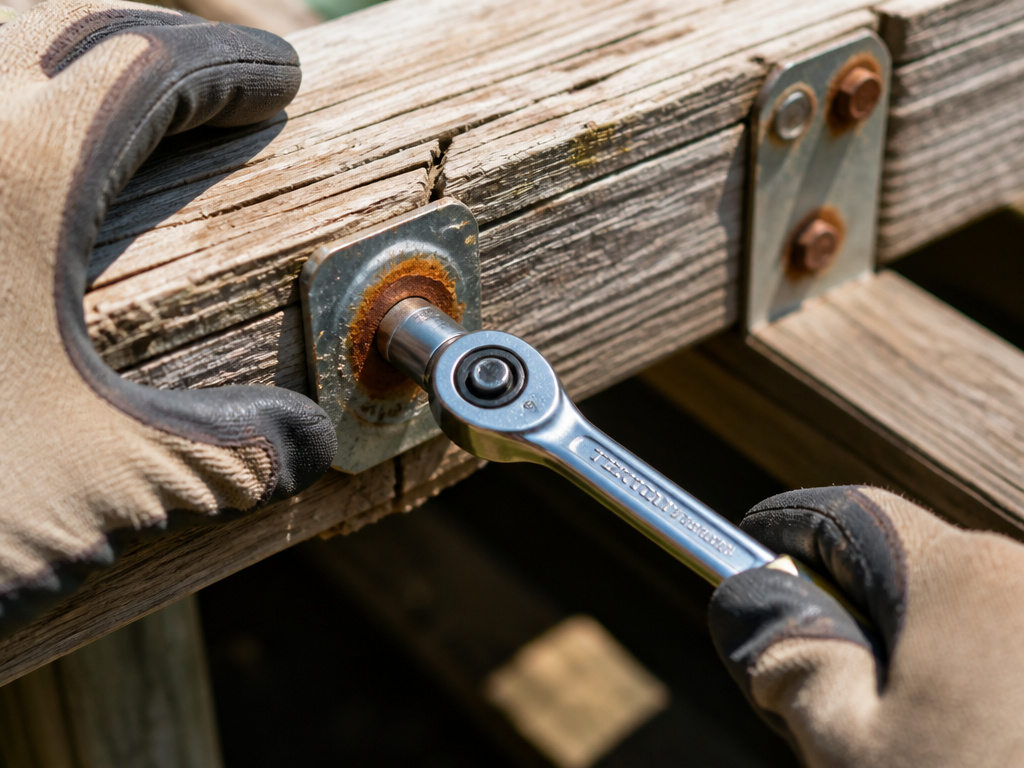
Rust retires more playsets than weight does. A 150 lb rating is a claim about a set in good repair, and corroded brackets, backed-out bolts, and a frame sitting on bare dirt all take capacity away without changing a word in the manual.
Before you start: Check the set in daylight, because rust bloom at a bracket is nearly invisible under a porch light. Wear gloves when you run a hand along the underside of the top rail; split wood and exposed bolt threads both draw blood. Never test a suspect joint by hanging your own weight from it.
The Two-Minute Hardware Check
- Put a hand on every bracket where a bolt passes through wood. Skip it and you’ll find the loose one the way I did, by watching a swing seat drop two inches mid-arc.
- Look for rust bloom around each bolt head. A fastener already showing orange is on its way out, and the joint loses clamping force as it goes.
- Rock the top rail side to side with one hand. Any movement at the post tells you the lag screws or T-nuts have lost their grip.
- Check the ground stakes. Backyard Discovery ships auger ground stakes with its fort kits for a reason, and a set that has pulled its anchors is a set with no capacity rating left.
A bolt that has backed out once will back out again, and the second time tends to happen mid-swing.
The manual lists the torque values and the hardware counts, and matching the set to the page is faster than guessing.
Where this goes sideways: Retightening hardware without checking the wood underneath. A bolt that keeps coming loose is sitting in soft, wet wood, and tightening it again just makes the hole bigger.
What to Do If Your Kid Is Already Over the Limit
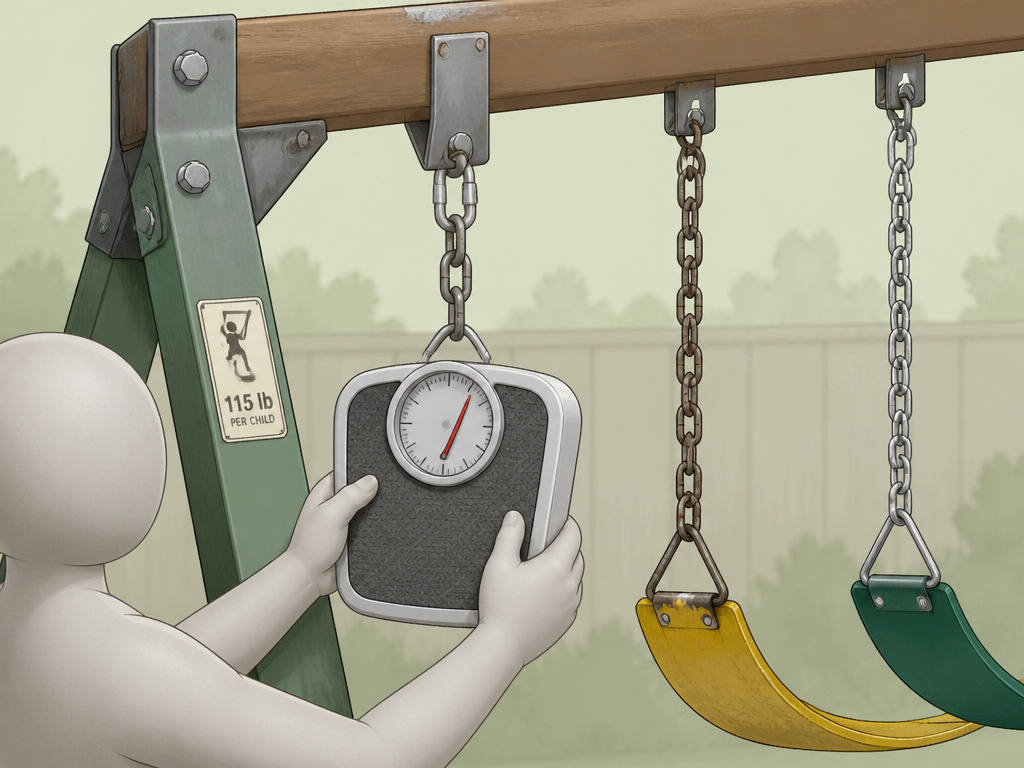
Outgrowing a weight rating is a normal event, not a failure of the set or the kid. A child who was 60 lb at six can be 90 lb at ten and swinging harder than the set was ever rated for.
You have four moves, and they cost different amounts of effort:
- Move the heavy activity to a stronger station. The fort deck and the slide carry their own ratings, and the loading is different from a swing.
- Replace the hangers and seats first. A worn swing seat with a stretched chain puts load where the frame wasn’t designed to take it.
Easy to miss: The age range on the box is not a weight promise. A set labeled ages 3 to 10 can be fine for a 12-year-old at 85 lb who’s under the per-child limit, and completely wrong for a 9-year-old at 160 lb who’s over it.
When to Move Up to a Heavier-Rated Set
The number to check is the weight, not the birthday. Every manual I’ve read prints both, and only one of them is a capacity rating.
If the per-child limit on your set is 105 lb and your oldest is 95 lb, you’re one growth spurt from a problem. That’s the moment to plan the upgrade, not the moment after something bends.
Frequently Asked Questions
Is there a standard weight limit for a playset?
Can two kids use a swing at the same time?
Does a heavier post mean a higher weight limit?
Post size isn’t what the rating is built on. The capacity number comes from the manufacturer’s testing of the assembled structure, and the joints, brackets, and anchors carry the load into the ground. Hardware grade and assembly quality decide whether the printed rating still holds after a few seasons.
What happens if you exceed the weight limit on a playset?
The set doesn’t fail all at once. You’ll see it first as flex at the top rail, a swing hanger that bends, or a bolt that keeps backing out. Overloaded joints also crush the wood around them, which enlarges the hole and permanently reduces what the connection can hold.
How much weight can a commercial playset hold?
Do I need to re-check the rating after I move a playset?
Yes. A set that’s been taken apart and rebuilt has new hardware joints, and a set that’s been dragged across a yard has anchors that no longer hold. Re-read the assembly section of the manual and re-torque everything before you trust the original number.
The Bottom Line
If your kids’ combined weight on any single station is closing in on the printed limit, stop adding kids to that station and go read the combined-load line in the manual. That’s the trigger. Everything else is maintenance.
I’ll concede one thing before you go. The higher-rated set isn’t automatically the right buy. A 105 lb set that’s anchored properly, inspected once a year, and matched to the age group on the box will outlast a 150 lb set sitting on bare dirt with rusty brackets. Durable beats fancy every time.
So start with the number in your own manual. Then the hardware. Then the footprint. In that order, the question of how much weight can a playset hold stops being a guess.
