BPA and Phthalates in Toys Explained: What Labels Miss
This post contains affiliate links. As an Amazon Associate, we earn from qualifying purchases.
BPA and phthalates in toys explained: US federal law bans eight phthalates above 0.1 percent (1000 ppm) in any accessible part of a children’s toy or child care article. BPA has no federal toy limit in the US, while the EU caps BPA migration at 0.1 mg/L for toys intended for children under 36 months.
Accessible is the phrase doing the heavy lifting there, and it’s the BPA and phthalates in toys explained question in miniature. A part counts as accessible when it’s physically exposed, or when ordinary use and abuse would expose it, and that one definition decides whether a phthalate limit applies to it at all.
What follows walks the actual rule: the eight banned phthalates, the 5-centimeter mouthability line, the age bands that pick which lab test applies, and the two places where US and EU law genuinely disagree.
Key Takeaways
- The limit is 0.1 percent, or 1000 ppm, per phthalate, measured in each accessible component part.
- Eight phthalates are banned in the US: DEHP, DBP, and BBP permanently, plus DINP, DIBP, DPENP, DHEXP, and DCHP.
- Any part under 5 centimeters in one dimension is treated as mouthable and pulled into the rule.
- BPA sits outside the US federal phthalate rule entirely. The EU caps it at 0.1 mg/L for toys for children under 36 months.
- In a 2022 EU sweep, 8 of 94 toys failed, and every chemical failure turned up in soft plastic.
What Does the 0.1 Percent Limit Actually Cover?
Section 108 of the Consumer Product Safety Improvement Act sets the number that matters: 0.1 percent, or 1000 ppm, per phthalate, per accessible component part.
The federal limit applies at 0.1 percent, or 1000 ppm, for each prohibited phthalate measured separately in an accessible component part. Three phthalates, DEHP, DBP, and BBP, are permanently prohibited under the statute. Five more, DINP, DIBP, DPENP, DHEXP, and DCHP, were added by Commission rule in 2017. Materials subject to the limit must meet third-party testing requirements.
The measurement runs per phthalate, which is the BPA and phthalates in toys explained detail most people miss. A part can sit under the limit for DEHP and still fail on DINP, which is why labs run the full panel instead of a single screen. The federal ban on specified phthalates lists which three are permanent and which five arrived later.
Third-party testing applies unless a material is on the exempt list.
The CPSIA toy rules work the same way: the law targets plasticized parts, not everything in the box.
Easy to miss: A toy can clear the phthalate limit and still fail on labelling. In the 2022 EU campaign, 33 of 94 samples missed requirements for warnings, markings, or instructions.
Which Toy Parts Count as Accessible?
Accessibility is where most parent questions land, and the rule answers it in two steps.
The 5-Centimeter Line
A part counts as mouthable if a child can bring it to the mouth and keep it there to suck and chew. Licking doesn’t count. The regulation then draws a hard line: if a toy or part is smaller than 5 centimeters in one dimension, it can be placed in the mouth.
That number matters more than the age on the box. A 4-centimeter plastic wheel on a toy labeled for five-year-olds still trips the rule if it can work loose.
When Fabric Counts as a Barrier
Fabric casing can make a part inaccessible, but only if the covered part survives the right use and abuse tests. There’s a catch. The exemption dies if the part is under 5 centimeters in one dimension.
Paint gets no such treatment. The 16 CFR 1199.1 inaccessible components rule states that paint, coatings, and electroplating may not be considered a barrier, so a painted-over part stays accessible. The lead paint in toys rule follows the same logic: a coating can’t be used to hide what sits underneath it.
Common mistake: Assuming sheets and mattress pads shield a vinyl sleep surface. The rule treats vinyl-covered mattresses for children age 3 and younger as accessible regardless of fabric coverings.
The age on the box also picks which test the lab runs. That’s the part I keep returning to, because it means the label is doing regulatory work, not just marketing work.
| Intended age | Use and abuse tests applied | Rule |
|---|---|---|
| 18 months or younger | 16 CFR 1500.50 and 1500.51 | 1199.1(e) |
| Over 18 months, up to 36 months | 16 CFR 1500.50 and 1500.52 | 1199.1(f) |
| Over 36 months, up to 96 months | 16 CFR 1500.50 and 1500.53 | 1199.1(g) |
| Over 96 months through 12 years | 16 CFR 1500.50 and 1500.53 | 1199.1(h) |
Every one of those bands excludes the bite test. That’s why I test at the edges of a stated age range rather than the middle, and why the safe toys for toddlers question gets harder once a child mouths everything in reach.
A few scope questions come up constantly, and the CPSC phthalate compliance questions answered page settles them directly:
- Shoes and socks are out. They aren’t toys or child care articles under this rule.
- Packaging is usually out, unless it’s reusable or built into the play.
- Pool toys, beach balls, rafts, and inner tubes are in if they’re meant for children 12 or younger.
- Small batch manufacturers can qualify for testing relief.
Why Do Soft Plastic Toys Keep Failing Lab Tests?
Forty-nine of 255 toys failed chemical testing in one European market surveillance sweep, and 48 of those were rated a serious risk.
That’s the PROSAFE JA2015 report, published in 2018. DEHP and DINP were the predominant phthalates found. Authorities imposed a sales ban on 71 percent of the non-compliant products and a recall on 25 percent, then issued 43 rapid alert notifications.
Soft plastic keeps showing up because of how plasticizers work. They aren’t chemically bonded into the PVC polymer. They sit between the chains, doing the job of keeping the material flexible, and they migrate toward the surface over time.
The 2022 EU campaign found the same pattern in a smaller sample. Eight of 94 toys failed at least one health and safety requirement, and the dangerous chemicals turned up exclusively in toys made entirely or partly of soft plastic.
One detail is worth sitting with. Phthalates above the limit were found most often on dolls’ faces and legs made of pink soft plastic. BPA above the limit turned up in two duck bath toys.
The signs of toxic toys most parents watch for are smell and texture, and those catch the soft plastic category better than anything else.
Where this goes sideways: Assuming a toy is safer because it’s aimed at babies. The 2022 campaign found a 14 percent failure rate for toys intended for children over 36 months, against 4 percent for toys under 36 months.
The peer-reviewed picture is messier still. A PLOS ONE toy endocrine disruptor study tested 18 toys with two CALUX bioassays and found significant estrogenic activity in 9 of them. BPA explained only 2 of those 9. For 7 samples, the researchers couldn’t identify the source at all.
That last finding is the one I’d want every parent to read. A label covers a short list of named chemicals. A lab result covers whatever is actually in the plastic.
BPA: Two Regulators, Two Different Answers
Ask whether a toy is BPA-safe and the answer depends on which side of the Atlantic you’re standing on.
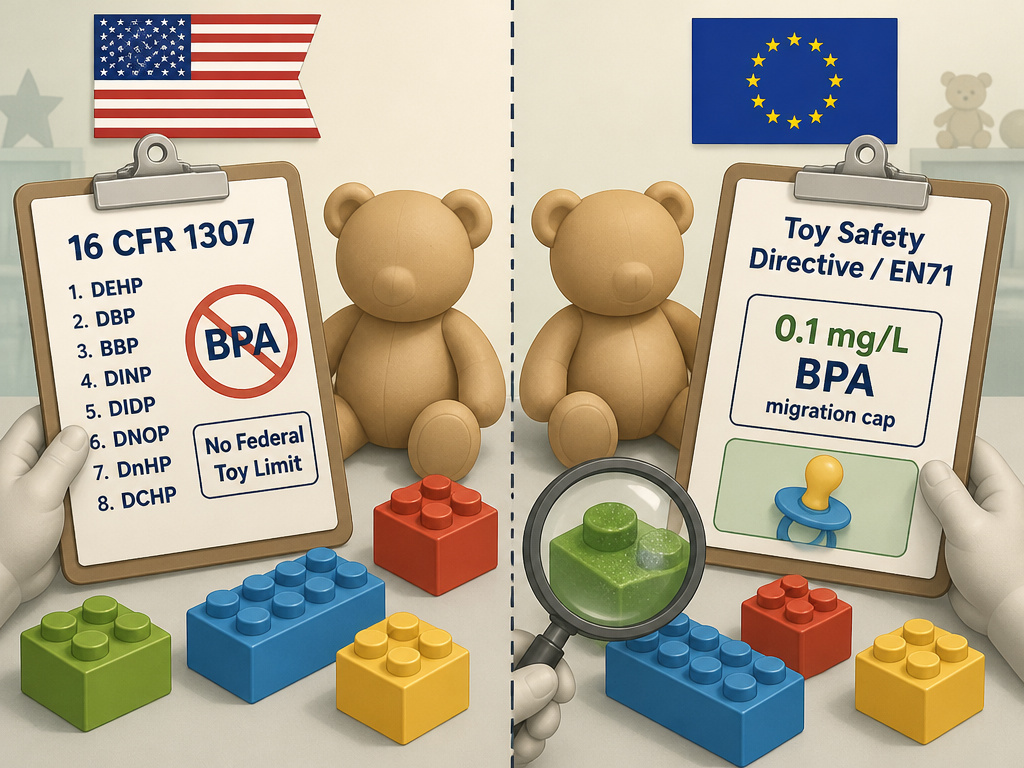
The US federal phthalate rule doesn’t restrict BPA at all. 16 CFR 1307 covers eight phthalates and stops there. The EU goes the other direction: BPA migration is capped at 0.1 mg/L for toys intended for children under 36 months, or for any toy intended to be placed in the mouth, applicable from 21 December 2015.
| What the rule covers | United States | European Union |
|---|---|---|
| Phthalates banned | Eight, above 0.1 percent each | Four in all toy polymer, three more in mouthable toys |
| BPA | No federal toy limit at all | Migration capped at 0.1 mg/L for under-36-month toys |
| Mouthability trigger | Any part under 5 cm in one dimension | Toys intended to be placed in the mouth |
The EU side runs through the Toy Safety Directive, with the EN71 toy safety standard handling the physical and mechanical testing alongside it.
Here’s the part worth flagging. The two systems restrict different chemicals and scope them differently. The EU’s REACH restrictions cover four phthalates in all toy polymer and three more only in mouthable toys. The US list is eight, applied uniformly to accessible parts.
The DINP Rule That Doesn’t Match Its Own Paperwork
The DINP restriction is written two different ways in two official places.
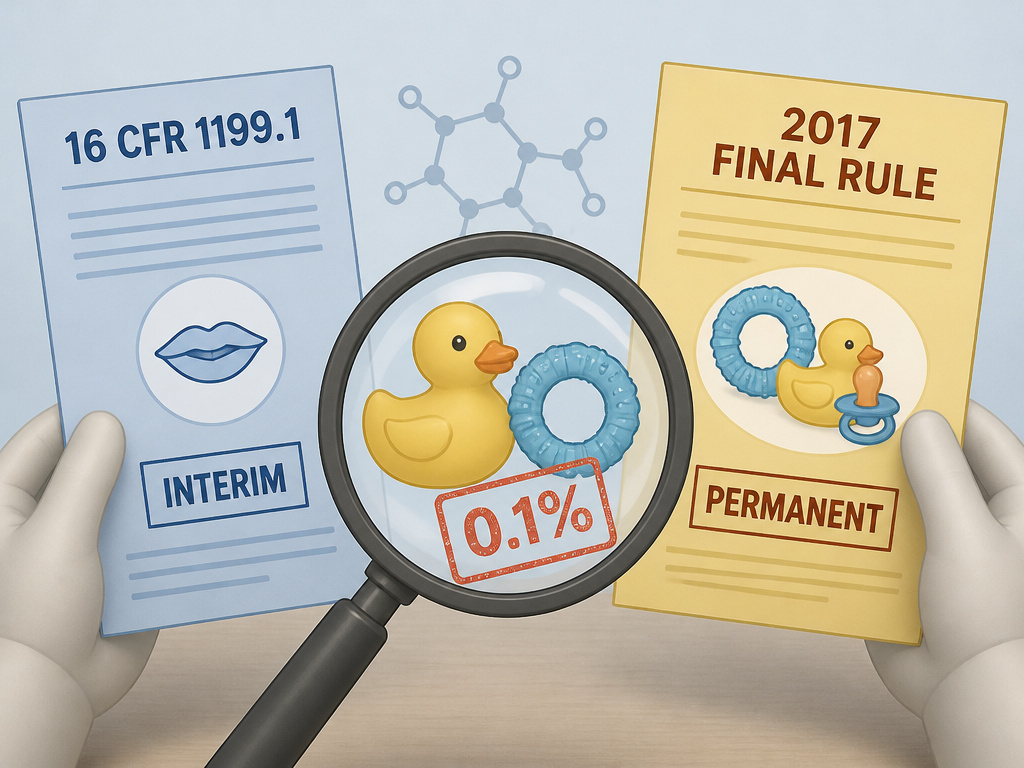
The codified text at 16 CFR 1199.1 still describes DINP as an interim prohibition, limited to toys that can be placed in a child’s mouth and to child care articles, at more than 0.1 percent, while the 2017 final rule made the DINP prohibition permanent and expanded it to all children’s toys and child care articles.
The 2017 final rule on phthalates in toys made that prohibition permanent and expanded it to all children’s toys and child care articles, effective April 25, 2018, while the codified text at 16 CFR 1199.1 still describes DINP as an interim prohibition limited to mouthable toys and child care articles.
Both documents are current. The regulation text and the rulemaking preamble disagree about scope, and the preamble is the newer of the two. I’d rather a parent know about the discrepancy than assume the shorter text is the current one.
Rule of thumb: When a compliance claim cites the mouthability test, ask which version of the DINP rule the lab worked from. The 2017 expansion made mouthability irrelevant for DINP.
Why the change happened matters too. The CHAP found that certain phthalates cause adverse effects on the developing male reproductive tract and act cumulatively. DINP was classified as an active, antiandrogenic phthalate. DIBP, DPENP, DHEXP, and DCHP all cause male reproductive developmental effects and are as potent as, or more potent than, DEHP.
Does BPA-Free on the Box Mean Anything?
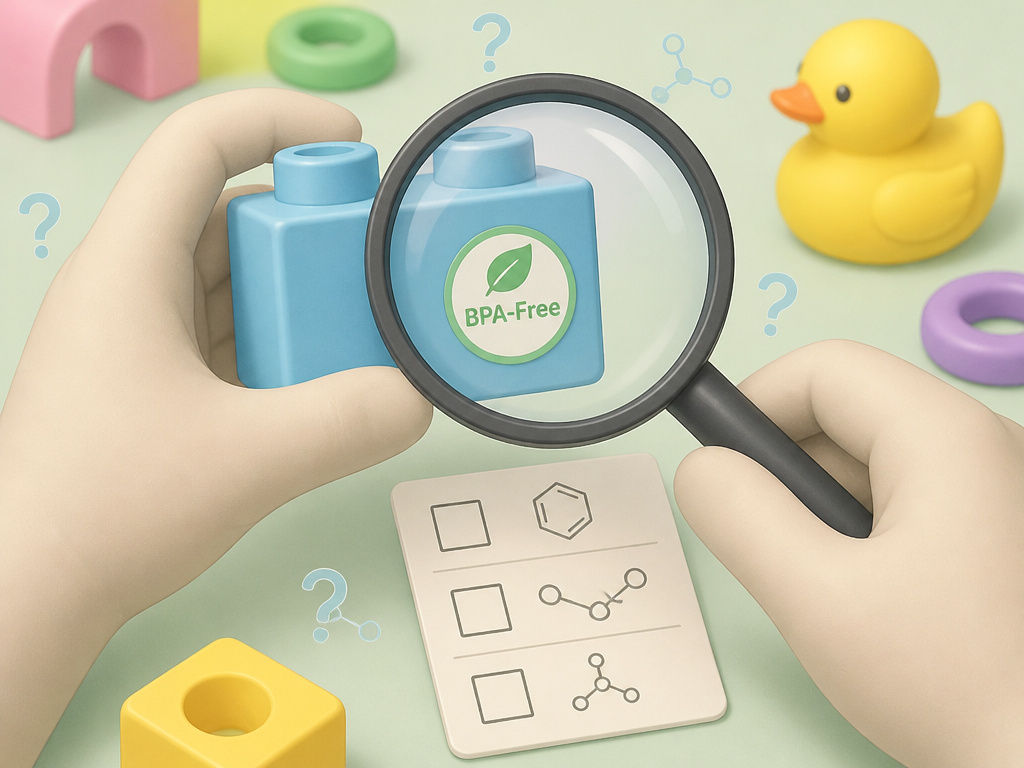
What does the phrase actually certify? In the US, nothing in federal toy law requires it.
BPA-free is a marketing claim, not a regulatory category. Nothing in 16 CFR 1307 defines it, and the CPSC guidance on phthalates in toys confirms BPA sits outside this rule entirely. A toy can carry the phrase and still contain a plasticizer that’s on the banned list.
What the claim does tell you is that the manufacturer is thinking about the question.
I’ve stopped treating BPA-free as a finish line. It answers a narrow question about one chemical, and the studies keep finding activity that one chemical doesn’t explain.
Shopping the non-toxic baby toys shelf gets easier once you know what the US rule actually covers.
- It covers one chemical. BPA isn’t on the US phthalate list at all.
- It says nothing about phthalates, which are the chemicals that dominate market surveillance failures.
- It says nothing about substitute plasticizers a manufacturer may legally use instead.
How to Check a Toy Before You Buy It
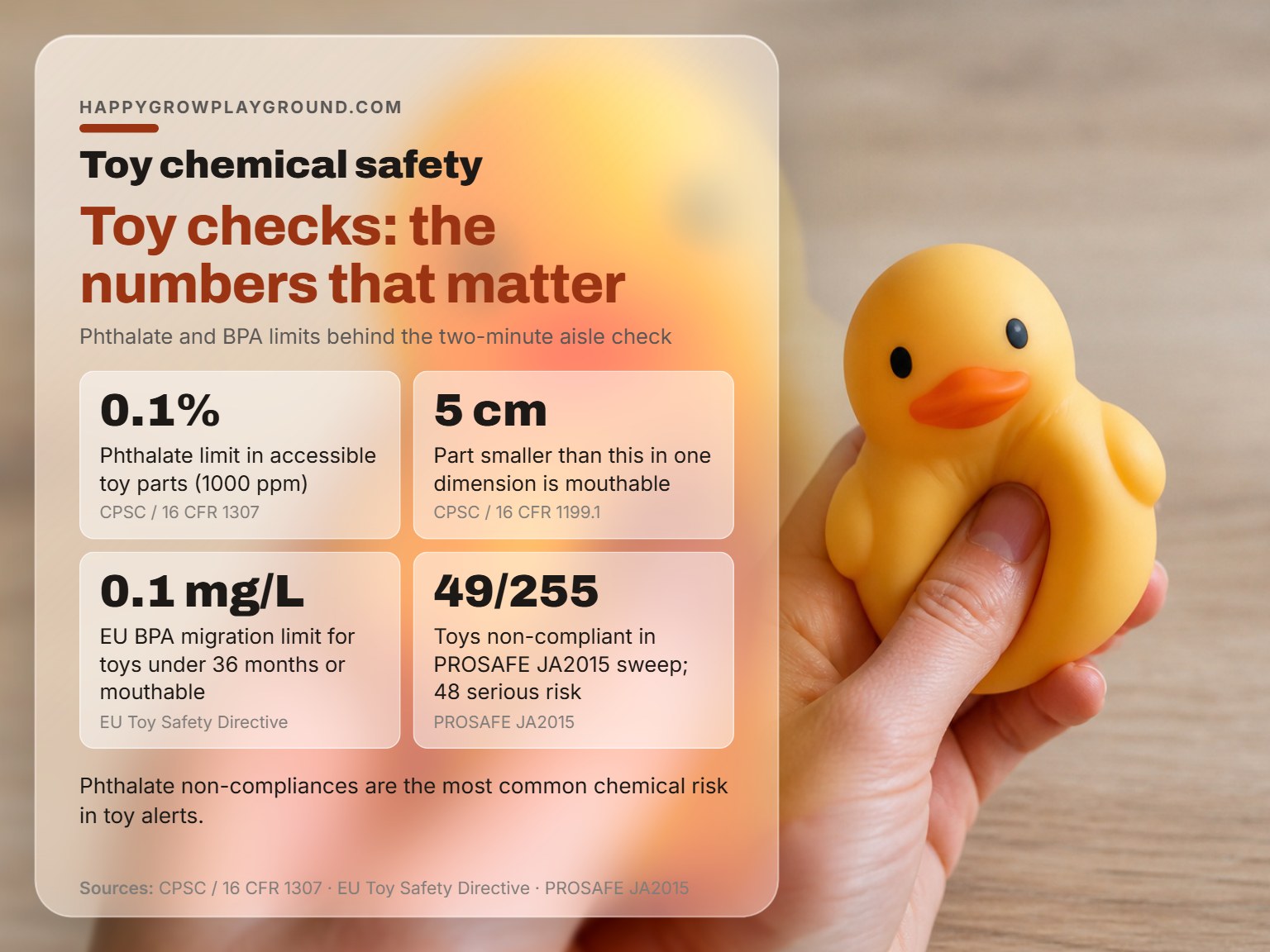
Five checks take about two minutes in the aisle, and none of them need a lab.
Before you start: Soft plastic is the category where market surveillance keeps finding chemical failures, so treat it with more suspicion than hard plastic or wood. Any part under 5 centimeters in one dimension is mouthable under the rule, whatever the age label says. And aging counts as reasonably foreseeable use, so a part that was sealed at the factory may not be sealed by the time it reaches your floor.
- Squeeze the part. If it flexes the way a bath toy does, it’s soft plastic, and soft plastic is where every chemical failure in the 2022 EU sweep turned up.
- Measure the smallest piece. Under 5 centimeters in one dimension, the law treats it as mouthable regardless of the age band.
- Read the age band, not the age range. The intended age picks which use and abuse test applies, and that changes what the manufacturer had to prove.
- Check the source. The 2022 campaign recommends buying from trustworthy retail channels and checking for the CE mark on EU-sold toys.
- Re-inspect after a few months. Aging is written into the accessibility definition, so a part that survives month one can still come loose in month six.
What to Buy Instead
Hard plastic, wood, and natural rubber aren’t automatically clean, but they aren’t the category where the failures cluster.
The wooden toys category is where I’d start for anything a child will put in their mouth.
One more thing. The age range on the box is a manufacturer’s declaration more often than an engineering fact. It picks the test procedure, and the CPSC definition of a children’s toy turns on what the manufacturer intended. I’d rather you watch your own kid than the label.
Frequently Asked Questions
Is BPA banned in children’s toys in the US?
No. The federal phthalate rule at 16 CFR 1307 covers eight phthalates and doesn’t restrict BPA at all. The EU does cap BPA migration at 0.1 mg/L for toys intended for children under 36 months, or for toys intended to be placed in the mouth. In the US, the BPA question is answered by the manufacturer, not by federal law.
What does 1000 ppm mean on a toy label?
It’s the same threshold as 0.1 percent, expressed as parts per million. The limit applies to each prohibited phthalate separately, measured in an accessible component part. A toy with three plasticized parts gets three separate measurements, not one average.
Are wooden toys automatically free of phthalates?
Not automatically, but wood isn’t a plasticized material, so the phthalate question mostly doesn’t apply. Watch the finishes and the plastic add-ons, since coatings can’t be used as a barrier and small plastic parts fall back under the 5-centimeter rule.
How do I know if a toy part is accessible?
Part is accessible if it’s physically exposed, or if normal use and abuse would expose it. That includes swallowing, mouthing, breaking, and aging. A sealed casing or fabric cover can make a part inaccessible, unless the part is under 5 centimeters in one dimension.
Do pool toys and beach balls have to comply?
Yes, if they’re designed or intended for children 12 years of age or younger. The CPSC treats pool toys, beach balls, blow-up rafts, and inner tubes as children’s toys under this rule. Children’s shoes and socks are excluded.
Why did a toy pass one country’s rules and fail another’s?
Because the rules cover different things. The US list is eight phthalates applied to accessible parts. The EU restricts four phthalates in all toy polymer and three more only in mouthable toys, and it caps BPA migration. A toy can be legal in one market and non-compliant in the other without a single change to the plastic.
Before You Go
The 2020 PLOS ONE study ends with a caveat worth keeping: compared with natural estrogens in food, the total uptake of estrogen activity from mouthing toys looks low. Eighteen toys is a small sample, and that finding doesn’t clear the category. It does mean the goal is fixing specific problems rather than emptying the toy bin.
So here’s the trigger I’d use. If a toy is soft plastic and any part is under 5 centimeters in one dimension, it leaves the shelf. Everything else gets inspected, tightened, and re-checked after a few months, because aging counts as foreseeable use and a sealed part doesn’t stay sealed.
This all assumes a toy that’s still intact. Once a plastic part cracks or a seam splits, the accessibility math changes, and the phthalate question comes back for a part that already passed.
And the thing I’d actually change: stop reading the age range as a safety rating. It’s a test-selection input and a marketing line. Watch your own kid instead. A cautious 6-year-old and a climbing 3-year-old need different toys, and you’re only shopping for one of them.
