
Magnet Toy Safety: What the Box Doesn’t Say
This post contains affiliate links. As an Amazon Associate, we earn from qualifying purchases.
Magnet toy safety rests on two measurable tests, not the age printed on the box: the magnet must fit entirely inside the small parts test cylinder, and it must reach a flux index of 50 kG2mm2 or more to count as hazardous under 16 CFR Part 1262. The rule covers products made after October 21, 2022.
That 50 kG2mm2 line is where the confusion starts. It measures the magnet itself, and the magnet is the part that ends up inside a child regardless of what age the box claims. Two magnets swallowed hours apart will find each other through soft tissue, and that is the whole reason the rule exists.
What follows: the two tests in plain English, the four jurisdictions that treat the same magnet four different ways, and the clipboard routine I run before any magnetic toy goes into a play space.
Key Takeaways
- Two gates, not one. A magnet is hazardous only if it fits entirely inside the small parts test cylinder and hits a flux index of 50 kG2mm2 or more.
- The US rule keys to manufacture date. Products made after October 21, 2022 fall under 16 CFR Part 1262; older inventory sits outside it.
- Warnings don’t carry the load alone. CPSC states that safety messaging is not likely to adequately reduce the ingestion hazard.
- Teens and tweens are the real exposure group. Magnet sets intended for users 14 and older are the product type most often named in ingestion incidents.
- A visible magnet means a failed shell. If you can see the disc, the toy is already done.
The Two Tests That Decide Whether a Magnet Is Hazardous
A magnet earns the label hazardous by clearing two gates, and missing either one drops it out of scope. The first gate is size: the magnet has to fit entirely inside the small parts test cylinder. The second is strength, measured as flux index.
A magnet is hazardous under 16 CFR Part 1262 when it fits entirely within the small parts test cylinder and reaches a flux index of 50 kG2mm2 or more. Flux index is measured per ASTM F963-17 sections 8.25.1 through 8.25.3, and BS EN 71-1:2014+A1:2018 sets the same limit for accessible magnets in toys that are also small parts.
Flux index is a measure of magnetic strength, written in units of kG2mm2. It gets tested to a fixed procedure rather than eyeballed, which matters because two magnets that look identical can read very differently on a gauge.
The full text of the 16 CFR Part 1262 magnet standard sets out the requirements, and the scope section is the one people skip. The scope section is the one people skip.
Here is the part that catches buyers out. The rule doesn’t care whether the magnet is loose in the box or sealed inside a plastic brick. CPSC states that the definition of a subject magnet product doesn’t differentiate between magnet sets and individual magnets, so both land in scope.
If a magnet can’t be loosened from its component but the whole component still fits the cylinder, CPSC treats it as in scope and requires flux index testing anyway. Both gates have to close.
Why the Age Range on the Box Is a Guess, Not a Test
Age ranges on magnetic toys get read as tested safety limits. The Federal Register tells a messier story. CPSC reviewed consumer reviews of magnet products and found many showed the buyer had purchased the item for a child, or that their kids had started playing with it, even though the product wasn’t intended for anyone under 14.
That’s the gap. The label says 14 and up. The living room says otherwise.
The rule tries to close it from the manufacturer’s side. It prohibits manufacturers from knowingly marketing or selling magnet sets intended for users 14 and older to children under 14, and requires them to “undertake reasonable efforts” to keep the product from being displayed as a children’s toy. For online sales, the same reasonable-efforts standard applies to online sellers, and direct-to-consumer sales must include warnings and instructional literature about the hazard pattern.
The Federal Register safety standard for magnets lays out those marketing restrictions in full, and one paragraph in it should be read by every parent.
Repeated safe use shrinks the perceived risk. The Federal Register notes that when a child or teen uses the product around their mouth without swallowing anything or having a bad outcome, they and their caregivers tend to conclude the hazard is unlikely or irrelevant. That is how a 12-year-old ends up sharing a magnet set built for teenagers.
I test magnetic toys with kids at both ends of the stated range, and the label is wrong about as often as it’s right. A cautious six-year-old on a 14+ set is a different risk than a climbing three-year-old on the same set, and the box can’t tell you which one you have.
The same logic runs through toy age labels generally, and through small parts warning labels specifically. A label is a claim about a population, not a measurement of your kid.
What most people get wrong: Treating a “14+” sticker as a guarantee. The Federal Register notes that magnet sets and magnet toys intended for users 14 and older are the most common product types identified in magnet ingestion incidents.
How Do You Check Magnet Toy Safety at Home?
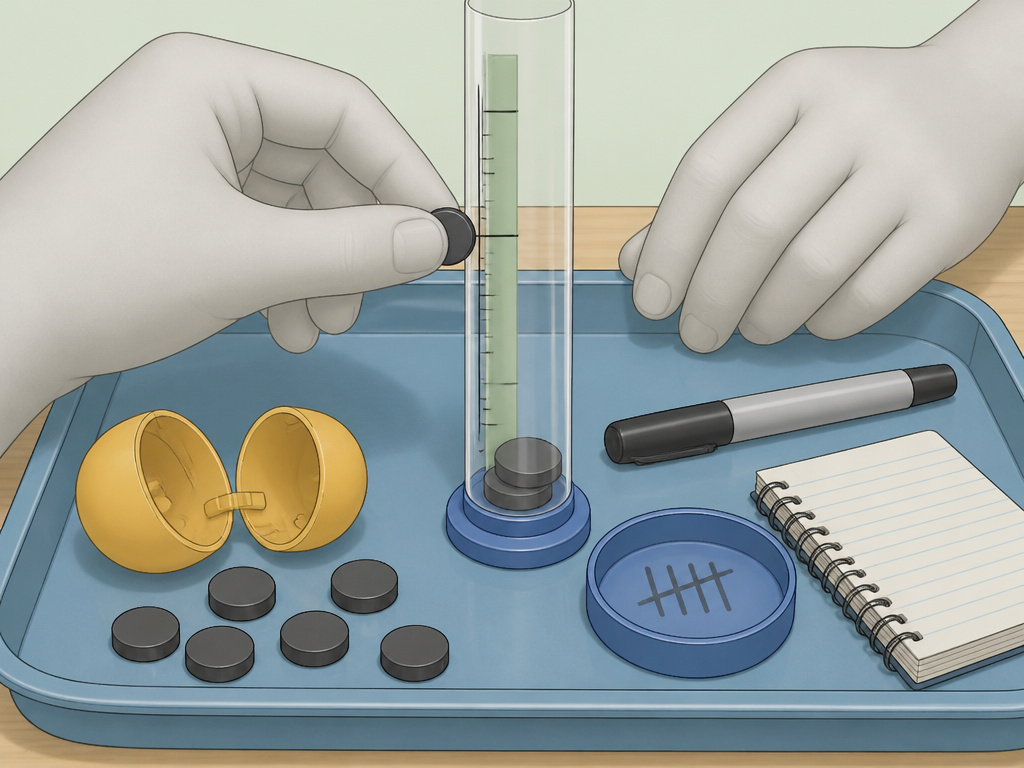
You need a tray with a lip, a marker, and about ten minutes. The tray matters more than people expect, because a dropped magnet rolls under furniture and stays there until a toddler finds it.
Before you start: High-powered magnets are a safety risk to children from toddler through teen, and CPSC reports that ingestion injuries are increasing, serious, and sometimes fatal. Work over a lipped tray so a dropped magnet can’t escape. Count the magnets before and after every check, and write the number on the lid in marker so a missing one shows up as a number rather than a hunch.
The Small Parts Cylinder Test
The cylinder is a fixed-size tube, and the test is binary. If the magnet drops through and sits entirely inside, it fails the size gate. If it doesn’t fit, the size gate doesn’t apply to it.
You can approximate the cylinder with any rigid tube of the same internal diameter, but approximations are approximations. If you’re checking a whole collection, buy the real gauge.
The Twist-and-Tug Check
- Count the magnets first. Write the total on the lid. Skip this and you’ll never know whether one went missing three weeks ago or yesterday.
- Shake the toy beside your ear. A magnet that has broken free inside a sealed shell makes a dull tick against the plastic. Silence means it’s still seated.
- Tug each exposed magnet with steady pressure for a few seconds. Yanking tells you nothing; slow pressure tells you whether the seat is compromised.
- Press every seam and corner. A hairline crack at a magnet seat is where the shell stops doing its job.
- Retire anything that fails, even if the magnet still holds. The shell is the only thing keeping it in.
That last step is the one people argue with me about. A magnet that’s still seated in a cracked shell is a magnet waiting for one good drop.
If you want the same discipline applied to the rest of the toy box, button battery safety follows an almost identical logic: small, round, and catastrophic when swallowed twice. Sealed-shell magnetic tiles are the category where this check takes the least time, because there’s usually nothing exposed to tug.
What the US, UK, Canada and Australia Actually Require
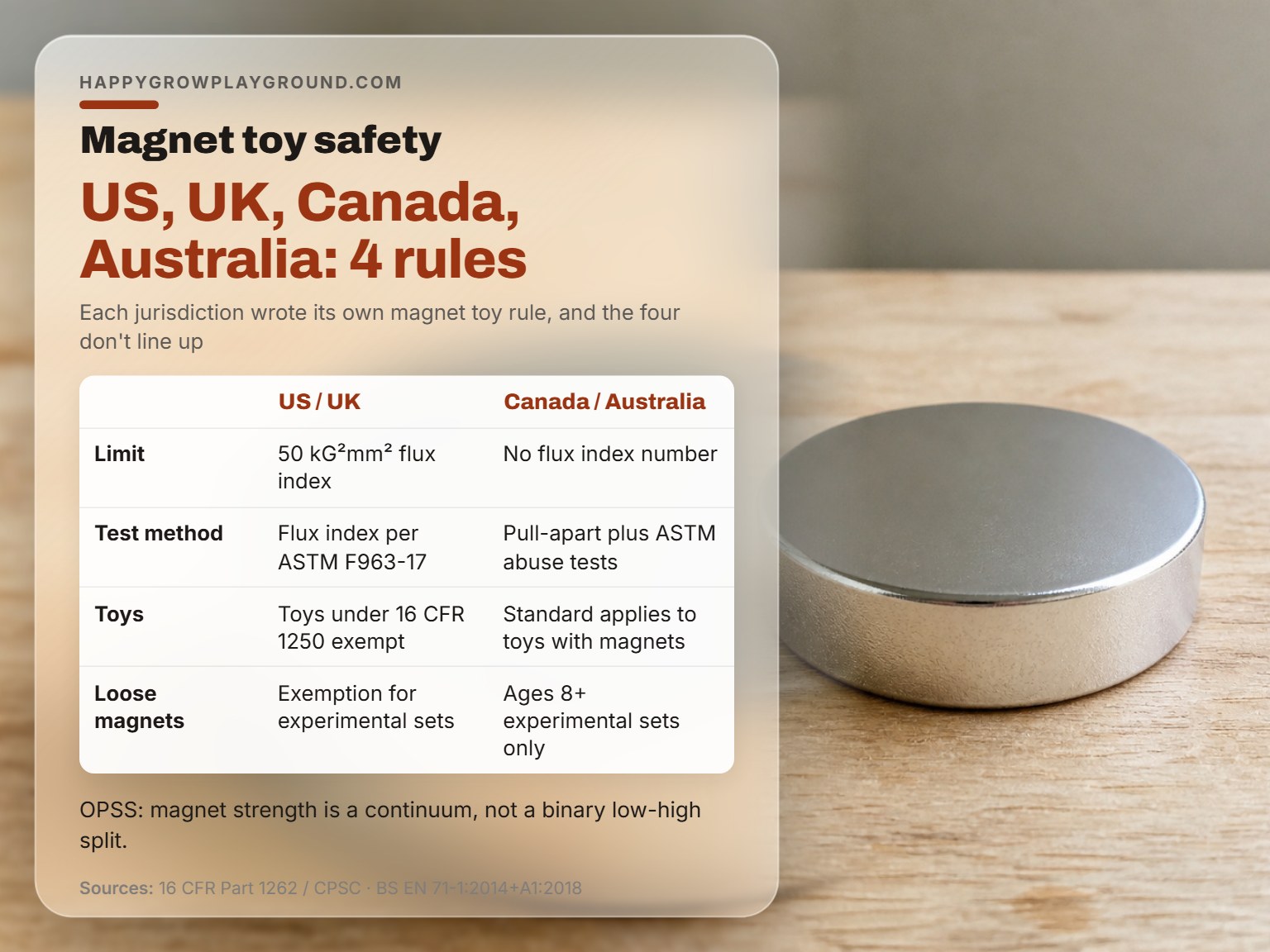
16 CFR Part 1262 is the American rule, and it’s the one most US parents end up reading about. The UK, Canada, and Australia each wrote their own version, and the four don’t line up.
| Jurisdiction | What the rule does | How it’s tested |
|---|---|---|
| US (16 CFR 1262) | Hazardous magnets out of subject products | Flux index per ASTM F963-17 |
| UK and EU (BS EN 71-1) | 50 kG2mm2 limit for accessible toy magnets | BS EN 71-1:2014+A1:2018 |
| Canada (Schedule 9) | Tests whether magnets stay put | Pull-apart plus ASTM abuse tests |
| Australia (2020 standard) | Loose high-powered magnets out of toys | One of four toy standards |
The US and Australia split hardest on toys. Under 16 CFR 1262.1(c), CPSC exempts toys subject to 16 CFR 1250 (which incorporates ASTM F963) from the magnet standard, while Australia’s mandatory standard applies directly to children’s toys containing magnets and permits loose, small high-powered magnets only in magnetic or electrical experimental sets intended for children 8 and over.
Canada takes a third path on testing. Schedule 9 doesn’t use a flux index number at all. It uses a physical pull-apart test: place the component near another magnetic component in the orientation that creates the strongest attraction, let them connect, then pull them apart to the distance where attraction ceases. Then repeat that nine more times.
Where a toy can’t be tested without breaking, or has only one magnet, Canada substitutes a flat circular reference disc with a minimum nickel content of 99%, a diameter of 30 mm, and a thickness of 10 mm. Then it runs the toy through ASTM F963 drop, tipover, torque, tension, impact, and compression tests, and repeats the pull-apart ten more times.
The UK sits closer to the US on numbers. The UK guidance on high-powered magnets defines high-powered magnets as those with a magnetic flux greater than 50 kG2mm2, and BS EN 71-1:2014+A1:2018 sets that same limit value for accessible magnets in toys that are also small parts, with an exemption for magnetic and electrical experimental sets.
OPSS adds one line worth remembering: magnet strength should be considered along a continuum, not as a binary low-high split. OPSS notes that magnets with a flux index below the limit are not always safe, because weak magnets can still apply enough pressure to cause severe harm if they end up on opposite sides of the intestinal wall, though the probability is regarded as very low; the US, by contrast, permits any magnet below 50 kG²mm² in subject magnet products.
The Australia mandatory standard for magnetic toys also sets design and construction requirements to stop a child from reaching small magnets, including testing to confirm a magnet won’t separate from the toy during play. Toys must comply with the relevant sections of one of four standards: AS/NZS ISO 8124.1:2019, EN 71-1:2014+A1:2018, ISO 8124-1:2018, or ASTM F963-17.
That separation question is the same one sitting behind choking hazards in toys generally.
Honestly, I’d take the Australian framing over the American one. Design and construction testing catches the toy that’s going to fail, and a flux number only grades the magnet that’s already strong. The rules don’t line up.
When a Magnet Comes Loose: What Recalls Actually Show
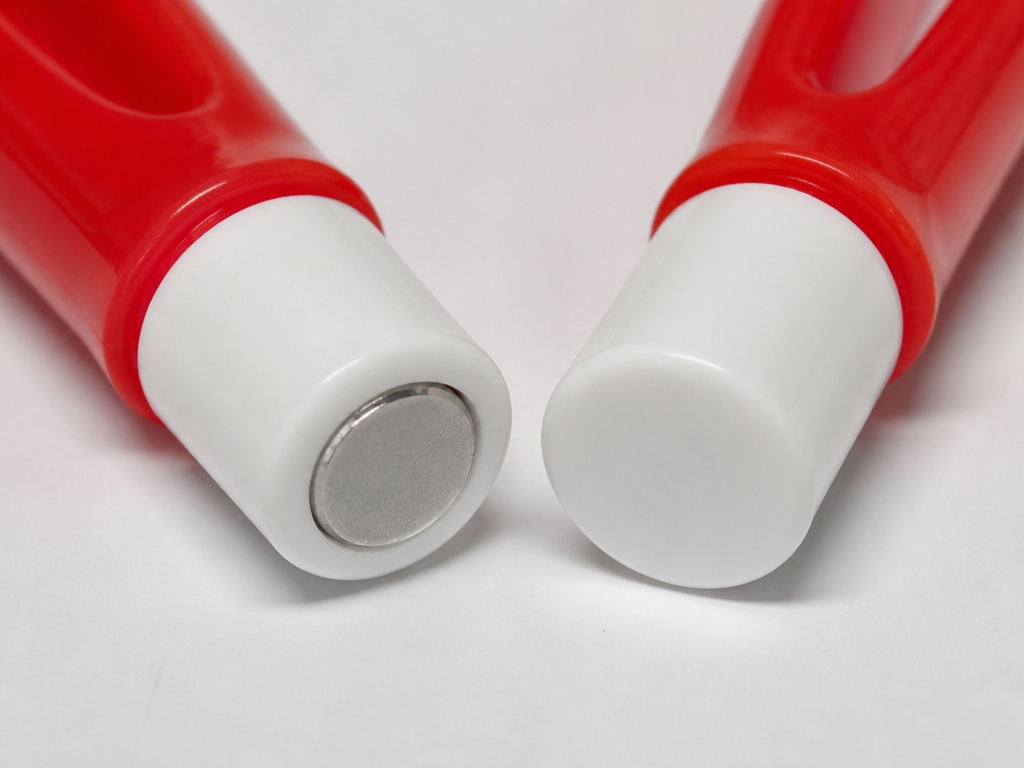
About 683,000 Barbie and Tanner play sets were recalled because one small magnet in the “scooper” accessory could work its way free. Model numbers J9472 and J9560. Mattel had received three reports of magnets coming loose, and no injuries were reported.
The scooper detail is the useful part. Recalled scoopers had a visible, silver-colored, disc-shaped magnet on the end. Scoopers with a white material covering the magnet, and products manufactured after January 31, 2007, were not recalled.
That gives you a visual cue you can use on any magnetic toy. A magnet you can see is a magnet you can lose. The white-covered version wasn’t recalled because the covering was the fix.
The more recent case is less tidy. CPSC warned consumers to immediately stop using magnetic building ball and stick sets and dispose of them, because the sets contain stronger than permitted magnets that can be liberated from the product.
That’s the difference between a recall and a warning. A recall has a company on the other end. A warning leaves you holding the box.
It is a long list.
The part nobody mentions: CPSC states that safety messaging alone is not likely to adequately reduce the magnet ingestion hazard, because children and caregivers commonly disregard it. Incident data also shows children often get the magnets from somewhere other than the packaging the warning is printed on.
Special packaging doesn’t solve it either. CPSC’s own analysis says special packaging would only prevent young children (typically under 5) from accessing the product, not the older children and teens who make up the majority of ingestion incidents, while Australia’s mandatory standard sets design and construction requirements to prevent a child from accessing small magnets, including testing to make sure a magnet won’t separate from the toy during play. Warnings are not a control. I’ve come around on this one. If a magnet toy’s safety case rests on a sticker, I don’t put it in a shared play space.
The Inspection Routine I Run on Every Magnetic Toy
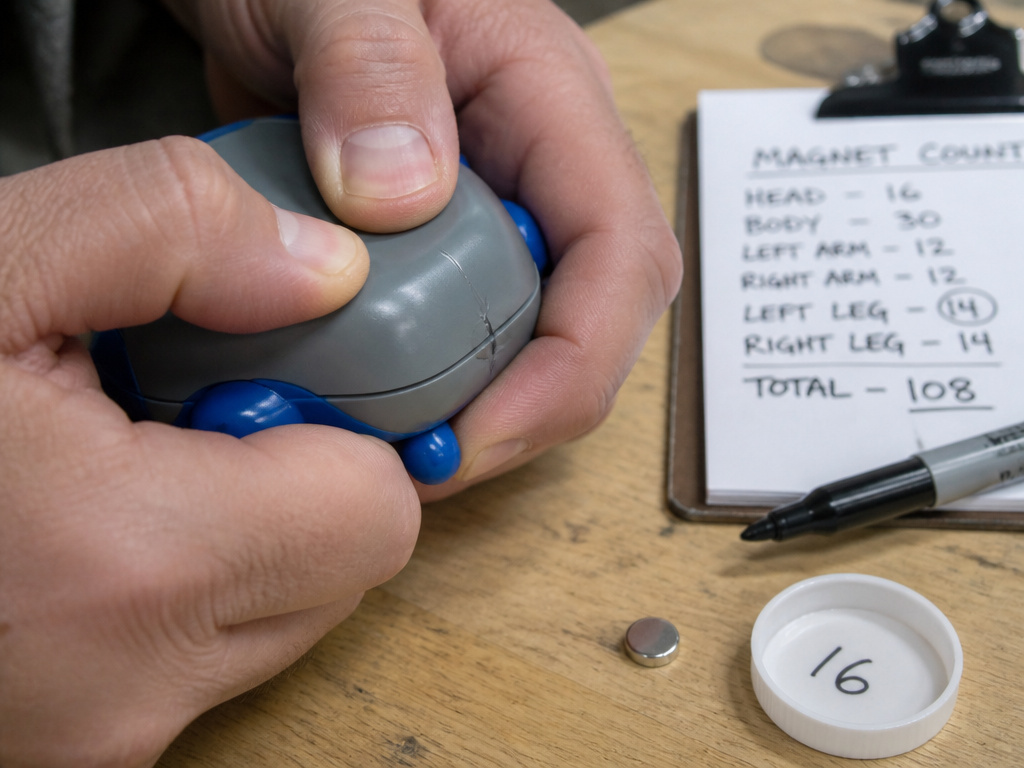
A neighborhood group asked me to look at a small play structure a few years back. One slide, one climbing frame, nothing complicated. I skipped the full audit because it looked like a two-hour job.
A loose bolt turned up a few weeks later. Nobody got hurt, but I got the phone call, and I had to explain that I’d eyeballed it instead of checking it. Since then I run the same checklist whether it’s one slide or ten.
The lesson transfers straight onto magnets. A magnetic toy doesn’t fail because the design was bad. It fails because a magnet worked loose and nobody was counting.
My Six-Point Clipboard Check
- Count the magnets. Write the number on the lid in marker.
- Shake it and listen. A freed magnet makes a dull tick against the inside of the shell, nothing like the sharp snap two magnets make when they meet on the outside. That dull tick is the sound you’re hunting for.
- Press every seam with your thumbnail. A hairline crack near a magnet seat is where fingers and water get in.
- Tug exposed magnets with steady pressure for a few seconds.
- Check the age call against the kid, not the box.
- Retire anything cracked, even if the magnet is still seated.
A proper loose parts test is the same idea applied to the whole toy rather than just the magnets, and it catches the rattles that turn out to be a screw instead of a magnet.
| What you notice | What it usually means | What to do |
|---|---|---|
| Visible silver disc on the surface | The magnet is exposed, not encased | Retire it now |
| Dull tick when you shake it | A magnet has broken free inside | Open or retire; never re-glue |
| Hairline crack at a corner seam | The shell is the only thing holding it | Retire at the first crack |
| Magnet pulls through the shell wall | The shell is thin at that point | Retire, or keep away from under-3s |
| Toy rattles but magnets still hold | Something else is loose in there | Treat it as a loose-parts problem |
Count first. Everything else on that list depends on it.
Magnetic Tiles and Building Sets: Where the Real Risk Sits
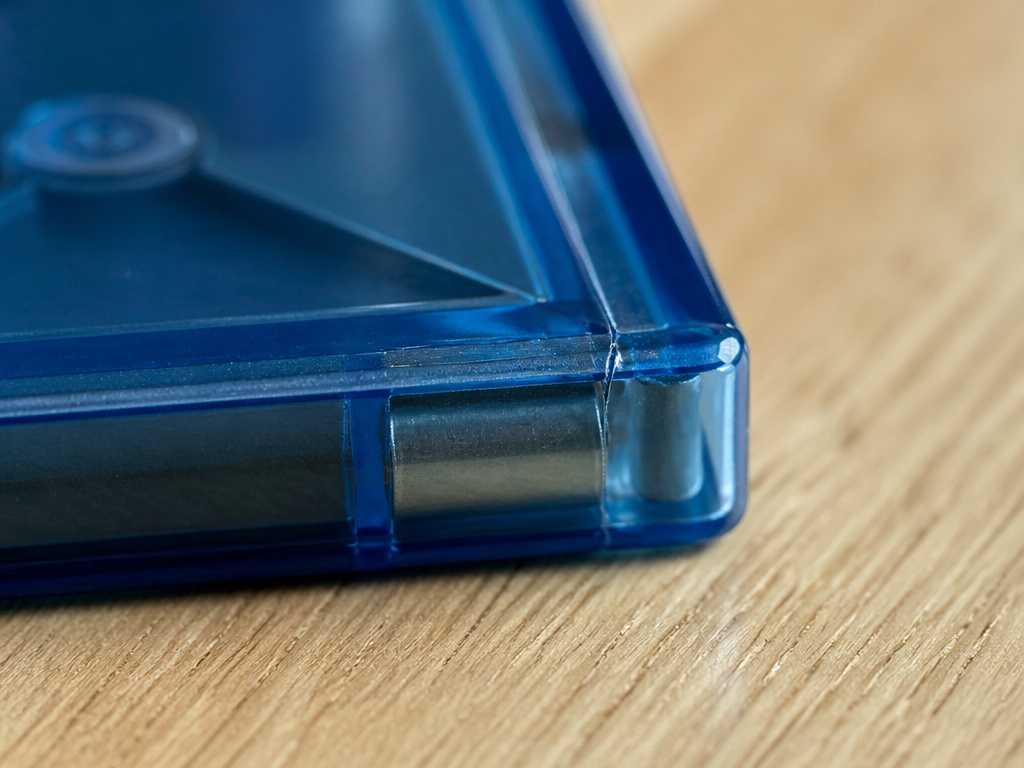
Sealed magnetic tiles are the safest magnetic toy category on the shelf. The reason is construction: the magnet sits behind a welded or bonded plastic shell with no access point, so the failure mode is a cracked corner rather than a magnet on the floor.
Most of the magnet toy safety conversation online is about strength, and strength is the easier thing to talk about. Shell integrity is what actually decides whether a magnet ever gets out.
That’s the number that separates a tile set from a fridge magnet, and it’s also why a tile that fails usually fails at a seam rather than in the middle of a face.
Not every brand on the market clears the bar. CPSC’s violation chart lists numerous magnetic balls and cubes marketed to children in violation of federal toy safety standards, sold on Amazon, Walmart, GearBest.com, dx.com, and Miniinthebox.com.
Sealed-shell construction is why magnetic tiles keep showing up at the top of the category. The magnetic tile pros and cons are worth reading before you commit to a set size, and any best magnetic toys roundup that ignores shell construction is grading the wrong thing.
Buy the shell, not the magnet.
Frequently Asked Questions
At what age are magnetic toys safe?
There’s no single age that makes a magnetic toy safe, because the rule keys to the magnet rather than the child. What matters is whether the magnet fits inside the small parts test cylinder and whether it reaches a flux index of 50 kG2mm2. A sealed magnetic tile set with no access point behaves very differently from a box of loose magnetic balls, even at the same stated age range.
How strong does a magnet have to be to be dangerous?
Under 16 CFR Part 1262, a magnet is hazardous if it fits entirely inside the small parts test cylinder and has a flux index of 50 kG2mm2 or more, measured per ASTM F963-17 sections 8.25.1 through 8.25.3. Below that number, the US rule permits the magnet, while the UK’s OPSS notes that magnets with a flux index below the limit are not always safe, because weak magnets can still cause severe harm across thin intestinal wall, though the probability is regarded as very low.
Are magnetic tiles safer than magnetic balls?
Construction makes the difference, not the shape. Sealed tiles put the magnet behind a bonded shell with no access point, so the failure mode is a crack you can spot. Loose magnetic balls have no shell at all, and CPSC’s violation chart is full of magnetic ball and cube products marketed to children in violation of federal toy safety standards.
What should I do if my child swallows a magnet?
Get medical attention and tell the team exactly how many magnets were in the toy. CPSC reports that when two or more magnets are swallowed they attract each other internally, and many incidents have required surgery to remove the magnets and repair damaged stomach and intestines. CPSC also notes that in X-rays, multiple magnetic pieces may appear as a single object, which is why the count matters.
Do magnetic toys need a certificate of compliance?
Yes. CPSC states that manufacturers or importers of magnets must issue a certificate of compliance: a Children’s Product Certificate for children’s products, or a General Certificate of Compliance for general-use products. That requirement holds even when the magnet is too large to fit inside the small parts test cylinder, as long as the product meets the definition of a subject magnet product.
The Bottom Line
One rule I’d put on the fridge: if you can see the magnet, the toy is done. The shell has already failed at the one job it had, and a visible disc is the last warning you get before it’s on the floor.
Everything above assumes an adult is doing the counting. If your magnetic tiles live in a room shared by a toddler and a nine-year-old, the calculus changes, because the nine-year-old’s toys are the ones the toddler gets into. That’s a supervision problem, not a product problem, and no standard fixes it.
The trigger I use is simple. Any magnetic toy whose magnets you can’t account for by count gets pulled from rotation that same day, not put on a high shelf.
The 50 kG2mm2 threshold and the small parts cylinder are the formal version of that instinct. They exist because CPSC found that warnings alone don’t reduce the hazard and that packaging only protects the youngest kids. Magnet toy safety, in practice, is a counting habit.
