
Playset Ideas for a Small Backyard: 3 Layouts That Work
This post contains affiliate links. As an Amazon Associate, we earn from qualifying purchases.
Playset ideas for a small backyard start with three measurements: a 6 ft use zone on every side, surfacing depth matched to fall height (9 in. Of loose fill for equipment up to 8 ft), and a footprint that leaves the swing beam its full arc. Miss one and the yard fights you.
The swing beam is the piece that decides whether the playset ideas for a small backyard work at all. A to-fro swing needs surfacing extending front and rear a distance equal to twice the height of the top bar, and that arc has to land inside your fence line. Everything else in the layout can be squeezed. That cannot.
What follows walks those three measurements in order, then the parts the catalogs bury: fastener metallurgy, the age band that actually applies to your kid, and the three checks that keep the whole thing standing.
Key Takeaways
- Measure the use zone first, before you fall in love with a set. Six feet of clear ground on every side is the floor, not a suggestion.
- Nine inches of loose fill is the depth for equipment up to 8 ft high, while equipment under 4 ft high needs 6 inches. Twelve inches dumped fresh compresses to about nine.
- Ground-level play may need no surfacing underneath it. CPSC Publication 324 says sandboxes, activity walls, and playhouses with no elevated deck need no protective surfacing, while the TSC-1004 manual says to install protective surfacing at least six feet in all directions from play equipment.
- Check swing seats, ropes, chains, and cables monthly.
Six Feet Is Where Most Small-Backyard Plans Die
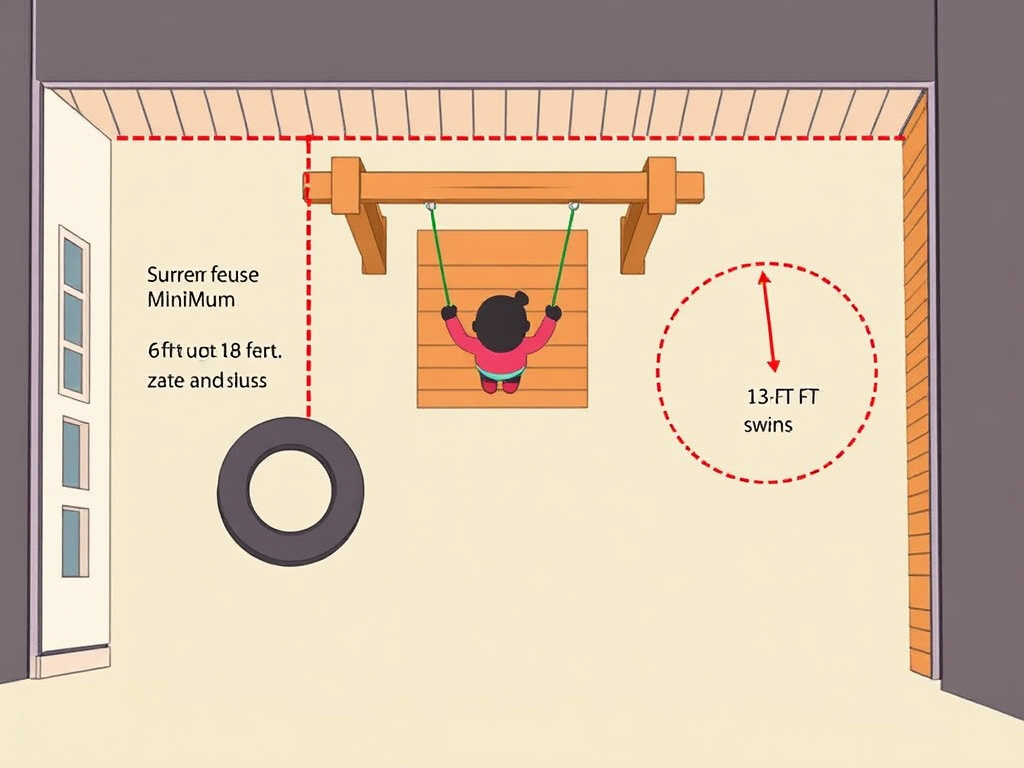
Measure from the outermost point of the equipment, not from the posts. That habit is what separates a yard that works from one where a child lands against a fence rail.
A use zone is the clear area under and around play equipment where a child can land without striking a hard surface or an obstacle. CPSC Publication 324 sets that distance at a minimum of 6 ft from any structure or obstacle, measured from the perimeter of the equipment rather than from the center of the set.
Before you start: the swing arc is the hazard that bites first. A to-fro swing needs surfacing extending front and rear twice the height of the top bar, so a 7 ft bar means 14 ft of clear ground, and a fence inside that line gets hit on the first unsupervised run. Never set posts into ground you have not checked for buried irrigation, cable, or gas. Keep children under six away during assembly, because the hardware bag is a choking hazard.
Two documents land on the same 6 ft number, which is reassuring. CPSC Publication 324 says at least 6 ft from any structure or obstacle. The TSC-1004 swing set manual says no obstructions or structures within six feet, and it names electrical wires, branches, house, fence, and garage.
Tire swings break the rule in a way that catches people out. CPSC Publication 324 requires a circle of surfacing whose radius equals the suspending chain or rope height plus 6 ft. Hang a tire from a 7 ft branch and you need a 13 ft radius of clear, soft ground. Few small yards can do that.
One more distinction is worth holding onto. Publication 324 covers homes and residential child care. Schools, parks, and other public-use facilities belong to a different document, the CPSC Public Playground Safety Handbook, and quoting the wrong one is how people end up arguing the wrong number at a planning meeting.
If your yard is genuinely tight, the honest answer is a different class of equipment rather than a smaller version of the same one. There are playgrounds for small spaces built to sit inside a 6 ft use zone without crowding it.
Which Playset Type Actually Survives a Small Yard?
Swing set, climber, or playhouse. The footprint picks for you, and it picks long before the catalog does.
The types of playsets divide into three families: swing structures, climbers with a slide deck, and ground-level playhouses. Each one eats a different amount of yard.
Swing Sets and Swing Beams
A swing beam is the greediest piece of equipment you can put in a small yard. A single-bay to-fro swing needs twice the top bar height in clear surfacing front and rear. That rule does not shrink because the yard is small.
Most tight yards can carry small swing sets only in a single-bay, low-beam configuration. Two bays and a trapeze bar is a different yard.
Climbers and Slide Decks
A climber with a slide deck is the best small-yard compromise, and I will say that plainly. It needs 6 ft of clear ground on all sides plus runout at the bottom of the slide, and that footprint is smaller than any swing configuration.
For kids under five, toddler playsets for small yards are almost always low-deck climbers rather than swing structures. A four-year-old cannot pump, and a swing they cannot move is a swing they ignore.
Playhouses and Ground-Level Towers
CPSC Publication 324 says a ground-level playhouse needs no protective surfacing under it at all, while the TSC-1004 manual says to install protective surfacing at least six feet in all directions from play equipment.
The trade-off is ceiling. A playhouse stops being interesting around age seven, and a climber keeps going.
| Playset Type | Clear Space Rule | Best Fit |
|---|---|---|
| To-fro swing set | Twice the top bar height, front and rear | Kids 3 to 8 who want motion |
| Climber with slide deck | 6 ft on all sides, plus slide runout | Narrow yards, ages 2 to 5 |
| Ground-level playhouse | No surfacing required underneath | Mixed ages, tight corners |
| Tire swing | Radius of rope height plus 6 ft | Large yards only |
Climber versus swing set: for a yard narrower than a driveway, the climber wins. Swing set versus playhouse: the playhouse wins when the kids are under four, and the swing set wins the moment one of them learns to pump.
Three kids on one structure is where small yards go wrong. The TSC-1004 manual caps its set at seven children, ages 3 to 8, and requires adult supervision at all times, while Backyard Adventures’ limited non-residential warranty requires installation in a location not accessible to the general public and all use supervised by a responsible adult.
Surfacing Depth Is the Part You Cannot Fake
A few years into this work, a client talked me into trimming the fall zone on a playset ideas for a small backyard install. The yard was tight, the set was low, and I said yes. Then I stood and watched two kids swing out over ground that was grass and packed dirt, and I spent the rest of that afternoon with a tape measure. I have not skipped full fall-zone depth since, not even on a job the size of a parking space.
Depth gets measured after compaction, not when the truck dumps it. CPSC Publication 324 calls for at least 9 inches of loose-fill surfacing under equipment up to 8 ft high. Wood mulch, wood chips, engineered wood fiber, and shredded or recycled rubber all qualify.
Under equipment less than 4 ft high, the minimum drops to 6 inches. Sand and pea gravel need 9 inches as well, but only for equipment up to 5 ft high.
Here is the number that trips people up. The handbook states that an initial fill of 12 inches compresses to about 9 inches. Order 9 inches of mulch and you are short before anyone steps on it.
Loose fill works because it deforms on impact and spreads the deceleration over a longer distance than a hard surface can. That is why the TSC-1004 manual says plainly that dirt and grass do not adequately protect children from serious head injuries.
| Equipment Height | Loose Fill: Mulch, Chips, EWF, Shredded Rubber | Sand or Pea Gravel |
|---|---|---|
| Under 4 ft | 6 in. Minimum | 9 in. |
| Up to 5 ft | 9 in. | 9 in. |
| Up to 8 ft | 9 in. | Not rated |
Loose Fill, Poured-in-Place, and Rubber Tile
CPSC Publication 324 says poured-in-place rubber and rubber tile generally require a professional and are not do-it-yourself projects, while another source recommends engineered wood fiber as the most affordable certified safety surface and rubber mulch as more durable and requiring less replenishment.
The CPSC Outdoor Home Playground Safety Handbook is the document behind those depths, and it is worth reading the surfacing section end to end before you order
Frequently Asked Questions
Can a playset fit in a yard that is only 20 feet wide?
Sometimes, but only if you choose the equipment around the space rather than the other way around. A compact set with a short or single-bay swing beam and a small elevated deck will usually clear a 20 ft width once you subtract the required clear ground on both sides. Measure your actual fence-to-fence distance before shopping, then compare it against the manufacturer’s stated use zone rather than the product dimensions.
Is a wooden or metal playset better for a tight space?
Wood sets can be cut down or reconfigured, which helps when a beam is a few inches too long for the yard. Metal sets are typically lighter and easier to reposition if you get the layout wrong the first time. Either material works if the hardware is galvanized or stainless, since treated lumber and outdoor moisture will corrode cheap zinc-plated bolts within a season or two.
What age range should I shop for?
Match the set to the youngest regular user, not the oldest. Two- to five-year-olds need lower deck heights, shorter rungs, and full-bucket swings, while five- to twelve-year-olds can handle taller platforms and open-access ladders. Buying for a child several years away from the equipment’s upper limit usually means the set is too advanced and unsafe in the meantime.
How do I keep the set from sinking or tipping on uneven ground?
Level the area before assembly and set posts below the frost line where the ground freezes. Footings should be concrete or manufacturer-supplied ground anchors, not just compacted soil. Recheck the posts each spring for heaving and refill any surfacing that has migrated away from the base of the structure.
